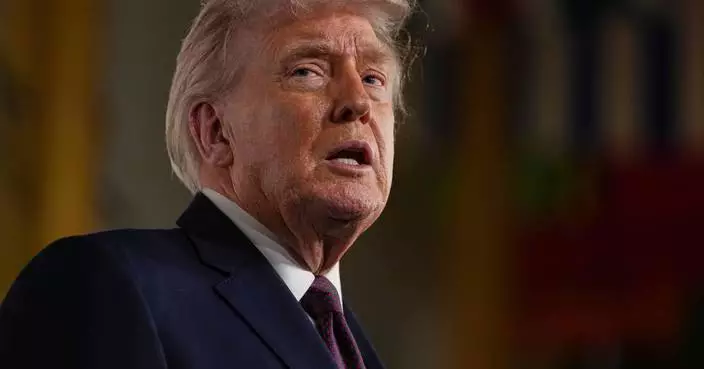
U.S. President Donald Trump says President Vladimir Putin has agreed to temporarily halt the targeting of the Ukrainian capital and other towns as the region suffers under bitterly cold temperatures.
The Kremlin confirmed Friday it agreed to hold off striking Kyiv until Sunday, but refused to reveal any details, making it difficult for an independent assessment of whether the conciliatory step had indeed taken place.
In the past week, Russia has struck energy assets in the southern Ukrainian city of Odesa and in Kharkiv in the northeast. It also hit the Kyiv region on Wednesday, killing two people and injuring four.
Trump said Thursday that Putin had agreed to the temporary pause amid the freezing temperatures that have brought widespread hardship to Ukrainians. “I personally asked President Putin not to fire on Kyiv and the cities and towns for a week during this ... extraordinary cold,” Trump said at the White House, adding that the Kremlin leader had agreed. Trump did not elaborate on when the request was made, and the White House didn’t immediately respond to a question seeking to clarify the scope and timing of any pause. The Kremlin said the supposed pause was aimed at creating “favorable conditions for negotiations.”
It's not the first attempt at a partial halt to Russia's brutal bombardment of Ukraine that ravaged the country's civilian infrastructure — leaving thousands without power or heat in winter — since Moscow's full-scale invasion on Feb. 24, 2022. Russia has effectively rejected a 30-day unconditional truce proposed by U.S. and Ukraine last year as a step to peace, but it has announced several short, unilateral ceasefires.
Here's a look at previous attempts:
Putin orders a 36-hour ceasefire starting Jan. 6 to mark Orthodox Christmas. It was the first time he directed his troops to observe a ceasefire across Ukraine, even though Russian authorities had ordered limited, local truces for evacuating civilians or for other humanitarian reasons. Kyiv indicates that it wouldn't follow suit, and accuses Moscow of continuing attacks despite the self-declared truce.
Officials from Ukraine and the U.S. hold talks in Saudi Arabia. Kyiv says it is open to a 30-day ceasefire, subject to Kremlin agreement — something Trump has pushed for.
Putin effectively rejects the proposal, saying that Moscow agrees with it in principle but certain “issues” still need to be discussed.
Putin and Trump hold a long phone call and announce an agreement for Moscow and Kyiv to halt strikes against each other's energy infrastructure for 30 days. Russia and Ukraine subsequently repeatedly accuse each other of violations until the measure expires.
Putin announces a unilateral, 30-hour truce to mark Orthodox Easter, celebrated on April 20. Ukraine says it would reciprocate a genuine ceasefire but accuses Russia of attacks the next day. Moscow also accuses Kyiv of attacks during the supposed truce.
The Kremlin declares another unilateral ceasefire for 72 hours on May 8-10 to coincide with Russia’s celebrations of Victory Day, marking the end of World War II in Europe and attended by a number of foreign dignitaries. Both sides accuse each other of multiple attacks, with Kyiv calling the gesture “a farce.”

An elderly man looks out from his damaged balcony after a Russian attack in Zaporizhzhia, Ukraine, Wednesday, Jan. 28, 2026. (AP Photo/Kateryna Klochko)
NEW YORK (AP) — Federal prosecutors can’t seek the death penalty against Luigi Mangione in the killing of UnitedHealthcare CEO Brian Thompson, a judge ruled Friday, foiling the Trump administration’s bid to see him executed for what it called a “premeditated, cold-blooded assassination that shocked America.”
U.S. District Judge Margaret Garnett dismissed a federal murder charge that had enabled prosecutors to seek capital punishment, finding that it was technically flawed. She wrote that she did so to “foreclose the death penalty as an available punishment to be considered by the jury" as it weighs whether to convict Mangione.
Garnett also dismissed a firearm charge but left in place stalking charges that carry a maximum punishment of life in prison. In order to seek the death penalty, prosecutors needed to show that Mangione killed Thompson while committing another "crime of violence." Stalking does not fit that definition, Garnett wrote in her opinion, citing case law and legal precedents.
The government could try to appeal. A message seeking comment was left for a spokesperson for the U.S. attorney's office in Manhattan, which is prosecuting the federal case.
Garnett acknowledged that the decision “may strike the average person — and indeed many lawyers and judges — as tortured and strange, and the result may seem contrary to our intuitions about the criminal law." But, she said, it reflected her "committed effort to faithfully apply the dictates of the Supreme Court to the charges in this case. The law must the Court’s only concern.”
Mangione, 27, has pleaded not guilty to federal and state murder charges. The state charges also carry the possibility of life in prison.
He was due in court at later Friday for a conference in the case. His lawyers didn't immediately comment on the decision but might do so during the conference or afterward.
Jury selection in the federal case is scheduled to begin Sept. 8, followed by opening statements and testimony beginning on Oct. 13. The state trial's date hasn’t been set yet. On Wednesday, the Manhattan district attorney’s office sent a letter urging the judge in that case to schedule a July 1 trial date.
Thompson, 50, was killed on Dec. 4, 2024, as he walked to a midtown Manhattan hotel for UnitedHealth Group’s annual investor conference. Surveillance video showed a masked gunman shooting him from behind. Police say “delay,” “deny” and “depose” were written on the ammunition, mimicking a phrase used to describe how insurers avoid paying claims.
Mangione, an Ivy League graduate from a wealthy Maryland family, was arrested five days later at a McDonald’s in Altoona, Pennsylvania, about 230 miles (about 370 kilometers) west of Manhattan.
Following through on Trump’s campaign promise to vigorously pursue capital punishment, Attorney General Pam Bondi ordered Manhattan federal prosecutors last April to seek the death penalty against Mangione.
It was the first time the Justice Department was seeking to bring the death penalty in President Donald Trump’s second term. He returned to office a year ago with a vow to resume federal executions after they were halted under his predecessor, President Joe Biden.
Garnett, a Biden appointee, ruled after a flurry of court filings in the prosecution and defense in recent months. She held oral arguments on the matter earlier this month.
In addition to seeking to have the death penalty thrown out on the grounds Garnett cited, Mangione’s lawyers argued that Bondi’s announcement flouted long-established Justice Department protocols and showed the decision was “based on politics, not merit.”
They said her remarks, which were followed by posts to her Instagram account and a TV appearance, “indelibly prejudiced” the grand jury process that resulted in his indictment a few weeks later.
Prosecutors urged Garnett to keep the death penalty on the table, arguing that the charges allowing for such punishment were legally sound and that Bondi’s remarks weren’t prejudicial, as “pretrial publicity, even when intense, is not itself a constitutional defect.”
Rather than dismissing the case outright or barring the government from seeking the death penalty, prosecutors argued, the defense’s concerns can best be alleviated by carefully questioning prospective jurors about their knowledge of the case and ensuring Mangione’s rights are respected at trial.
“What the defendant recasts as a constitutional crisis is merely a repackaging of arguments” rejected in previous cases, prosecutors said. “None warrants dismissal of the indictment or categorical preclusion of a congressionally authorized punishment.”
The defense has also sought to suppress certain evidence collected during his arrest, including a 9 mm handgun and a notebook in which authorities say Mangione described his intent to “wack” an insurance executive.
Mangione’s lawyers contend that Altoona police illegally searched his backpack because they hadn't yet obtained a warrant. Prosecutors say the search was legal. Officers were following protocols, which require promptly searching a suspect’s property for dangerous items, and later obtained a warrant, prosecutors said.
Garnett has yet to rule on that request.
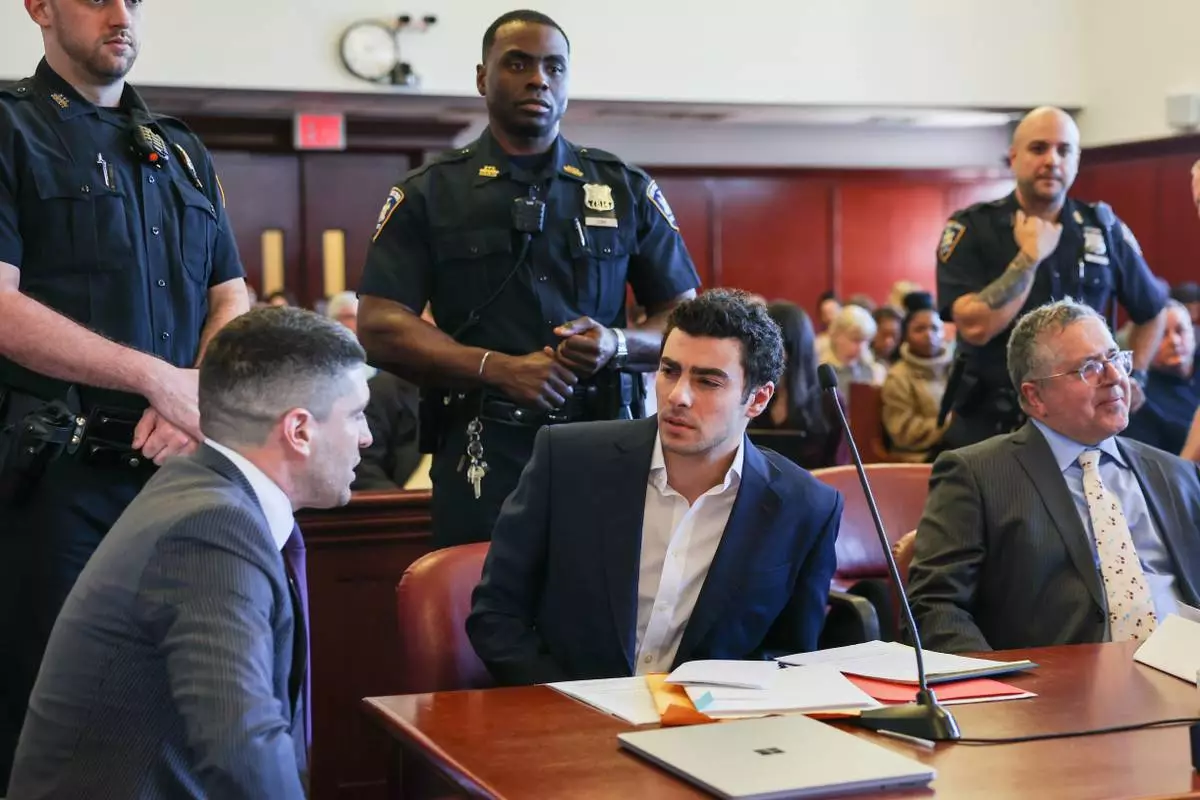
FILE - Luigi Mangione appears in Manhattan Criminal Court for an evidence hearing, Dec. 18, 2025, in New York. (Shannon Stapleton/Pool Photo via AP, File)