Skip to Content Facebook Feature Image

China's manufacturing activity softens, business sentiment stays upbeat

China

China

China

China's manufacturing activity softens, business sentiment stays upbeat

2026-01-31 09:51 Last Updated At:13:07

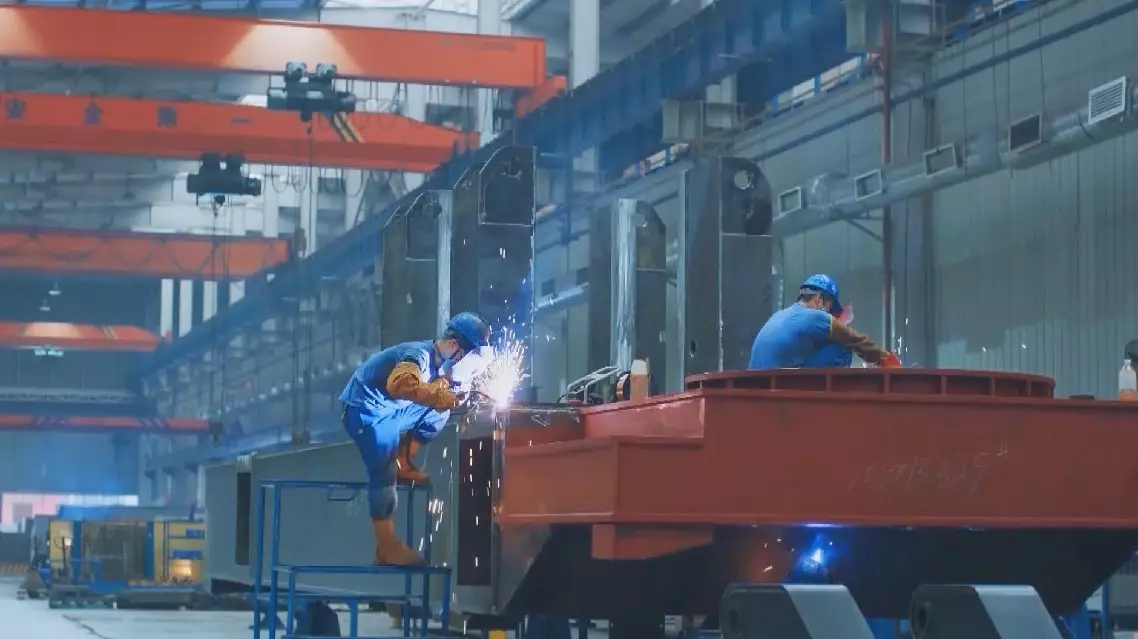
The purchasing managers' index (PMI) for China's manufacturing sector fell to 49.3 in January as some industries entered a traditional seasonal lull and effective market demand remained insufficient, official data showed on Saturday.

This figure was down 0.8 percentage points from the previous month. A reading above 50 indicates expansion, while a reading below 50 reflects contraction.

Despite the overall contraction, factory output continued to expand. The sub-index for production stood at 50.6, indicating steady growth in manufacturing activity. However, the new orders index dropped to 49.2, pointing to a slowdown in market demand.

By sector, production and new orders indices in industries like agricultural and sideline food processing, as well as railway, shipbuilding and aerospace equipment manufacturing, were all above 56.0, reflecting relatively strong supply and demand.

"For different industries, the production index and new order index of industries such as the processing of food from agricultural and sideline products and the manufacture of railway, ship and aerospace equipment are all above 56 percent, showing a relatively quick release in both production and demand," said Huo Lihui, director of the Business Climate Survey Division of the Service Survey Center under the National Bureau of Statistics (NBS).

High-tech manufacturing remained a bright spot, with its PMI at 52.0, marking a second consecutive month above what is considered a relatively strong level. Equipment manufacturing PMI stood at 50.1 in January, also indicating expansion. Meanwhile, PMIs for consumer goods and high energy-consuming industries dropped to 48.3 and 47.9, respectively.

Business sentiment stayed upbeat, with the index for production and business activity expectations at 52.6, still in expansion territory. Industries such as agricultural and sideline food processing and food and beverage manufacturing posted readings above 56.0 for a second straight month, underscoring strong confidence in near-term prospects, the data revealed.

The PMI for China's non-manufacturing sector came in at 49.4 in January, down 0.8 percentage points from the previous month.

"The service sector remained generally stable, with (the Business Activity Index for) the financial industry staying in the high expansion range of over 65 percent," said He Hui, vice president of the China Federation of Logistics and Purchasing (CFLP).
China's manufacturing activity softens, business sentiment stays upbeat

China's manufacturing activity softens, business sentiment stays upbeat
The Beijing Stock Exchange (BSE) has seen a significant expansion of its investor base, with the total number of qualified investors exceeding 10 million as of Jan 20, indicating the bourse's rising vitality and appeal.

This represents a net increase of almost 2 million accounts on the third-born of China's A-share market compared to the same period last year.

This figure marks the highest number of qualified investors since the establishment of the BSE in 2021, doubling from 4 million at its inception. In just the past five months alone, the number surged from 9 million to more than 10 million.

Experts say that the rapid growth of the investor base is attributed to the robust performance of the bourse's new share market.

Since the beginning of 2026, the frozen funds for new share subscriptions on the BSE has exceeded 1 trillion yuan (about 143.85 billion U.S. dollars), reflecting sustained high investor enthusiasm for entering the market.

"The scale of 10 million investors is a key indicator of the maturity of the Beijing Stock Exchange's market ecosystem. The impressive performance of the new stock market has validated the investment value of BSE-listed companies, attracting incremental capital inflows. And the expansion of market size and growth in investor numbers form a virtuous cycle, providing more sufficient capital support for innovation-oriented small and medium-sized enterprises," said Lu Zhe, chief economist at the Soochow Securities.

The total market capitalization of the BSE has approached to 1 trillion yuan. Data shows that the number of companies listed on the bourse has reached 290, with a total value of 949.571 billion yuan (about 136.59 billion U.S. dollars).

Meanwhile, the BSE has demonstrated strong market resilience, with the Beijing Stock Exchange 50 Index up by around 50 percent cumulatively in 2025. The benchmark index includes 50 stocks considered to be representative of the market, providing a tool to monitor the overall performance of the bourse.

Since the opening of the BSE, over 90 percent of the listed companies have cumulatively distributed 19.86 billion yuan (about 2.86 billion U.S. dollars) in cash dividends, with 16 companies having paid out dividends exceeding their total amount of funds raised through listing.

The 2025 third-quarter report shows that the average revenue of 279 BSE-listed companies stood at 520 million yuan (about 74.8 million U.S. dollars), an increase of 5.99 percent year-on-year. Their average net profit was almost 32.99 million yuan (about 4.74 million U.S. dollars).

Five companies included in the Beijing Stock Exchange 50 Index, as well as eight companies not included, have disclosed their equity distribution plans, with the combined cash distribution amounting to 358 million yuan (about 51.5 million U.S. dollars).

Beijing Stock Exchange sees record number of qualified investors

Beijing Stock Exchange sees record number of qualified investors

Recommended Articles