The Jiulong Lake in Dazhou City, southwest China's Sichuan Province has been transformed by nature into what appears to be a breathtaking natural painting, captivating visitors with its serene winter beauty.
In the early winter morning, the lake is shrouded in mist, while a layer of frost glistens under the golden rays of the rising sun. As the fog gradually lifts, still waters stretch peacefully between the mountains, occasionally disturbed by wild ducks skimming the surface, bringing liveliness to the quiet scene.
At sunset, the lake turns a shimmering gold beneath the glowing sky. With each frame, the view captures the unique tranquility and poetic beauty of winter.
The Jiulong Lake is an artificial lake built in 1954, with a water area of 212 hectares and a storage capacity of 19.54 million cubic meters.

Jiulong Lake in Sichuan shines with poetic winter beauty
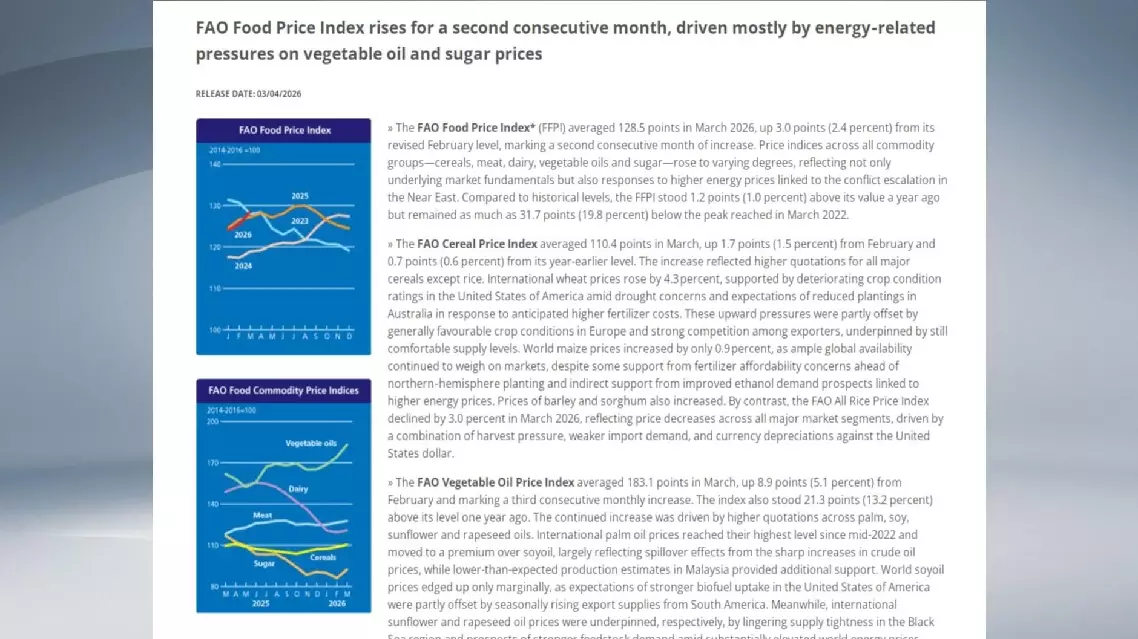
Global food commodity prices climbed for a second consecutive month in March, driven mainly by higher energy costs linked to escalating conflict in the Middle East, the Food and Agriculture Organization of the United Nations (FAO) said in report released on Friday.
The FAO Food Price Index, which tracks monthly changes in the international prices of a basket of globally traded food commodities, averaged 128.5 points in March, up 2.4 percent from February and 1.0 percent above its level a year ago.
According to the report, the FAO Vegetable Oil Index and Sugar Price Index showed the largest increases, up 5.1 percent and 7.2 percent, respectively.
The FAO Cereal Price Index increased by 1.5 percent from the previous month, driven primarily by higher world wheat prices, which rose 4.3 percent.
The FAO Meat Price Index rose by 1.0 percent from the previous month, and the FAO All-Rice Price Index declined by 3.0 percent in March, according to the report.
FAO stated that rising energy and fertilizer prices have been driving up agricultural input costs.
If the conflict stretches beyond 40 days, farmers will have to choose to farm the same with fewer inputs, plant less, or switch to less intensive fertilizer crops, according to FAO Chief Economist Maximo Torero.
These choices will hit future yields and shape food supply and commodity prices for the rest of this year and beyond, Torero said.
Global food prices rise for 2nd consecutive month in March amid Middle East conflict: FAO