As China's ice and snow season sparks a surge in winter sports and related consumption, homegrown carbon fiber technology is revolutionizing sports equipment manufacturing and helping domestic gear gain global traction with its unique competitive edge.
The thriving ice and snow economy is fueling dramatic change across traditional industries. A high-tech transformation is underway in the factories of northeast China's old industrial heartland.
Jilin Chemical Fiber Group, one of the country's earliest chemical fiber manufacturers, has pivoted from traditional textiles to become China's largest carbon fiber producer, a move now central to upgrading ski equipment and beyond.
Carbon fiber is seven to nine times stronger than steel, yet only a quarter of its weight. Its high strength and lightweight properties make it widely applicable in sports equipment, aerospace, drone manufacturing, and other high-end sectors.
"Our carbon fiber industrial chain has an annual production capacity of 240,000 tons, accounting for around 65 percent of the domestic market share. When applied to sports goods, it enhances strength while reducing weight significantly," said Zhuang Xiaodong, deputy general manager of Jilin Chemical Fiber Group.
As a pioneer in China's textile industry modernization, this traditional enterprise has seized the opportunities brought by the ice and snow economy. Leveraging decades of industrial expertise, it has driven the upgrading of homegrown skis and propelled the ice and snow industry toward greater sophistication.
"Our factory was built and put into operation in 1964. We initiated carbon fiber R and D in 2008. Building on our long-standing industrial foundation and manufacturing expertise, we have collaborated with research institutions on technological innovation, and now we have achieved full coverage of the carbon fiber industrial chain," said Zhuang.
The global appeal of carbon fiber sports products is growing. Diplomats in China see great potential for these products in their countries.
"I use it almost every day with tennis rackets, with the shoes, so it's daily use. This one is found in the shoes. You see, it's for shock absorbing, and then it gives you a bouncy feeling, just to give you an edge," said Ashwin Kumar Ruhee, Minister-Counsellor of the Embassy of the Republic of Mauritius to China
"There are a lot of bicycle riders in my country. This is for mountains, we have a lot of mountains in Peru. There is the area of the Andean mountains that is between the coast and the Amazon jungle, and I think that a lot of Peruvians could be extremely interested in buying these kind of bicycles," said Carlos Vasquez, Ambassador of the Republic of Peru to China.
The China Ice and Snow Industry Development Research Report 2025 forecast that the scale of China's ice and snow economy would exceed one trillion yuan or 142 billion U.S. dollars in 2025, with an average annual growth rate of over 26 percent in the past decade.
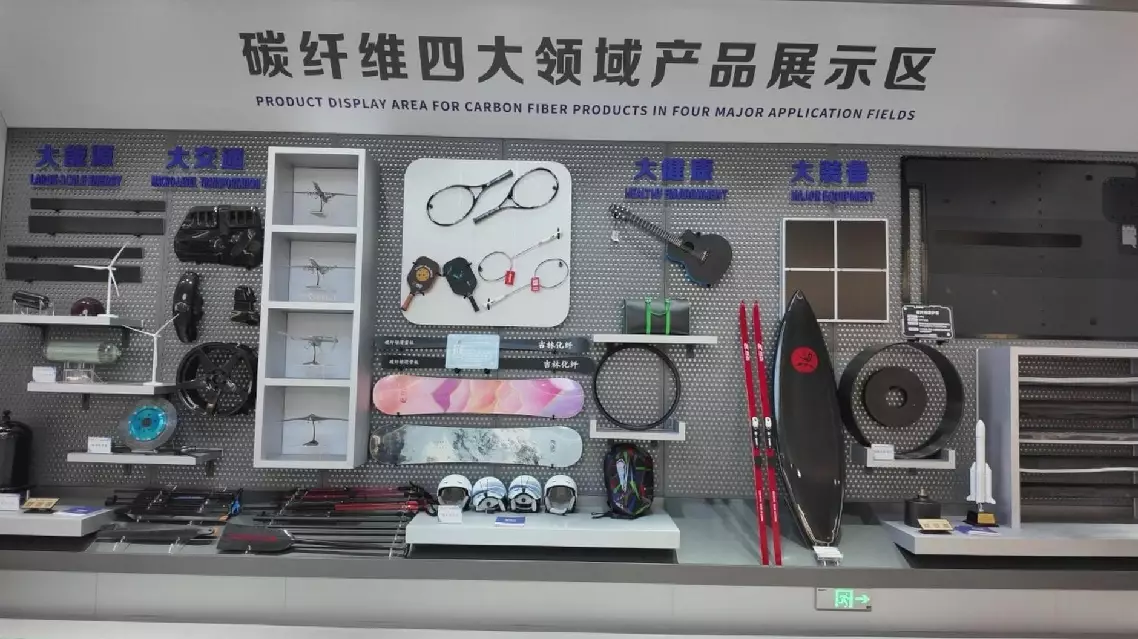
China's carbon fiber innovations empower sports equipment industry