Multiple AI-generated photos falsely claiming to show New York City Mayor Zohran Mamdani as a child and his mother, filmmaker Mira Nair, with disgraced financier Jeffrey Epstein and his confidant Ghislaine Maxwell, along with other high-profile public figures, were shared widely on social media Monday.
The images originated on an X account labeled as parody after a huge tranche of new Epstein files was released by the Justice Department on Friday. They are clearly watermarked as AI and other elements they contain do not add up.
Here's a closer look at the facts.
CLAIM: Images show Mamdani as a child and his mother with Jeffrey Epstein and other public figures linked to the disgraced financier.
THE FACTS: The images were created with artificial intelligence. They all contain a digital watermark identifying them as such and first appeared on a parody X account that says it creates “high quality AI videos and memes."
In one of the images, Mamdani and Nair appear in the front of a group photo with Maxwell, Epstein, former President Bill Clinton, Amazon founder Jeff Bezos and Microsoft founder Bill Gates. They seem to be posing at night on a crowded city street. Mamdani looks to be a preteen or young teenager.
Another supposedly shows the same group of people, minus Nair, in what appears to be a tropical setting. Epstein is pictured holding Clinton sitting in his arms, while Maxwell has her arm around Mamdani, who appears slightly younger.
Other AI-generated images circulating online depict Mamdani as a baby being held by Nair while she poses with Epstein, Clinton, Maxwell and Bezos. None of Epstein's victims have publicly accused Clinton, Gates or Bezos of being involved in his crimes.
Google's Gemini app detected SynthID, a digital watermarking tool for identifying content that has been generated or altered with AI, in all the images described above. This means they were created or edited, either entirely or in part, by Google's AI models.
The X account that first posted the images describes itself as “an AI-powered meme engine” that uses “AI to create memes, songs, stories, and visuals that call things exactly how they are — fast, loud, and impossible to ignore.”
An inquiry sent to the account went unanswered. However, a post by the account seems to acknowledge that it created the images.
“Damn you guys failed,” it reads. "I purposely made him a baby which would technically make this pic 34 years old. Yikes."
The photos began circulating after an email emerged in which a publicist, Peggy Siegal, wrote to Epstein about seeing a variety of luminaries, including Clinton, Bezos and Nair, an award-winning Indian filmmaker, at 2009 afterparty for a film held at Maxwell's townhouse.
While Mamdani appears as a baby or young child in all of the images, he was 18 in 2009, when Nair is said to have attended the party.
The images have led to related falsehoods that have spread online in their wake. For example, one claims that Epstein is Mamdani's father. This is not true — Mamdani's father is Mahmood Mamdani, an anthropology professor at Columbia University. Another alleges that Nair's first marriage was to a relative of Epstein. It was not. She was previously married to photographer Mitch Epstein. A search of public records and existing reporting about the two men reveals no evidence of familial ties. Epstein is a common last name among Jewish families.
The NYC Mayor’s Office did not respond to a request for comment. A representative for Mitch Epstein declined to comment.
Find AP Fact Checks here: https://apnews.com/APFactCheck.
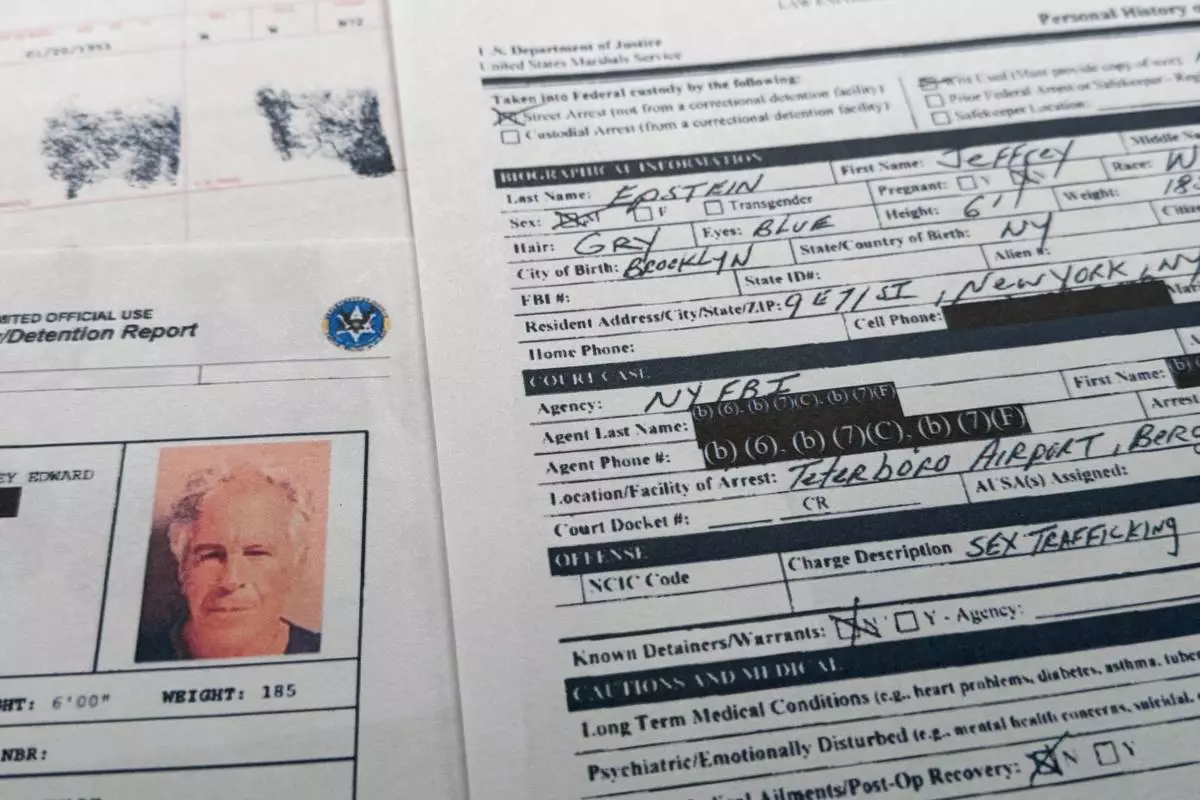
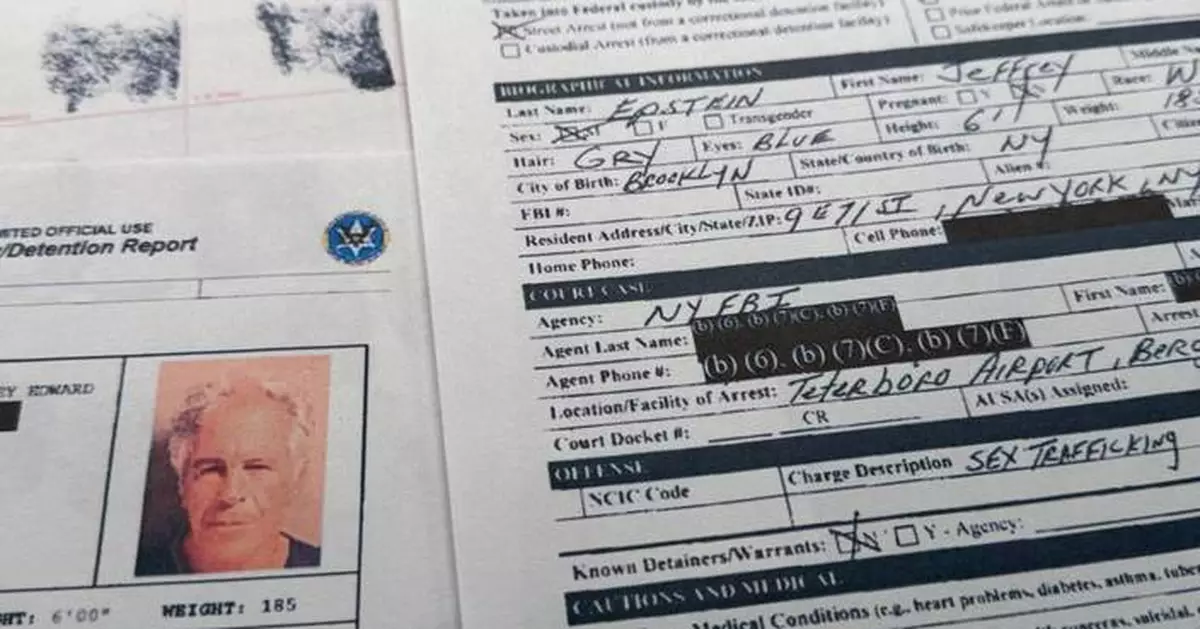
A document that was included in the U.S. Department of Justice release of the Jeffrey Epstein files is photographed Sunday, Feb. 1, 2026, shows the report when Epstein was taken into custody on July 6, 2019. (AP Photo/Jon Elswick)
CAIRO (AP) — Iranians began to regain internet access on Wednesday after authorities ended a monthslong shutdown. But users said service was slow and spotty in some areas, with apps like YouTube and Instagram heavily restricted, as they were before the cutoff began during nationwide protests in January.
Authorities justified the outage as a military imperative after the United States and Israel attacked Iran on Feb. 28. Their decision to lift some restrictions this week came as negotiators appeared to be closing in on a more permanent truce. But many Iranians feared access could be cut off again at a moment's notice.
Internet tracking company Netblocks said Iran’s connectivity, which measures the ability of devices to connect to the internet, is at around 86% of capacity from before the cutoff. Internet analysis firm Kentik said internet traffic, which measures the amount of data transferred and is a good illustration of usage, was at around 40%.
Amir Rashidi, an Iranian cybersecurity analyst, said there were still widespread disruptions. “It's too early to say the shutdown is over,” he wrote on X.
Iran’s roughly 90 million people have been cut off from the internet for most of 2026, one of the world’s longest and strictest national shutdowns. Young people with online careers saw their incomes evaporate. Job losses and the closure of online businesses added to the war's steep economic costs.
The cutoff made it difficult for Iranian families to communicate through months of unrest and war. At some points, phone lines were also cut off, though they were later restored.
A woman living in Tehran said that for months she was barely able to speak to her sons living abroad. She couldn't believe authorities had restored access, saying she had assumed they would find some justification to prolong the outage.
A taxi driver said service was restored but weak. He expressed hope it would improve so he could use messaging apps with family and friends. Both spoke on condition of anonymity for security reasons.
Prices spiked during the shutdown, with residents in Tehran at times paying around $7.50 per gigabyte. Prices are back down to around $2.25 for 30 gigabytes, roughly where they were before the protests.
Even then, Iran tightly controlled access to popular social media sites, leading many to rely on virtual private networks, or VPNs. The cost of those workarounds soared during the shutdown, making them unaffordable for many as the economy was battered.
Businesses have started reappearing online, announcing their return with posts on sites like Instagram and Telegram.
A gamer and tech influencer in the central city of Isfahan said the shutdown had caused him to lose a lot of his audience on YouTube and Instagram, where he had spent years building up a large following.
“All my views and interactions are way down. I’ve been erased from the algorithm,” he said in a voice note sent by WhatsApp, adding that his internet connection was still slower than before the shutdown.
“The situation is such that many content producers have had their income reduced to zero, have moved on to other jobs, or have been forced to sell their equipment to survive,” he said. He spoke on condition of anonymity for fear of reprisal.
Iranian authorities first shut down the internet in January during mass anti-government protests that were eventually stamped out in a violent crackdown. Thousands of people were killed and tens of thousands detained.
That cutoff was just starting to ease when the government imposed a complete internet blackout after the start of the war, when U.S. and Israeli strikes killed Iran's supreme leader and other top officials.
The government faced criticism for the prolonged shutdown, which caused even more harm to an economy devastated by inflation, strikes on key industries and a U.S. blockade on Iranian ports.
The internet cutoff cost an estimated $30-40 million daily, with indirect losses likely twice that much, a member of Iran’s Chamber of Commerce, Afshin Kolahi, told a local newspaper last month. About 10 million people have jobs that depend on internet connectivity, according to Communications Minister Sattar Hashemi.
Iranians still had access to a national net, but that has a far narrower reach, and users complained of poor service and heavy censorship. Senior government officials are given SIM cards granting them access to the global internet. Under pressure, the government expanded access to the SIM cards to some professions during the shutdown.
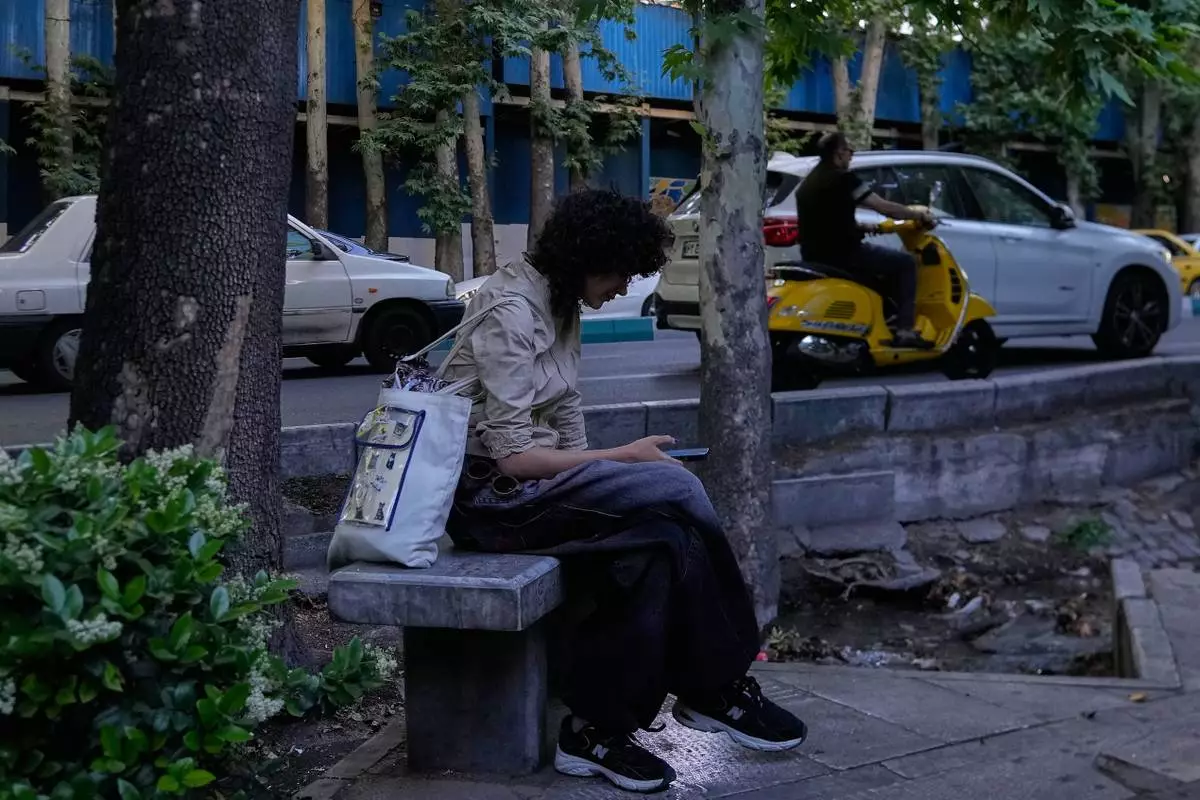
A woman checks her smartphone while sitting on a bench along a sidewalk in northern Tehran, Iran, Tuesday, May 26, 2026. (AP Photo/Vahid Salemi)