MADRID (AP) — Spain plans to ban social media access for children under 16, Prime Minister Pedro Sánchez said Tuesday, in a move designed to shield young people from the harms of online content.
Sánchez chided the world's biggest tech companies in a speech at a Dubai summit for allowing illegal content such as child sex abuse and nonconsensual sexualized deepfake images and videos to proliferate on their platforms, saying that governments also needed to “stop turning a blind eye.”
“Today, our children are exposed to a space they were never meant to navigate alone," Sánchez said. “We will no longer accept that.”
Spain joins a growing number of countries, including Australia and France, which have taken or are considering measures to restrict minors' access to social media.
In January, France approved a bill banning social media for children under 15, paving the way for the measure to take effect at the start of the next school year in September. The bill would also ban the use of mobile phones in high schools.
Australia has started implementing the world's first social media ban for under-16s, after its government passed a measure that holds platforms including TikTok, Twitch, Facebook, Snapchat, Reddit, X and Instagram liable for failing to prevent children from having accounts.
Denmark has introduced similar legislation to ban access to social media for users under 15, while the U.K. said last month it would consider banning young teenagers from social media, as it tightens laws designed to protect children from harmful content and excessive screen time.
Sánchez said that Spain would require social media companies to enforce the ban with age verification systems, “not just check boxes, but real barriers that work."
Many social media apps require users to be at least 13, though enforcement varies. Users are often asked to declare their own age.
Spain's ban will be added to an already existing measure centered on digital protections for minors that is being debated by parliament, a government spokesperson said. Sánchez said that could happen as early as next week.
It’s unclear if Sánchez’s left-wing coalition will get the approval needed in Parliament, where his government lacks a majority. A spokesperson for the far-right Vox party said the Sánchez government's measure was aimed at "making sure that no one criticizes them,” while the main opposition party — the center-right Popular Party — said it had proposed similar restrictions last year, seemingly offering its support.
Social media companies Meta — which owns Facebook and Instagram — and X did not immediately respond to a request for comment.
Sánchez also said that Spain had joined five other European countries in what the Spanish leader dubbed a “coalition of the digitally willing" to coordinate the regulation of social media platforms at a multinational level.
Additionally, Spain would make it a criminal offense to manipulate algorithms to amplify illegal content and would hold tech executives liable for failing to take down criminal content from their platforms, he said.
“No more pretending that technology is neutral," Sánchez said.
Both measures would require parliamentary approval to change Spanish law, a government spokesperson said.
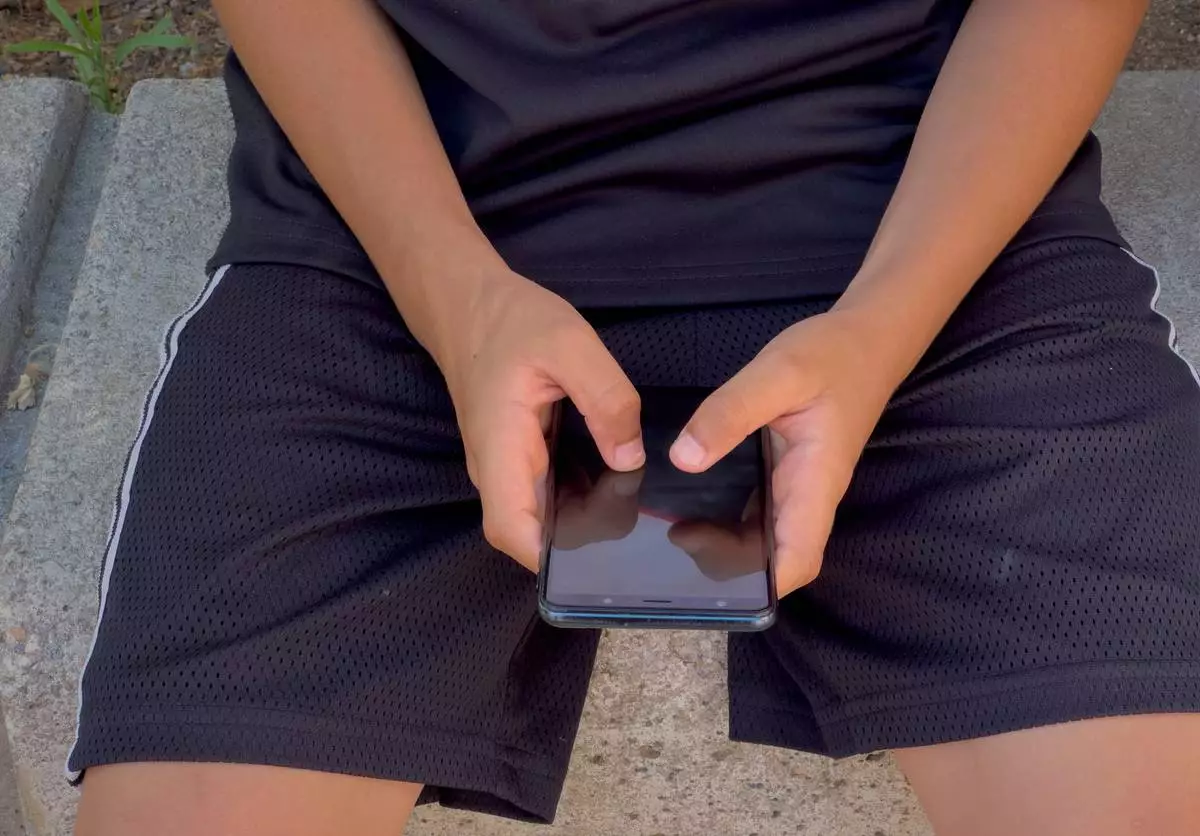
FILE - A 12-year-old boy plays with his personal phone outside school, in Barcelona, Spain, Monday, June 17, 2024. (AP Photo/Emilio Morenatti, FIle)
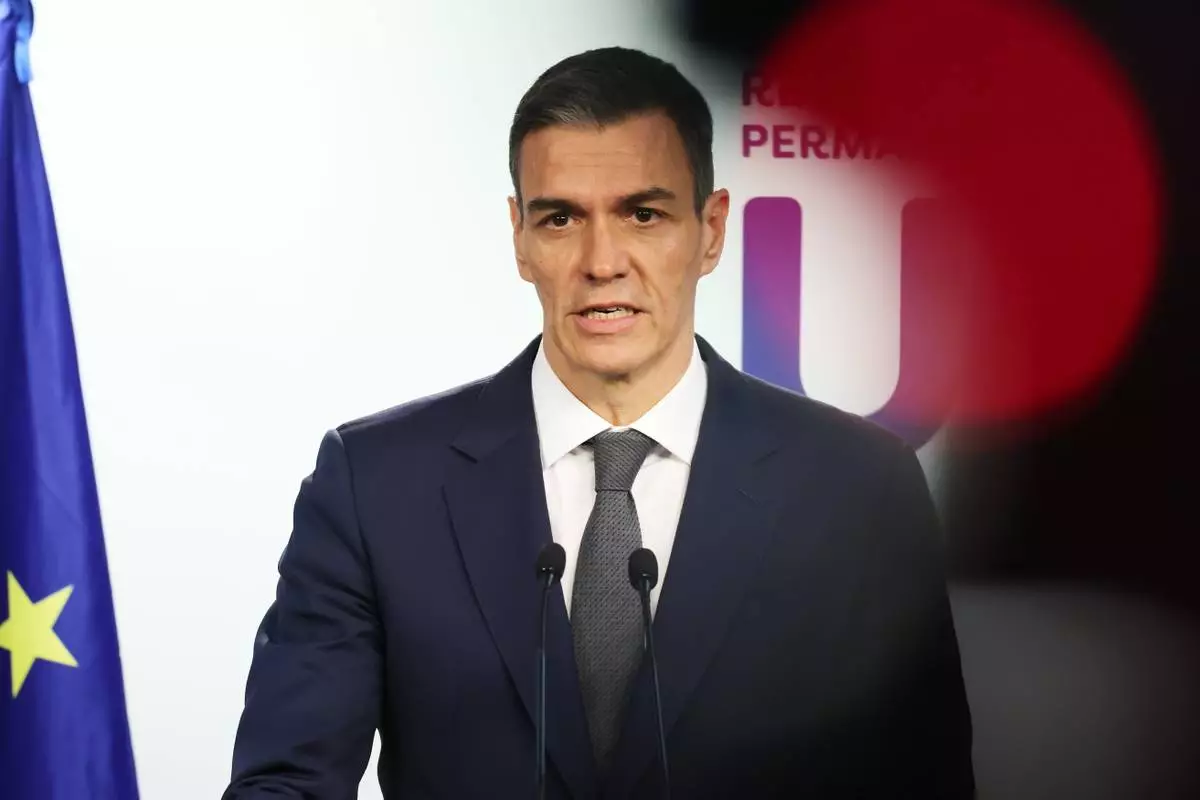
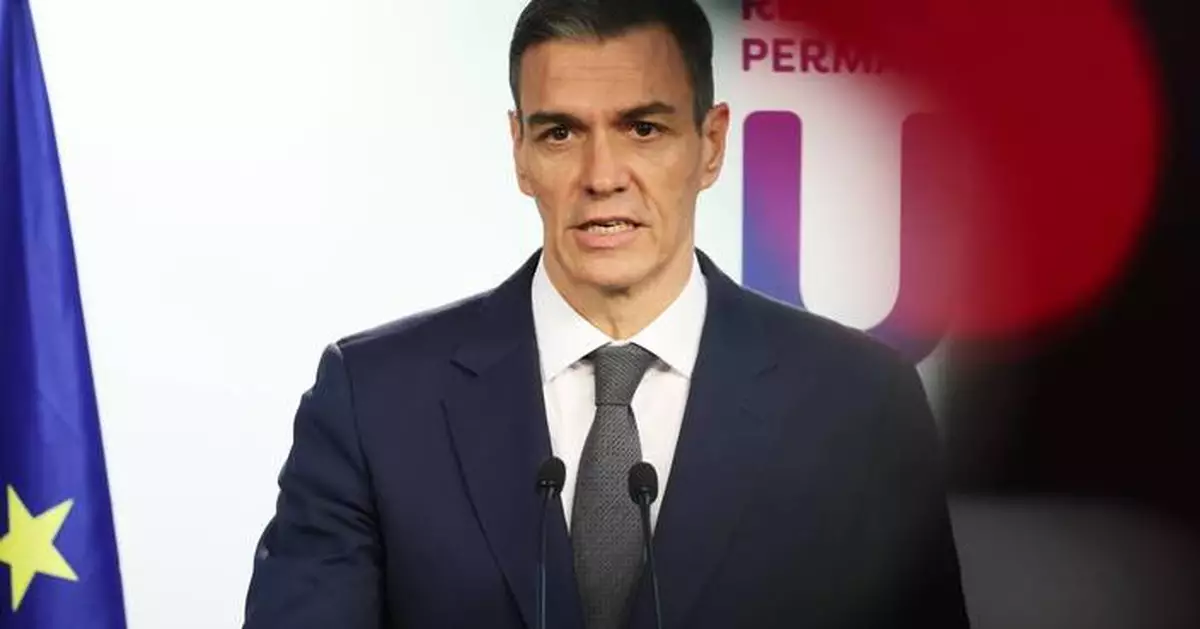
Spain's Prime Minister Pedro Sanchez speaks during a media conference at the end of the EU summit in Brussels, Friday, Jan. 23, 2026. (AP Photo/Omar Havana)
WASHINGTON (AP) — President Donald Trump is holding talks with Colombian President Gustavo Petro at the White House on Tuesday only weeks after threatening military action against the South American country and accusing the leader of pumping cocaine into the United States.
U.S. administration officials say the meeting will focus on regional security cooperation and counternarcotics efforts. And Trump on Monday suggested that Petro — who has continued to criticize Trump and the U.S. operation to capture Venezuela’s Nicolás Maduro — seems more willing to work with his administration to stem the flow of illegal drugs from Colombia.
“Somehow after the Venezuelan raid, he became very nice,” Trump told reporters. “He changed his attitude very much.”
Yet, bad blood between the leaders overshadows the sit-down, even as Trump sought to downplay any friction on the eve of the visit.
The conservative Trump and leftist Petro are ideologically far apart, but both leaders share a tendency for verbal bombast and unpredictability. That sets the stage for a White House visit with an anything-could-happen vibe.
In recent days, Petro has continued poking at the U.S. president, calling Trump an “accomplice to genocide” in the Gaza Strip, while asserting that the capture of Maduro was a kidnapping.
And ahead of his departure for Washington, Petro called on Colombians to take to the streets of Bogotá during the White House meeting. He planned to hold a news conference at the Colombian Embassy in Washington after the meeting with Trump.
Historically, Colombia has been a U.S. ally. For the past 30 years, the U.S. has worked closely with Colombia, the world’s largest producer of cocaine, to arrest drug traffickers, fend off rebel groups and boost economic development in rural areas. Colombia is also designated by the U.S. as a major non-NATO ally.
But relations between the leaders have been strained by Trump’s massing U.S. forces in the region for unprecedented deadly military strikes targeting suspected drug-smuggling boats in the Caribbean Sea and the eastern Pacific. At least 126 people have been killed in 36 known strikes.
In October, Trump's Republican administration announced it was imposing sanctions on Petro, his family and a member of his government over accusations of involvement in the global drug trade.
The Treasury Department leveled the penalties against Petro; his wife, Veronica del Socorro Alcocer Garcia; his son, Nicolas Fernando Petro Burgos; and Colombian Interior Minister Armando Alberto Benedetti.
The sanctions, which had to be waived to allow Petro to travel to Washington this week, came after the U.S. administration in September announced it was adding Colombia to a list of nations failing to cooperate in the drug war for the first time in three decades.
Then came the audacious military operation last month to capture Maduro and his wife to face federal drug conspiracy charges, a move that Petro has forcefully denounced. Following Maduro’s ouster, Trump put Colombia on notice and ominously warned Petro he could be next.
Colombia is “run by a sick man who likes making cocaine and selling it to the United States,” Trump said of Petro last month. “And he’s not gonna be doing it very long, let me tell you.”
But a few days later, tensions eased somewhat after a call between the leaders. Trump said Petro in their hourlong conversation explained “the drug situation and other disagreements.” And Trump extended an invitation to Petro for the White House visit.
The Colombian president is expected to use the meeting in part to detail his country’s counternarcotics initiatives to Trump. And in a diplomatic gesture amid the acrimony, Colombian officials said Petro came bearing gifts, including a signature Wounaan indigenous basket from Colombia's Chocó region for Trump and a handmade gown crafted by indigenous artisans from Nariño for first lady Melania Trump.
Trump skipped on greeting Petro upon his arrival and posing for a photograph with him in front of the North Portico of the White House before a gathered press, a set piece for most foreign leaders' visits. Instead, Petro arrived at a side entrance of the White House along West Executive Avenue, minutes before the start of their scheduled meeting.
The White House indicated that the two leaders would hold private talks in the Oval Office and that they did not plan joint comments before the press. Trump, however, frequently changes his mind and opens closed-press events at the last minute.
Trump on a couple of occasions has used the typically scripted leaders' meetings to deliver stern rebukes to counterparts in front of the press.
Trump and Vice President JD Vance lashed out at Ukrainian President Volodymyr Zelenskyy in February for showing insufficient gratitude for U.S. support of Ukraine. Trump also used a White House meeting in May to forcefully confront South African President Cyril Ramaphosa, accusing the country, with reporters present, of failing to address Trump’s baseless claim of the systematic killing of white farmers.
Associated Press writer Moriah Balingit contributed reporting.
President Donald Trump speaks in the Oval Office of the White House, Monday, Feb. 2, 2026, in Washington. (AP Photo/Alex Brandon)
FILE - Colombian President Gustavo Petro arrives at the presidential palace in Panama City, Jan. 28, 2026. (AP Photo/Matias Delacroix, File)