HELSINKI, Feb. 4, 2026 /PRNewswire/ -- Roughly 80% of the world's data centers still rely on air cooling. Fixing a 'half-degree' error there can avoid around $805 million in cooling waste every year, about $8 billion over a decade, based on moderate 10 MW sites.
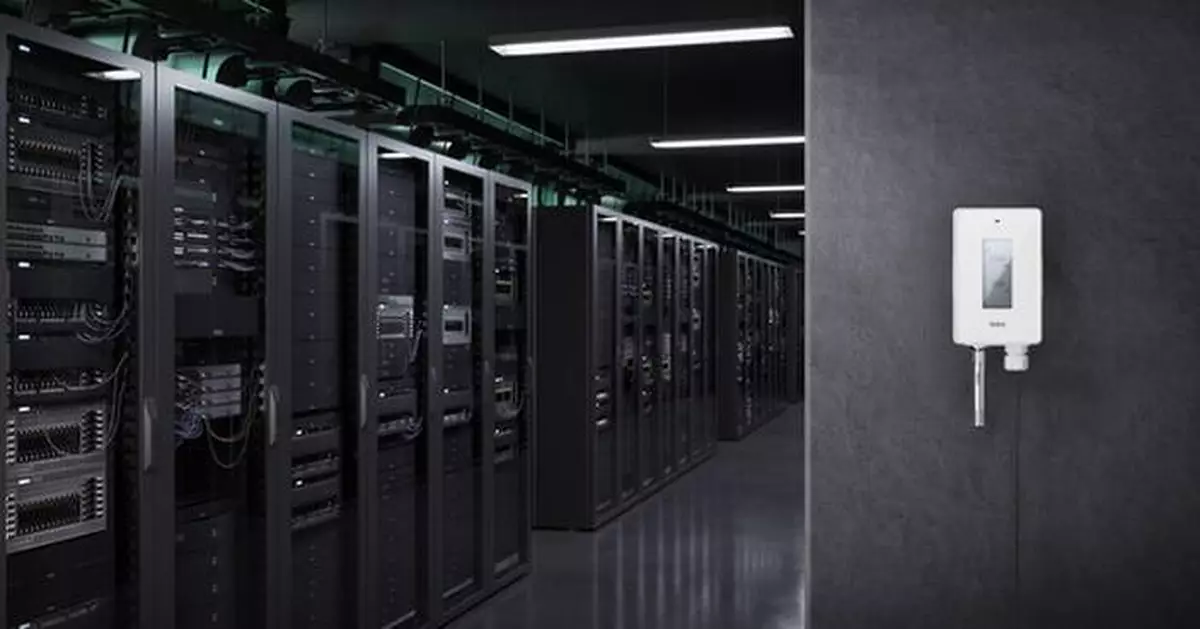
Vaisala, a global leader in measurement instruments and intelligence for climate action, introduces Origo, a next-generation modular measurement platform designed to transform environmental monitoring in data centers and other mission critical-buildings.
Why half a degree matters
A temperature sensor off by just 0.5 °C (32.9 °F) might sound trivial, but for example in a 10 MW data center, that small error can cost more than $800,000 in wasted cooling energy over ten years. In life science cleanrooms, for example, the stakes are even higher: any critical environmental parameter such as temperature or relative humidity can compromise product integrity or research outcomes, with losses that go far beyond energy costs.
Air cooling remains essential in a rapidly evolving data center market
There are an estimated 12,000 data centers worldwide, with the U.S. and Europe accounting for more than a half. While liquid and hybrid cooling are growing fast for high density AI workloads, air cooling remains the universal foundation of data center thermal management. It provides the room-level baseline cooling every facility needs, while liquid cooling adds targeted, high efficiency heat removal for the hottest racks. As a result, hybrid architectures —air for space, liquid for the densest loads— are now standard in both new builds and retrofit projects.
Impact at scale
Reliable, precise measurement is critical for optimizing air-cooled environments.
"Generic sensors with ±0.5 °C accuracy drive overcooling and energy waste, costing operators tens of thousands of dollars annually. Origo's precise ±0.1°C and ±1 %RH accuracy and stable measurements reduce unnecessary cooling while ensuring the reliable environmental control that critical facilities depend on. It translates to performance that pays for itself in months and protects uptime for years to come," says Anu Kätkä, Vaisala's Product Line Manager for HVAC and Critical Buildings.
Applied at global scale, eliminating the "half-degree" error across today's predominantly air-cooled installed base — roughly 80% of the world's ~12,000 data centers — would avoid around $805 million in wasted cooling energy every year, totaling approximately $8 billion over a decade.
With data centers consuming about 1.5% of global energy, and demand set to more than double by 2030, precision sensing is essential to keep energy use and emissions in check while safeguarding IT performance.
Designed for today's and tomorrow's critical environments
Origo is engineered for simplicity and long-term adaptability. Its modular design enables monitoring of multiple parameters through Vaisala's compatible probes, such as carbon dioxide (CO₂) and dew point sensors, on the same platform. This flexibility makes Origo a future-proof solution that adapts to evolving measurement requirements also in other critical environments such as cleanrooms, life science applications, and semiconductor manufacturing.
Backed by Vaisala's commitment to reliability, Origo ensures accurate measurements and dependable performance throughout its service life, helping operators protect processes, reduce risk, and optimize resources.
Origo's field‑replaceable probes allow quick on‑site updates with minimal interruption. Vaisala's wide range of services, from accredited calibrations to technical support, is available to complement on‑site expertise.
Key facts briefly
- The world runs on approximately 12,000 data centers; U.S. + Europe together represent well over a half of all sites
- Air cooling remains a standard baseline for most facilities; liquid is growing fast for high-density AI, often in hybrid setups
- A 0.5 °C error can cost a 10 MW data center more than $800,000 in cooling energy over 10 years
- Vaisala Origo delivers ±0.1 °C temperature accuracy and ±1 %RH humidity accuracy for stable, reliable environmental control
- Modular design and multi‑parameter capability suit critical environments such as data centers, cleanrooms, hospitals, production facilities, and semiconductor environments
About Vaisala
Vaisala is a global leader in measurement instruments and intelligence for climate action. We equip our customers with devices and data to improve resource efficiency, drive energy transition, and care for the safety and well-being of people and societies worldwide. With over 90 years of innovation and expertise, we employ a team of close to 2,500 experts committed to taking every measure for the planet. Vaisala series A shares are listed on the Nasdaq Helsinki stock exchange.
Note to editors:
Figures are based on industry data (Uptime Institute, IEA, Statista, AFCOM/Upsite, and Vaisala calculations) and assume a global installed base of approximately 12,000 data centers, with air cooling as the primary method in around 80% of sites.
Calculation method:
A typical 10 MW air‑cooled data center may waste about 700,000 kWh of cooling energy annually when operating with a 0.5 °C temperature error. At an energy price of $0.12/kWh, this equates to $83,800 per site per year, or over $830,000 over a decade.
With roughly 9,600 air‑cooled sites worldwide (80% of 12,000), the global annual impact is calculated as:
$83,800 × 9,600 ≈ $805 million per year, which amounts to approximately $8 billion over ten years.
Savings calculations compare this baseline with the reduced overcooling achieved using ±0.1 °C high‑accuracy temperature measurements.
** The press release content is from PR Newswire. Bastille Post is not involved in its creation. **

What's the cost of a half-degree? Vaisala's new Origo slashes cooling waste in data centers