China's commercial aerospace strategy is advancing through sea launch breakthroughs, with Haiyang's Oriental Spaceport accelerating its mission pace to strengthen satellite constellation deployment.
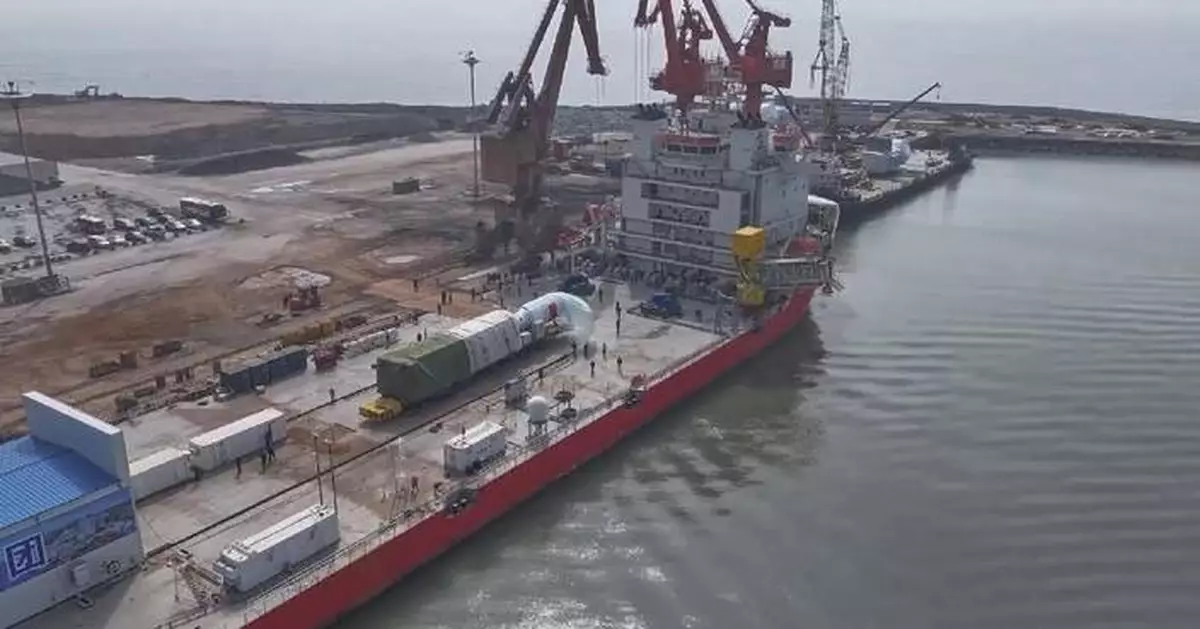
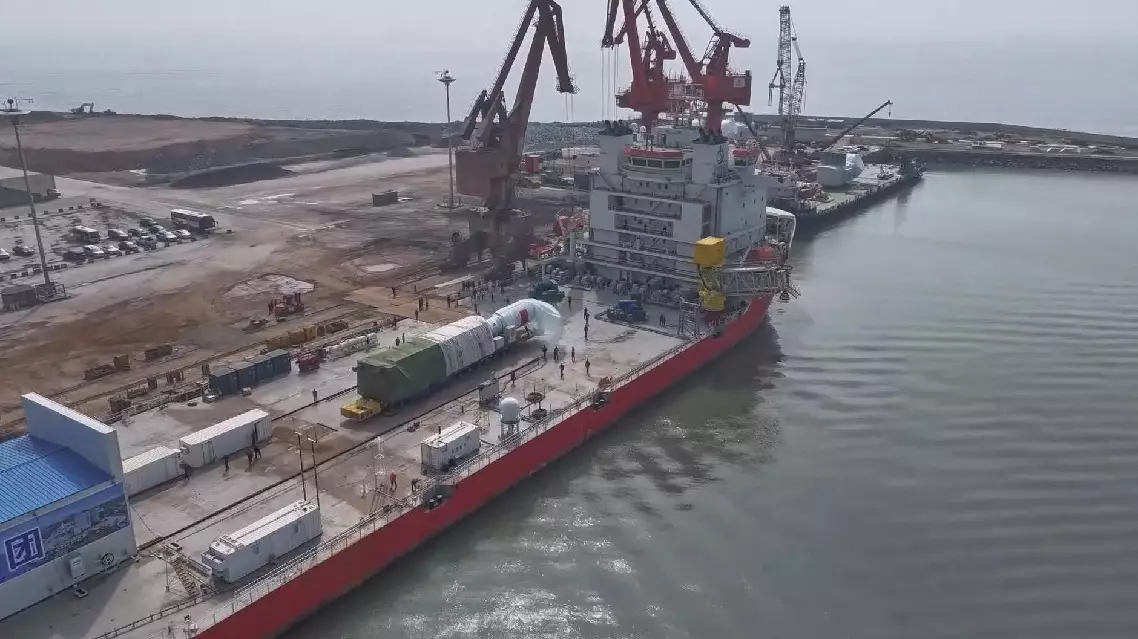
On January 16, the year opened with the Ceres-1S (Haiyao-7) rocket lifting off from the Shandong coast, marking the start of an intensive schedule. Central to this expansion is the Oriental Maritime Space Launch Vessel, enabling flexible access to multiple orbits from the sea.
"This unique equipment on the launch vessel is the dynamic positioning system. It automatically holds the ship in position as commanded, especially in deep sea, maintaining the location within 3 to 5 meters of precision. We also reinforce and maintain the vessel to ensure the safety of both the ship and the rocket for stormy weather," said Li Jun, Chief Mate of the vessel.
Besides offering flexibility and safer rocket recovery, efficiency is key to sea-based launches. At Haiyang's Oriental Spaceport, a "port‑factory integration" model enables rockets to move directly from production to launch. Orienspace and its rocket stand out in this regard.
In the company's Assemble, Integrate, and Test (AIT) workshop, workers are preparing for the latest launch in the first half of this year.
"We are now securing the cables, which act as the rocket's nervous system, running through all its systems to provide signal output and power transmission. We use fiberglass tape to wrap and protect them. Since cables run throughout the entire rocket, a short circuit anywhere could jeopardize the launch," said Xu Jun, head of Rocket Assembly Team of Orienspace Technology Co.
"What you see here is the rocket's fairing, essentially the 'clothing' for the satellite, protecting it as it passes through the atmosphere," he added.
After their work, before launch, the well-assembled rocket will depart from this facility to the port for final vertical assembly.
"Rockets assembled at our AIT center, and then can be moved to the vertical assembly facility at the launch port within just one to two hours, and then moved onto the launch vessel. The entire process, from assembly to launch, takes about a week, enabling a weekly launch pace. Theoretically, this enables a weekly launch frequency, which is highly beneficial for satellite constellation deployment and rapid response to urgent missions. In space launch, after all, it's always a race against time," said Wang Fan, PR and branding director of Orienspace Technology Co.
Beyond the rocket base, Haiyang also hosts satellite companies such as the "Star AI", the developer of China's new intelligent remote sensing constellation "Oriental Smart Eye Constellation," aiming to create a globally responsive AI satellite network in space.
"In 2026, we plan to launch two hyperspectral satellites. Later this year we also plan to launch several high resolution optical satellites to further enhance the constellation's coverage and capacity. Internationally, the constellation has established partnerships with more than 110 organizations across over 40 countries. For example, star vision company has already manufactured and delivered one satellite for Oman," said Qu Fangqi, customer success manager of STAR.AI.
In recent years, space infrastructure has accelerated rapidly. China is working harder to launch more satellites to support global networks, with flexible and safer commercial sea launches providing a key boost.
"Our Oriental Space Port complements China's existing launch capabilities in trajectory and latitude, boosting access to space. We have achieved breakthroughs in key technologies, including rocket exhaust management and a maritime safety monitoring system. In 2026, the port will focus on sea-based liquid rocket launches and strengthen its integrated commercial space ecosystem,driving high-quality growth in the sector," said Zhang Zhiguo, deputy general manager of Oriental Maritime Space Port Devt. Co., Ltd.
Recently, in Haiyang, the construction of China's first offshore liquid-fueled rocket launch and recovery test platform is in full swing. People will witness the first offshore launch and recovery test for a domestic commercial liquid rocket in February, marking a new chapter for the commercial space industry.
China’s commercial aerospace strategy advances with sea launch breakthroughs