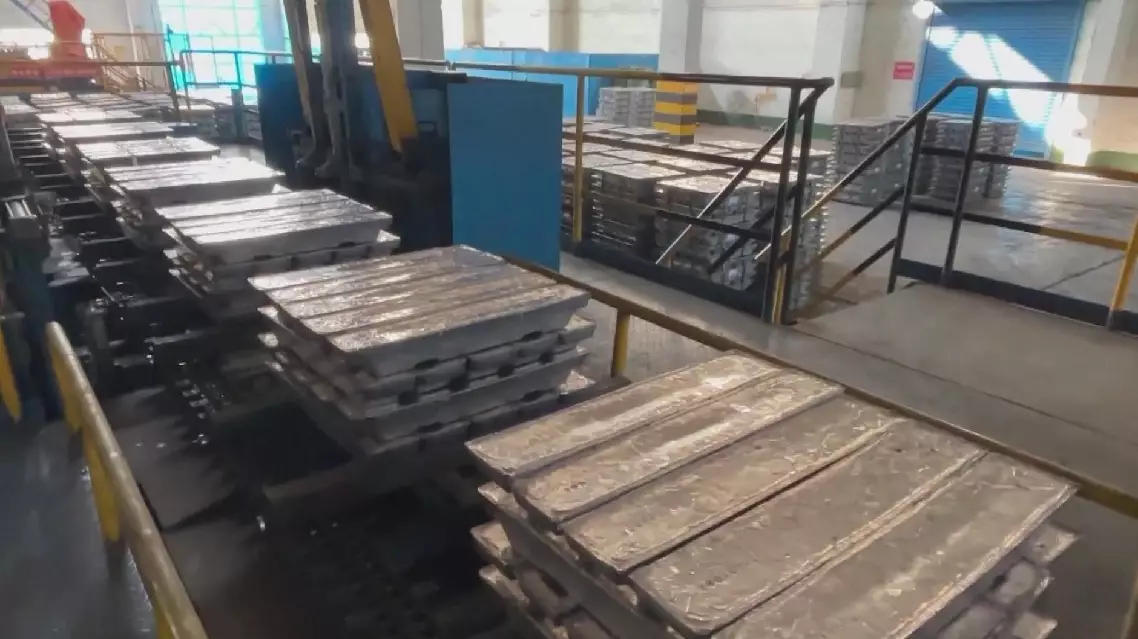
China's bulk commodity price index continued its upward trend in January 2026, marking the ninth straight month of month-on-month gains and the highest level recorded in the past three and a half years, according to the China Federation of Logistics and Purchasing (CFLP) on Thursday.
The index stood at 125.3 points in January, up 6.3 percent from last month, data released by the CFLP showed.
Of the 50 major types of bulk commodities monitored by the federation, 33 saw monthly price increases.
The strongest gains were recorded in neurolithium, refined tin, and refined nickel, up 48.4 percent, 20.2 percent and 19.5 percent, respectively.
Sector-wise, the sub-index for non-ferrous metals and chemical products rose sharply, up 9.9 percent and 3.8 percent, respectively, from the previous month, due to factors such as loose expectations for international monetary policy, geopolitics, and the futures market.
The supply and demand of the agricultural products market were balanced, and the price index rebounded slightly, up 0.2 percent from the previous month.
China's bulk commodity price index up for 9 consecutive months
Polish citizens are feeling the squeeze of surging energy costs, as the conflict in the Middle East continues to roil the international energy market,
In Poland, rising fuel prices are gradually making their way into everyday life and the real economy. Many residents said higher energy costs are taking a heavy toll.
"I do think about this issue more and try to reduce my fuel consumption. Overall, everything happening right now is unsettling," said Pawel, a Warsaw resident.
"I really feel it. Prices have gone up a lot. We're trying to cope and can manage for now. Taxi fares haven't increased yet, but it's definitely getting harder," said Wiktor, another resident.
"Of course it has affected us. Because fuel prices have gone up, everything else is more expensive and costs more now," said Anita, another local resident.
Meanwhile, those working in the transport and service sectors said rising oil prices are directly impacting their businesses.
"The courier industry, like most taxi drivers, is soon going to face closure and be forced out of business. I used to drive international long-distance buses, and honestly, some people in that sector are also thinking about quitting," said Michal, another Warsaw resident.
Lukasz Goczek, a professor from the Department of Macroeconomics and Theory of Foreign Trade at the University of Warsaw, said the continued shipping disruptions in the Strait of Hormuz, a vital global energy corridor, could leave global energy prices elevated for a long time, heavily impacting the world economy.
"Iran has this huge leverage. It's got the whole world in a chokehold because 20 percent of oil that's transported in the world goes through the Strait. It obviously means that the price of energy is going to increase. We see it at the petrol stations," said Goczek.
Goczek also noted that U.S. and Israeli military actions against Iran have dealt a serious blow to the international order.
"I think that's pretty much, by now, the international law. If it's not that, it's definitely very, very illegal. There wasn't any reason for war. It just straightforwardly began without any warning. So it was much of a surprise. We need the international order to have peace, to prosper, to have trade," said Goczek.

Rising energy costs squeeze Polish households, businesses