Shanghai's South Bund Soft Spinning Material Market has emerged as a premier destination for custom tailoring, drawing a growing stream of international visitors as China continues to ease entry policies for foreign travelers.
Home to more than 200 shops, the fabric market has been ranked by foreign tourists on the online travel review site TripAdvisor as Shanghai's second most worthwhile attraction, just after the iconic Bund.
The market offers bespoke suit services that allow travelers to place an order upon arrival and collect their finished garment before departure. Visitors from around the world describe it as a paradise for tailor-made clothing.
"It's cheap and the quality is great," said an international customer.
"When you try to buy it in Europe, it's crazy expensive," said another.
"People from China, they often come to Switzerland in order to buy some chocolates. But Swiss people like us, we come to Shanghai to get some very good suits," said a customer from Switzerland.
Language is no barrier here. Nearly all tailors speak English, and many are multilingual. Linda Shi, a vendor in the market, taught herself seven languages to better connect with clients.
"For example, German, if you know German, you will easily get attention from the German clients. I try to get attention from everybody," said Shi.
As China continues to streamline visa policies for foreign tourists, the market has seen a surge in visitors eager to take home a custom suit.
"I traveled [for] three weeks in China, and Shanghai is my final stop," said one customer.
"[If you want] normal materials, it's less than a week. So, if they visit until Friday -- today is Monday -- they can get it done before they leave," said another customer who introduced many of his friends to the market.
Xu Chengfang runs three stores in the market. After measuring a customer, she sends the data directly to her factory, where production begins immediately. Thanks to a smart pattern-making and cutting system, each suit is completed in just three to five days.
"If one piece is done by one tailor, the quality will be different. The machines can ensure the quality is standardized," said Xu.
Xu started her business at the market in 2010 and opened a factory in 2014 as demand grew.
With a history spanning two decades, the South Bund market has cultivated a loyal international following. Many customers return repeatedly.
"I've been here a few times since I live here. And I told him it's a very nice place," said the customer who introduced many of his friends to the market.
"We are usually not in a hurry, so Anna (tailor) decides how long it takes. And maybe I come here [to pick it up], or she sends it home to us," said another customer.
Suits are not traditional Chinese clothing. But Chinese tailors' ability to adapt quickly and embrace new approaches has helped this 20-year-old market continue to attract foreign buyers, allowing more people around the world to wear suits made by Chinese tailors.
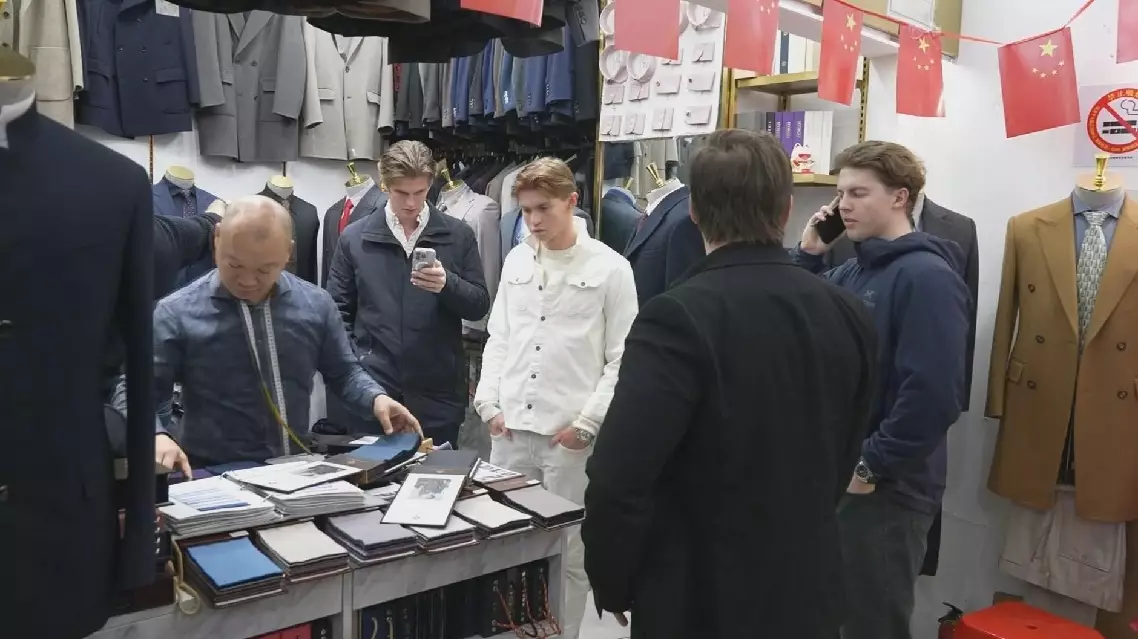
Shanghai's fabric market emerges as custom tailoring hotspot for int'l travelers