Skip to Content Facebook Feature Image

Thailand’s Bhumjaithai Party prepares for coalition talks after election win

HotTV

HotTV

HotTV

Thailand’s Bhumjaithai Party prepares for coalition talks after election win

2026-02-09 22:52 Last Updated At:02-10 13:29

The Bhumjaithai Party has emerged as the largest party in Thailand's House of Representatives, according to preliminary results released by the country's Election Commission on Monday.

As of 94 percent vote counting the Bhumjaithai Party captured 193 seats.

"Bhumjaithai's victory today is a victory for all Thais, whether you voted for Bhumjaithai Party or not," said Anutin Charnvirakul, Thailand's caretaker Prime Minister and leader of the Bhumjaithai Party at a press conference on Sunday.

Thai political analyst said the desire for stability is the key for Anutin's election success.

"What determined the winning of the election this time is the nationalist sentiments, the conflict that we have with Cambodia, the stability that they need at this particular point. And I think for the rural voters who actually voted more for Bhumjaithai, for them, I think they need a safety net which is not about large economic reforms, but they need something which is closer to them," said Virot Ari, a political analyst at Bangkok’s Thammasat University.

Since the Bhumjaithai Party failed to secure more than half of the seats in the lower house, it has to form a coalition government with other political parties.

The People's Party and the Pheu Thai Party ranked second and third, respectively, with 118 and 74 seats. The Kla Tham Party and the Democratic Party each got 58 and 22 seats, taking fourth and fifth positions.

Natthaphong Ruengpanyawut, leader of Thailand's People's Party, told the press on Sunday that the party is ready to act as the opposition party.

"No matter the reasons behind how people voted today, the People's Party is ready to continue working in politics, to rebuild political institutions, and to push forward policies for all people," he said.

Thailand’s Bhumjaithai Party prepares for coalition talks after election win

Thailand’s Bhumjaithai Party prepares for coalition talks after election win

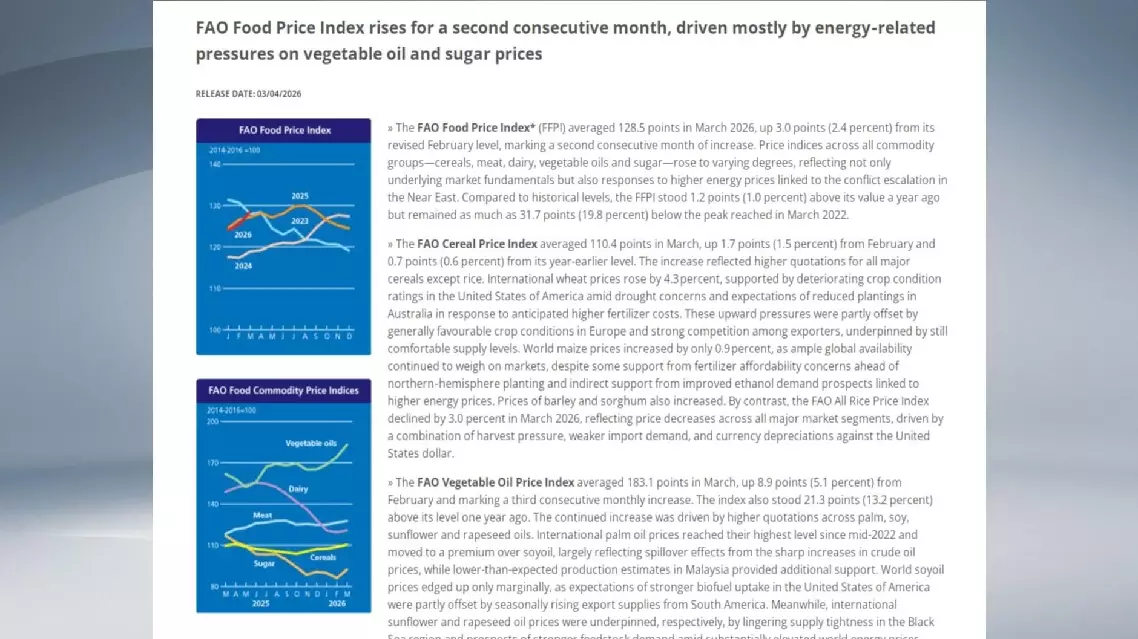
Global food commodity prices climbed for a second consecutive month in March, driven mainly by higher energy costs linked to escalating conflict in the Middle East, the Food and Agriculture Organization of the United Nations (FAO) said in report released on Friday.

The FAO Food Price Index, which tracks monthly changes in the international prices of a basket of globally traded food commodities, averaged 128.5 points in March, up 2.4 percent from February and 1.0 percent above its level a year ago.

According to the report, the FAO Vegetable Oil Index and Sugar Price Index showed the largest increases, up 5.1 percent and 7.2 percent, respectively.

The FAO Cereal Price Index increased by 1.5 percent from the previous month, driven primarily by higher world wheat prices, which rose 4.3 percent.

The FAO Meat Price Index rose by 1.0 percent from the previous month, and the FAO All-Rice Price Index declined by 3.0 percent in March, according to the report.

FAO stated that rising energy and fertilizer prices have been driving up agricultural input costs.

If the conflict stretches beyond 40 days, farmers will have to choose to farm the same with fewer inputs, plant less, or switch to less intensive fertilizer crops, according to FAO Chief Economist Maximo Torero.

These choices will hit future yields and shape food supply and commodity prices for the rest of this year and beyond, Torero said.

Global food prices rise for 2nd consecutive month in March amid Middle East conflict: FAO

Global food prices rise for 2nd consecutive month in March amid Middle East conflict: FAO

Recommended Articles