More than 230 million cross-regional passenger trips nationwide were predicted on Monday, the eighth day of China's 40-day 2026 Spring Festival travel rush, 3.4 percent more than the day before, according to the country's transport authorities.
Self-driving remains the main transport choice for people this year, accounting for about 80 percent of journeys so far. On Monday, expressways nationwide were expected to handle approximately 218 million passenger trips.
China's railway network was forecast to transport 14.25 million passenger trips on Monday, with additional overnight trains added to busy routes to accommodate the surge in demand.
Nearly 2.35 million passenger trips were expected to take to the skies on Monday, a year-on-year increase of 5.6 percent.
The Spring Festival, also known as the Chinese New Year, falls on February 17 this year, and the official holiday lasts nine days.
The annual travel surge, known as chunyun and often described as the world's largest human migration, is expected to generate a record 9.5 billion inter-regional passenger trips during the 40-day period running from February 2 to March 13 this year.

Over 230 mln passenger trips recorded on Day 8 of China’s Spring Festival travel rush
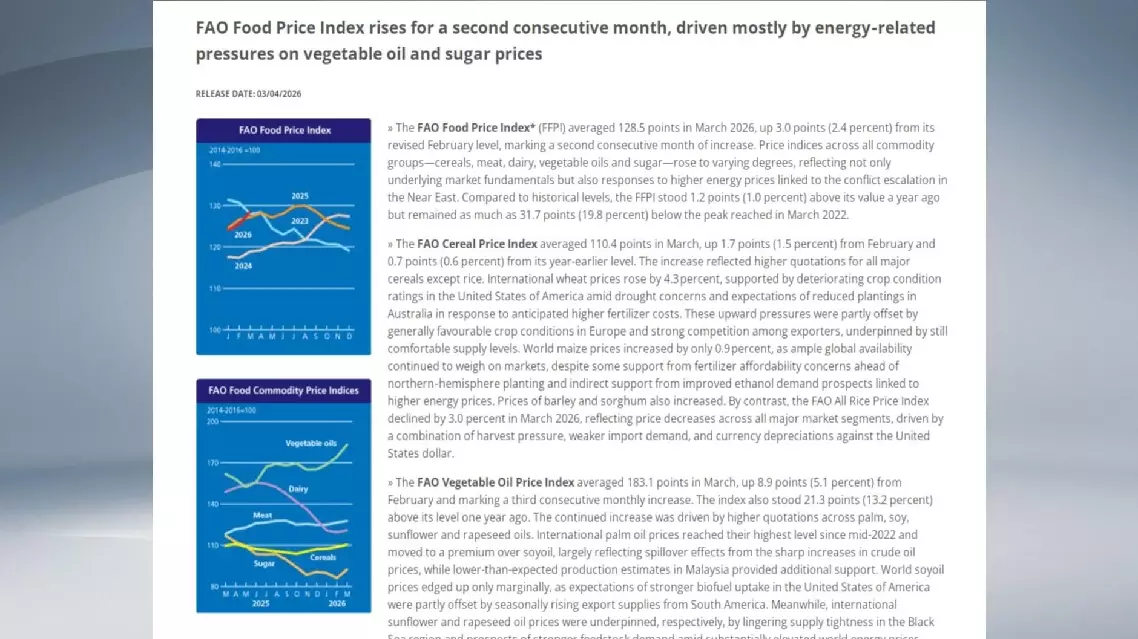
Global food commodity prices climbed for a second consecutive month in March, driven mainly by higher energy costs linked to escalating conflict in the Middle East, the Food and Agriculture Organization of the United Nations (FAO) said in report released on Friday.
The FAO Food Price Index, which tracks monthly changes in the international prices of a basket of globally traded food commodities, averaged 128.5 points in March, up 2.4 percent from February and 1.0 percent above its level a year ago.
According to the report, the FAO Vegetable Oil Index and Sugar Price Index showed the largest increases, up 5.1 percent and 7.2 percent, respectively.
The FAO Cereal Price Index increased by 1.5 percent from the previous month, driven primarily by higher world wheat prices, which rose 4.3 percent.
The FAO Meat Price Index rose by 1.0 percent from the previous month, and the FAO All-Rice Price Index declined by 3.0 percent in March, according to the report.
FAO stated that rising energy and fertilizer prices have been driving up agricultural input costs.
If the conflict stretches beyond 40 days, farmers will have to choose to farm the same with fewer inputs, plant less, or switch to less intensive fertilizer crops, according to FAO Chief Economist Maximo Torero.
These choices will hit future yields and shape food supply and commodity prices for the rest of this year and beyond, Torero said.
Global food prices rise for 2nd consecutive month in March amid Middle East conflict: FAO