At least 14 people were killed and several others injured when a residential building collapsed in the northern Lebanese city of Tripoli, the Lebanese authorities said on Monday.
The tragedy occurred on Sunday in Tripoli's Bab el-Tebbaneh district.
Civil Defense Director General Imad Khreish said search and rescue operations had come to an end after recovering the bodies of the 14 victims.
The injured were pulled out from the rubble as emergency teams were searching for survivors.
The Lebanese Ministry of Public Health issued a statement on Monday, saying that it would fully cover the medical expenses for those injured in the building collapse.
Lebanese Prime Minister Nawaf Salam has reaffirmed that the government is to provide shelters for evacuated residents and secure funding to immediately reinforce at-risk structures.
Mayor of Tripoli Abdel Hamid Karimeh said that there are 105 buildings in the city at risk of collapse, and the Lebanese government has promised to provide funds for the restoration and reinforcement of these buildings.

At least 14 dead after apartment building collapse in Lebanon

At least 14 dead after apartment building collapse in Lebanon

At least 14 dead after apartment building collapse in Lebanon
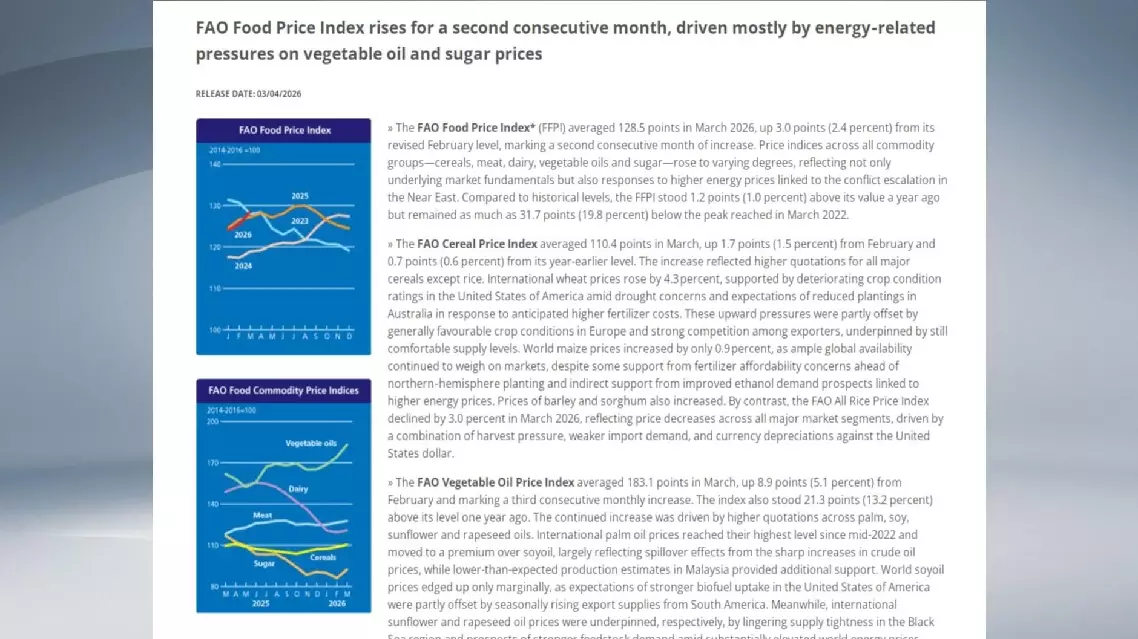
Global food commodity prices climbed for a second consecutive month in March, driven mainly by higher energy costs linked to escalating conflict in the Middle East, the Food and Agriculture Organization of the United Nations (FAO) said in report released on Friday.
The FAO Food Price Index, which tracks monthly changes in the international prices of a basket of globally traded food commodities, averaged 128.5 points in March, up 2.4 percent from February and 1.0 percent above its level a year ago.
According to the report, the FAO Vegetable Oil Index and Sugar Price Index showed the largest increases, up 5.1 percent and 7.2 percent, respectively.
The FAO Cereal Price Index increased by 1.5 percent from the previous month, driven primarily by higher world wheat prices, which rose 4.3 percent.
The FAO Meat Price Index rose by 1.0 percent from the previous month, and the FAO All-Rice Price Index declined by 3.0 percent in March, according to the report.
FAO stated that rising energy and fertilizer prices have been driving up agricultural input costs.
If the conflict stretches beyond 40 days, farmers will have to choose to farm the same with fewer inputs, plant less, or switch to less intensive fertilizer crops, according to FAO Chief Economist Maximo Torero.
These choices will hit future yields and shape food supply and commodity prices for the rest of this year and beyond, Torero said.
Global food prices rise for 2nd consecutive month in March amid Middle East conflict: FAO