China has stepped up training for its aircraft carrier groups, with rescue helicopters conducting demanding sea drills to ensure pilots can be saved quickly and safely in emergencies, including at night and in rough winter seas.
In recent years, the training of its aircraft carrier task forces has been accelerated, with frequent takeoff and landing drills for carrier-based aircraft.
Landing on a carrier is highly demanding, with jets required to touch down within a narrow area of just over 30 meters. If an accident occurs, ship-borne rescue helicopters provide the final safeguard for pilots.
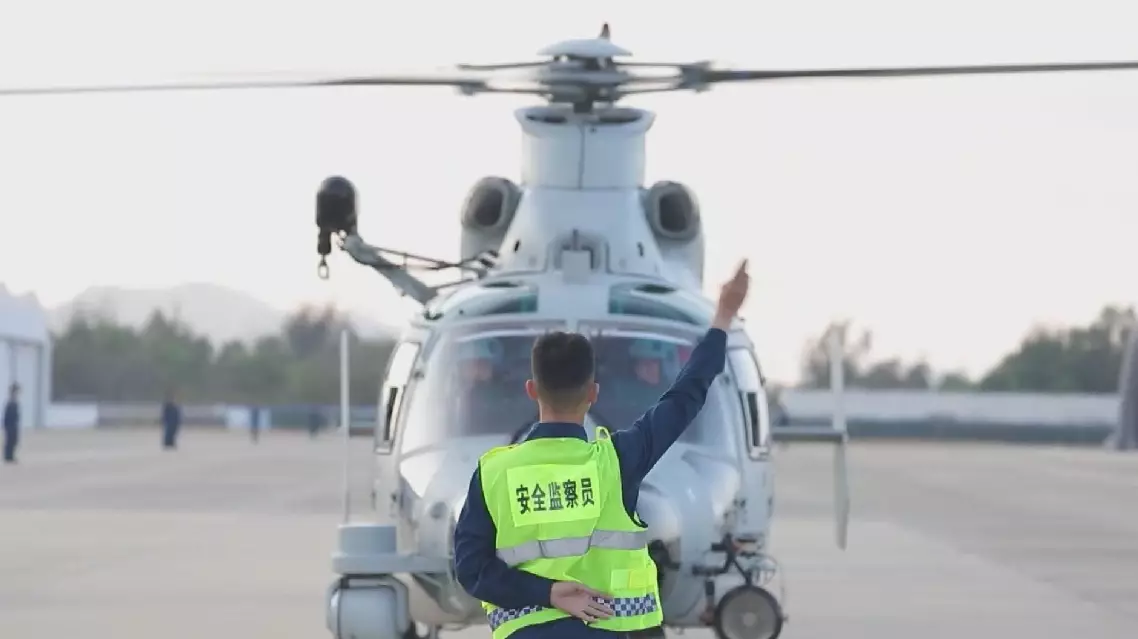
During a recent exercise, a Z-9S ship-borne helicopter took off immediately upon receiving the emergency order and rushed to a designated rescue area.
Harsh weather conditions in the South China Sea in winter, marked by strong winds and high waves, added to the difficulty in maritime rescue operations, making them far more complex than operations on land.
Hovering over the target, a dummy floating on the sea surface, the helicopter crew coordinated closely as a rescue swimmer descended by cable.
Precise control was required to avoid entanglement while securing the target and lifting it safely into the cabin.
To support round-the-clock carrier operations, rescue helicopters must also conduct night-time missions.
In darkness, pilots face serious visual illusions over the sea, making stable hovering particularly challenging.
"It is very difficult to see clearly the condition of the cable in water during nighttime rescue operations. While ensuring that the rescued person is secured with the sling as quickly as possible, we must also make sure that our bodies don't entangle with the cable. At the moment of us being hoisted out of the sea, the strong pulling force causes the cable to tighten instantly. The combined weight of myself and the rescued person can reach some 150 kilograms, so if our hands, feet, or necks get entangled with cable, the consequences would be really serious," said Gou Zejun, a member from a naval aviation unit under the Southern Theater Command of the Chinese People's Liberation Army (PLA).
On an aircraft carrier, rescue helicopters are stationed closest to the deck elevators and are always the first to take off and the last to land during flight operations.
"I have been working in maritime search and rescue services for 18 years. Although we cannot soar into the sky to directly face enemies like fighter pilots, I want to say that with us here, our 'flying' warriors can take to the skies with their mind at ease," said another soldier named Lu Jian.
China steps up aircraft carrier sea rescue training