Chinese President Xi Jinping visited primary-level officials and residents in Beijing during a two-day inspection tour from Monday to Tuesday, continuing the 14-year-long tradition of connecting with ordinary people ahead of the Spring Festival, the most significant occasion for the Chinese.
Xi, also general secretary of the Communist Party of China (CPC) Central Committee and chairman of the Central Military Commission, visited the Longfusi commercial area in Dongcheng District of Beijing on Tuesday, learning about festival market supplies and urban renewal efforts.
Xi wished the people good health, success in their careers, and happiness for their families in the Year of the Horse, and wished the country peace and prosperity.
The Spring Festival, or the Chinese New Year, is the most important holiday on the Chinese calendar and a time for family reunions. Since his election as general secretary of the CPC Central Committee in 2012, Xi has made it a tradition to visit ordinary people across the country ahead of the festival.
"No matter how busy I was, I spent time visiting people in the countryside. People shared many of their thoughts with me, and I always keep them in mind," Xi said in his annual New Year address in 2020.
In 2013, Xi, also general secretary of the Communist Party of China (CPC) Central Committee and chairman of the Central Military Commission, visited remote villages located in northwestern Gansu Province, asking villagers whether they had enough food, sufficient subsistence allowances, and access to medical and educational resources.
The following year, he braved the cold in Inner Mongolia ahead of the Spring Festival, visiting a forestry worker's home and checking the family's living conditions.
In February 2015, Xi returned to Liangjiahe Village, northwest China's Shaanxi Province, where he spent seven years as an adolescent and young adult.
Xi said he would never forget the villagers there and the people in the old revolutionary base.
A well-off society is incomplete if people in old revolutionary base areas cannot shake off poverty, Xi said later during a meeting with officials from Shaanxi and neighboring provincial regions in northwest China.
Xi's footsteps also reached the Jinggang Mountains, cradle of the Chinese revolution, in east China's Jiangxi province in February 2016.
Inspecting a village tucked away in the Jinggang Mountains before the 2016 Spring Festival, Xi joined a group of locals in preparing food for the festival.
In January 2017, Xi visited Zhangbei County in north China's Hebei Province. At the home of a farmer, Xi talked with the family about the ways to shake off poverty.
In February 2018, Xi went deep into the mountains of impoverished Liangshan Yi Autonomous Prefecture in southwest China's Sichuan Province.
In two ethnic Yi villages, Xi was happy to learn that villagers have increased their incomes by raising cattle and growing potatoes, peppers and walnuts.
"Not a single ethnic group or family should be left behind in building a moderately prosperous society in all respects," Xi said. Before the Spring Festival in 2019, Xi visited Beijing's primary-level community officials and residents in downtown neighborhoods.
He visited the deliverymen who were on duty there, stressing that priority should be given to solving employment problems and creating more jobs.
During that visit, Xi also joined local residents in making dumplings at their home. Xi chatted happily with locals as he made dumplings with them, asking about their festival purchases and the improvements to their living conditions following a renovation project.
"What the CPC pursues is to make people's life better and better," Xi said.
In January 2020, he paid a visit to Simola Wa Village, a 500-year-old Wa ethnic group village in Tengchong City, southwest China's Yunnan Province.
In a village square, he beat a wooden Wa drum three times in accordance with local customs to wish for a bumper harvest, peace and prosperity.
Before the Spring Festival in 2021, Xi traveled winding mountain roads to visit people of the Miao ethnic group in southwest China's Guizhou Province.
He went to Huawu Village in Xinren Miao Township. The once extremely impoverished village has eliminated poverty through crop planting and animal husbandry as well as tourism. Xi visited the home of a villager and a Miao embroidery workshop, urging efforts to promote ethnic and traditional cultures.
During his trip to the northern province of Shanxi in 2022, Xi visited villagers' homes and inspected the post-disaster reconstruction in areas affected by the previous year's floods as well as local work in restoring farming, ensuring public access to heating in winter, consolidating and expanding anti-poverty achievements and advancing rural vitalization.
In 2023, Xi held virtual talks with the general public from across the country ahead of the Spring Festival, wishing Chinese people of all ethnic groups healthy and happy life.
In February 2024, Xi visited residents in Tianjin, including villagers affected by floods, ahead of the Spring Festival.
At a villager's home, he chatted with four generations of the family and inquired about the family's losses during the disaster, their post-disaster production and income, and carefully tallied the numbers during the talk.
Xi said the importance of ensuring the people's livelihoods is always on the mind of the CPC Central Committee as well as Party committees and governments at all levels.
In 2025, Xi inspected northeast China's Liaoning Province. In the capital city of Shenyang, he visited Dadong non-staple food market to learn about the supplies for the upcoming Spring Festival.
At the market, children were delighted to see Xi and eagerly offered him the candy they just bought.
"I'm glad to accept your candy. You are the hope for our future. Eating your candy fills my heart with sweetness, and I hope your life will be as sweet as candy," Xi said.
Xi also visited people affected by floods in a village, and inspected the progress in post-disaster restoration and reconstruction.
This year, Xi has remained dedicated to this tradition, reaffirming his connection with the people and their well-being as a central focus of his leadership.
Xi went to a community canteen, an apartment complex for seniors, and a downtown commercial area to learn about community and elderly-care services, festival market supplies, and the development of distinctive urban districts on Monday and Tuesday.
"On behalf of the Communist Party of China Central Committee, I extend Spring Festival greetings to the people of all ethnic groups across the country. I wish the people of all ethnic groups vigor and vitality, good health, success in your endeavors, and happiness for your families in the Year of the Horse!" said Xi.
"I also wish our great motherland ever more magnificent landscapes, favorable weather, and enduring prosperity. May there be lasting peace and stability for our nation and people!" said Xi.
The Spring Festival falls on Feb 17 this year.
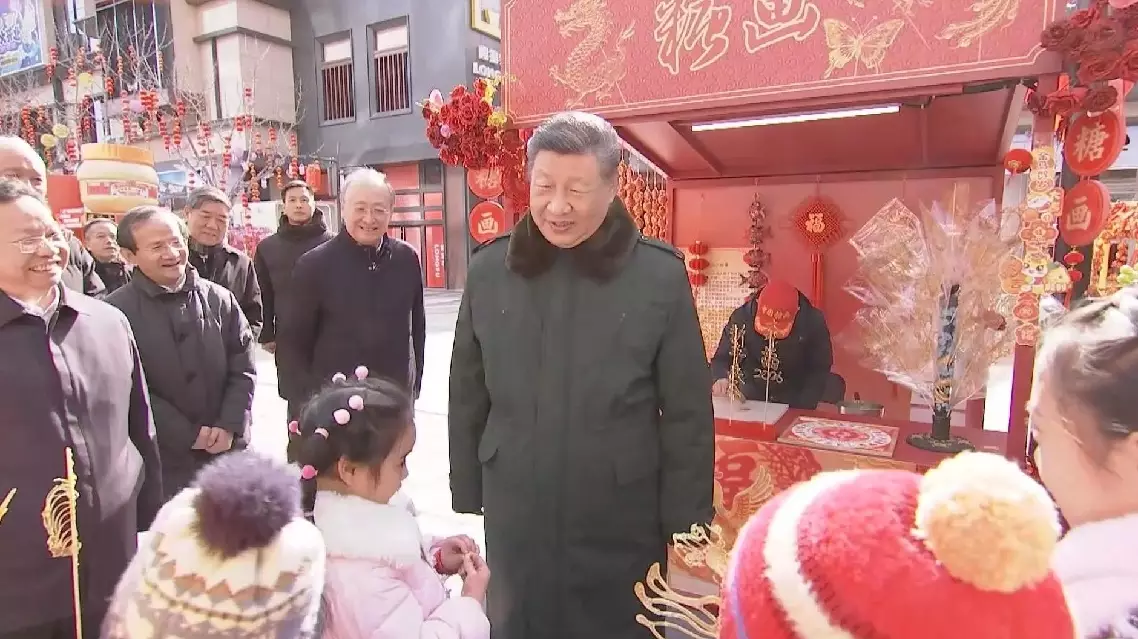
Xi makes annual visits to ordinary citizens ahead of Spring Festival for 14 years