Greenland's Kangerlussuaq town, once a U.S. military base, becomes the frontline of enhanced military presence, causing unprecedented levels of stress and anxiety to Greenlanders after it was established as a temporary military zone by Denmark on January 23 as tensions escalate over President Donald Trump's desire to acquire the Danish autonomous territory.
Recent weeks have seen a flurry of military activities in Greenland. In response to repeated threats by the current U.S. administration to take over the Arctic island, several European nations, including Norway, Sweden, France, Germany, the UK, the Netherlands, and Finland, have joined Denmark's Operation Arctic Endurance military exercise in Greenland.
In 1941, Kangerlussuaq became the site of the U.S. military base Bluie West-8, later known as Sondrestrom Air Base for its favorable terrain and stable weather. It served as a vital air transport hub and refueling station during World War II and the Cold War, formally closing in 1992.
Its strategic significance has never really changed. It connects Greenland's southern towns to the deep Arctic, and links Greenland itself to NATO's broader defense architecture. Training, exercises, logistics and support operations have once again placed this small town on the strategic chessboard. For the people of Kangerlussuaq, the return of military buildup carries a painful echo. Many here recall the Cold War era, when Greenland was treated as a strategic asset rather than a homeland. Today, as foreign troops once again arrive on their soil under the banner of allied solidarity, the anxiety is palpable.
"Yes, I've seen a little bit more military ships and also a little bit more Danish military aircraft. And again, that would be really, really outrageous if that would happen. The rhetorics, the way he's talking, makes the Greenlandic people uncertain. Some of them even feel scared a little bit and they don't want to be a part. International law, of course, it's everywhere. You shouldn't invade another country just because you want it. It just doesn't make sense to go out into the media and scare a whole population of a country where you're actually saying that a military force could be an option. It's hard to find words to describe it because it feels strange," said Jan Ingvar, a Kangerlussuaq resident.
"And of course, you can see all this NATO alliance, France and Germany, and everybody is coming here now to show some force and yeah, I'm not so worried about it, but I understand that the Greenland people are worried. And of course, it's not nice to have a president of the most powerful state in the whole world to have such a conquering rhetoric. I've seen some protests. Yeah, there's a lot of it. It gets people together now," said Tice, a Nuuk resident.
"We're trying to tell them that we are open for collaboration on security matter. We have red line. You don't take our country. You respect our sovereign nation. We really hope not to see this, the same thing they did to Venezuela. If Trump takes us by force, all our hopes and dreams would be shattered. So I'm concerned about mine and my kids' future," said Pipaluk Lynge, chair of the Foreign and Security Policy Committee in the Parliament of Greenland.
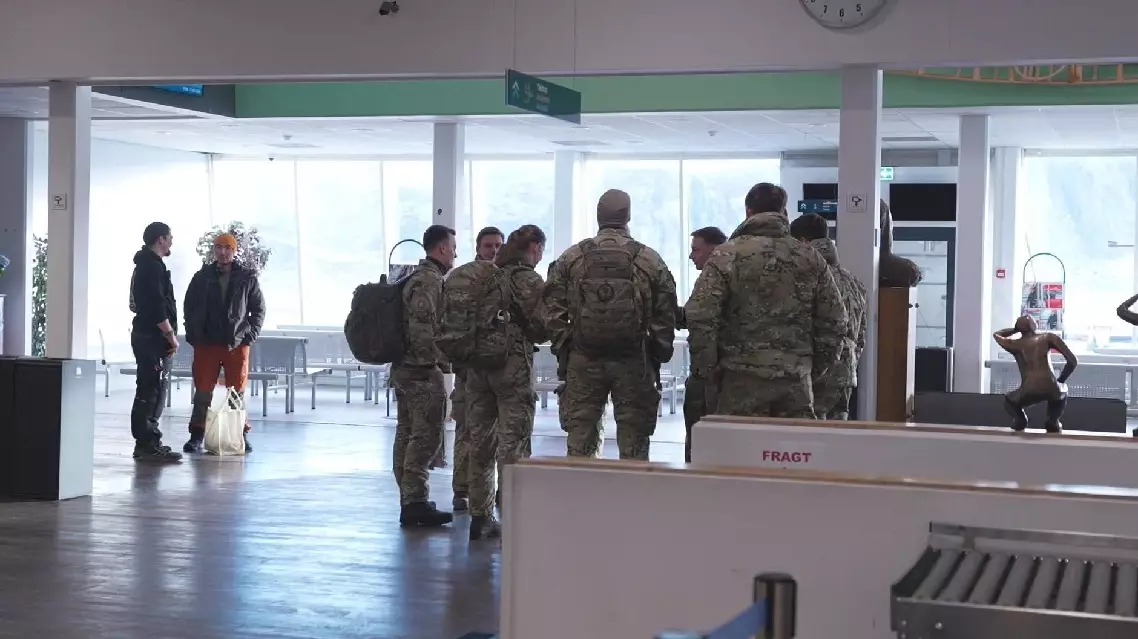
Greenlanders concerned over Trump's threat as NATO allies build up military in Kangerlussuaq