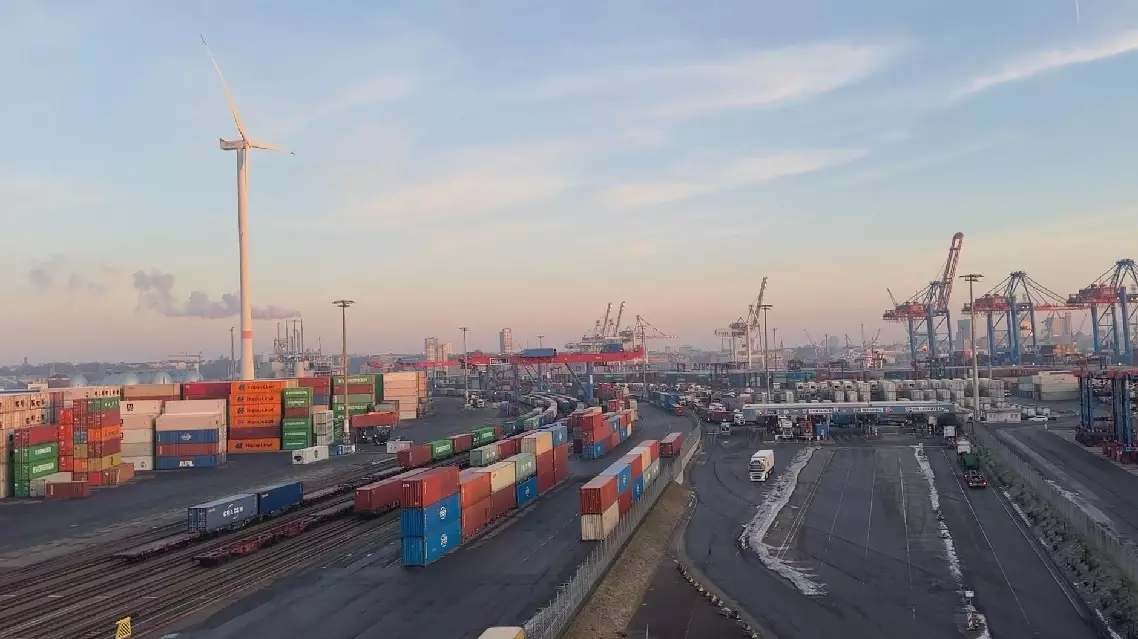
In the biting cold of northern Germany, Chinese company employee Song Liyong headed to the Port of Hamburg to supervise the unloading of offshore wind turbine castings ordered by Siemens.
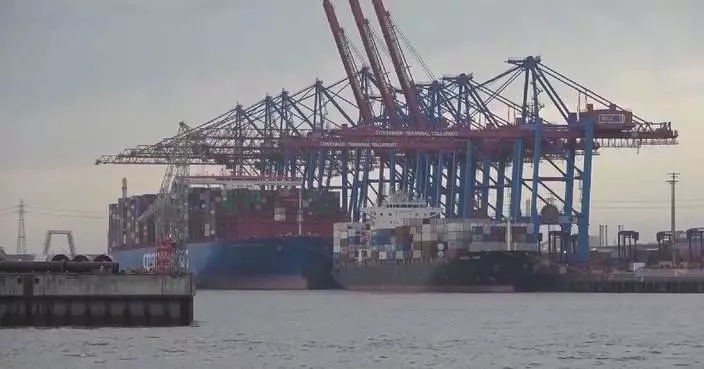
The the Port of Hamburg is the largest integrated seaport in Germany. As the cooperation between Chinese companies and the port gets closer in recent years, nearly 30 percent of cargo passing through its terminals is linked to China.
"We go to the port today, as I have a project, which is imports of offshore wind turbine parts for Siemens. I have to go there to oversee the unloading. The cargo weighs 55 tons, and normally a standard container load is no more than 40 tons. This cargo is more than five meters wide, over six meters long, and nearly seven meters high," said Song Liyong, an employee of a Chinese enterprise in Hamburg.
China has been its largest trading partner for many years in a row. In 2025 -- the year marked the 50th anniversary of the establishment of China-EU diplomatic relations, China overtook the United States to become Germany's largest trading partner.
The shift reflects how Chinese exports have evolved: once dominated by shoes, textiles and furniture, they now center on electric vehicles, lithium batteries and solar panels.
Fu Jinsong, deputy general manager of the Chinese firm, said the transformation has been striking.
"In recent 10 or 20 years, China's exports have increasingly been technology-intensive products. It's no longer like in the early days, when 'Made in China' meant mainly labor-intensive goods. Chinese products have been tested in terms of quality and usability. Facts have proven that their quality is very good and the products are highly useful," said Fu.
For Song, who has worked at the port for more than 20 years, the change is tangible.
"We used to export shoes, hats, and textiles. Now our exports are mainly machinery, large items and many equipment. In this regard, we as Chinese working overseas, are proud of our country's development," said Song.
At the port's operations area, Song coordinated with colleagues to unload the oversized turbine castings and transfer them onto barges along the Elbe for delivery to the customer's assembly site in the most economical and efficient way.
Some pieces weighed up to 80 tonnes, requiring floating cranes for the job.
By evening, the Elbe glowed with a winter sunset as Song wrapped up his shift, and joined colleagues for a dinner for an early celebration of Chinese New Year.
Despite the seven-hour time difference with China and the 8,000 kilometers separating Hamburg from home, the festive atmosphere was unmistakable.
"I have to say that China has undergone tremendous and fascinating development, and I hope that it can maintain the development momentum in the new year," said William Mayer, one of Song's German coworkers.
Port of Hamburg witnesses development of China-Germany trade