In the days leading up to the Spring Festival, cities across China have hosted a vibrant array of performances featuring folk art and traditional opera, building the festive atmosphere to a crescendo.
A dance drama centered on the relocation and reconstruction of Yongle Palace in the 1950s is currently on tour in cities including Wuhan, Shanghai, and Hangzhou.
Yongle Palace, built in Yuan Dynasty (1271-1368), is located in Ruicheng County of Yuncheng, a city in north China's Shanxi Province.
Through graceful choreography, the dance drama brings to life the artistic essence of the palace's murals, masterpieces of the Yuan Dynasty, offering audiences an artistic dialogue across time and immersing them in the timeless allure of China's cultural heritage.
An upgraded version of the dance drama "Tianxia Dazu" recently concluded its run in southwest China's Chongqing Municipality. It interprets the cultural depth of the Dazu Rock Carvings -- a UNESCO World Heritage Site in Chongqing -- through exquisite dance, conveying wishes for prosperity and harmony for all.
"A Tapestry of a Legendary Land," a theatrical piece for children inspired by the famous landscape scroll painting "Qian Li Jiang Shan Tu," or "A Thousand Miles of Streams and Mountains," is now being performed in cities including Wuhan and Chongqing.
The painting, from the Northern Song Dynasty (960-1126), is the only surviving work of prodigy court painter Wang Ximeng. It depicts a panoramic view of mountains and rivers and is celebrated as a hallmark of blue-green landscape painting, a style that uses mineral-based pigments like malachite (green) and azurite (blue) to create bold, vibrant colors.
Zhejiang Province in east China has also seen a surge in cultural performances. A new adaptation of the classic tragedy "Southeast Fly the Peacocks" -- based on a legendary love story from the late period of Eastern Han Dynasty (25-220AD) -- recently premiered at the Hangzhou Grand Theatre. The play weaves together three interlocking timelines to trace the emotional bond between Jiao Zhongqing and Liu Lanzhi, striking a chord with younger audiences.
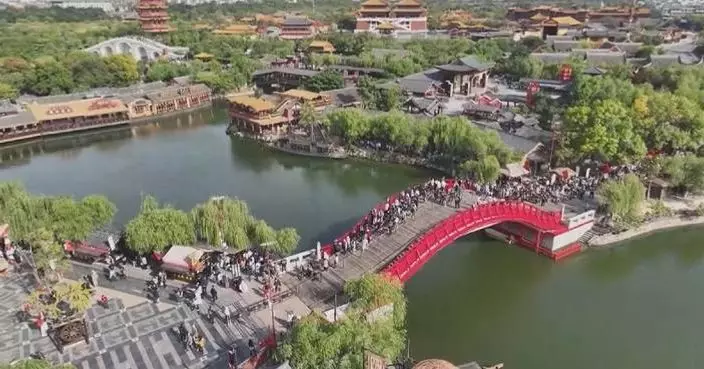
In Zhejiang's Changshan County, an immersive drama featuring culture and tourism titled "On the Road to Quzhou" -- inspired by a classical poem depicting the local landscape -- transports audiences on a journey back to the Song Dynasty (960-1279).
"I brought my child to the North Gate Historical and Cultural District today, and we experienced this incredibly fun and immersive performance. It really felt like we had traveled back to ancient times," said Luo Sasa, an audience member.
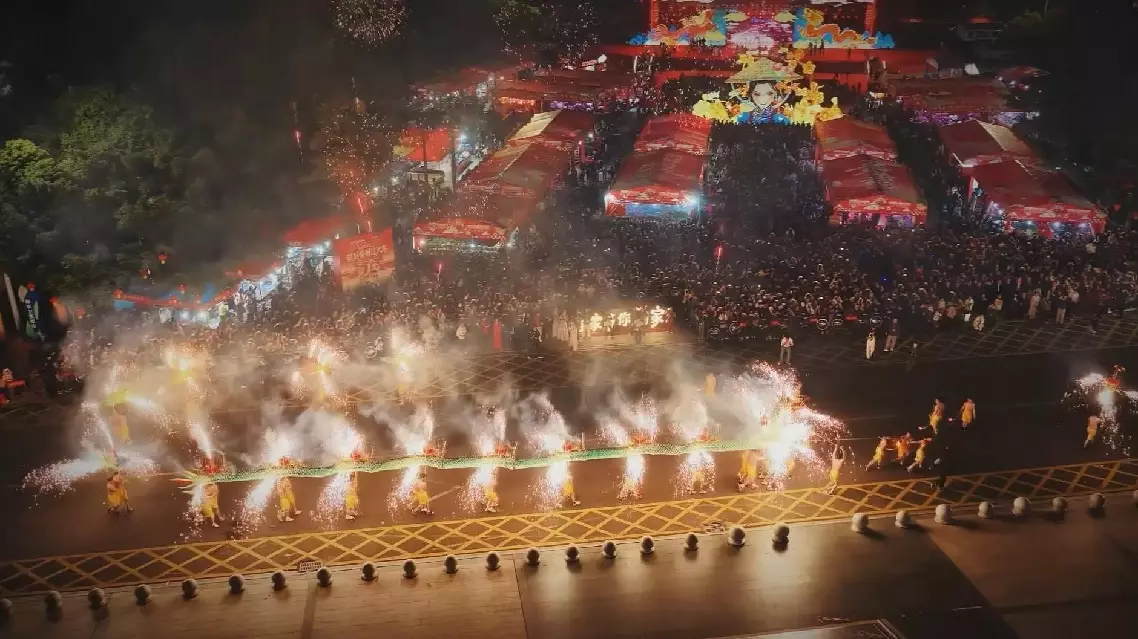
In Meizhou City, south China's Guangdong Province, local residents celebrated by performing the fire dragon dance and igniting sparks, praying for favorable weather, abundant harvests, and peace in the coming year. The dragon's sinuous form, set against a backdrop of dazzling sparks, created a spectacular scene in the night sky.
This traditional folk art is known as the Puzhai fire dragon dance, which was recognized as a national intangible cultural heritage of China in 2008.
In addition, in the cosmopolitan metropolis of Shanghai -- a city where tradition and modernity converge -- locals are embracing the New Year in distinctive ways, with technology taking center stage.
A robotics cultural carnival that kicked off in Putuo District has brought together more than 300 robots, each with unique functions. The event features multiple interactive experience zones and 11 robotics competitions, offering visitors and residents an immersive journey into cutting-edge technologies.
Spring Festival spirit sweeps China as cities host vibrant cultural performances