China's Shenzhou-21 crew members carried out a series of key tasks aboard the Tiangong space station over the past week, including scientific experiments, station upkeep, and equipment maintenance.
The mission is seen as crucial for advancing long-duration spaceflight and strengthening China's role in global space research, according to the China Manned Space Agency (CMSA).
The crew, consisting of mission commander Zhang Lu and astronauts Wu Fei and Zhang Hongzhang, have spent more than three months in orbit, and they will celebrate the Spring Festival in space.
The Spring Festival, also known as the Chinese New Year, falls on Feb 17 this year and represents the most important holiday for Chinese people.
In the core module, the crew used the metacognitive training system to complete image recognition and operational tests in various initial conditions.They conducted a microgravity intuitive-physics experiment with onboard laptops, collecting behavioral data to examine how extended spaceflight affects instinctive physical representations and recovery mechanisms.
The astronauts engaged in close interaction with their old friend aboard the space station, the intelligent robot "Xiaohang." Through collaborative human-machine interface software, they worked alongside "Xiaohang" to conduct experiments on spatial relationships and multi-modal interaction techniques, exploring ways to optimize human-robot collaboration in space.
The astronauts also participated in a research related to musculoskeletal stress during exercise. Using equipment such as plantar pressure sensors and patch-type ultrasound devices, they collected data on foot pressure, joint kinematics, exercise imagery, and relevant muscle parameters during different running intensities in flight, aiming to establish the mapping relationship between different movement parameters and plantar pressure, as well as to understand the changing characteristics of muscle-tendon interactions.
In a related study, the crew wore specialized biomimetic adhesive shoes to perform lower-limb force stimulation tests, with data collected to explore muscle function retention capabilities.
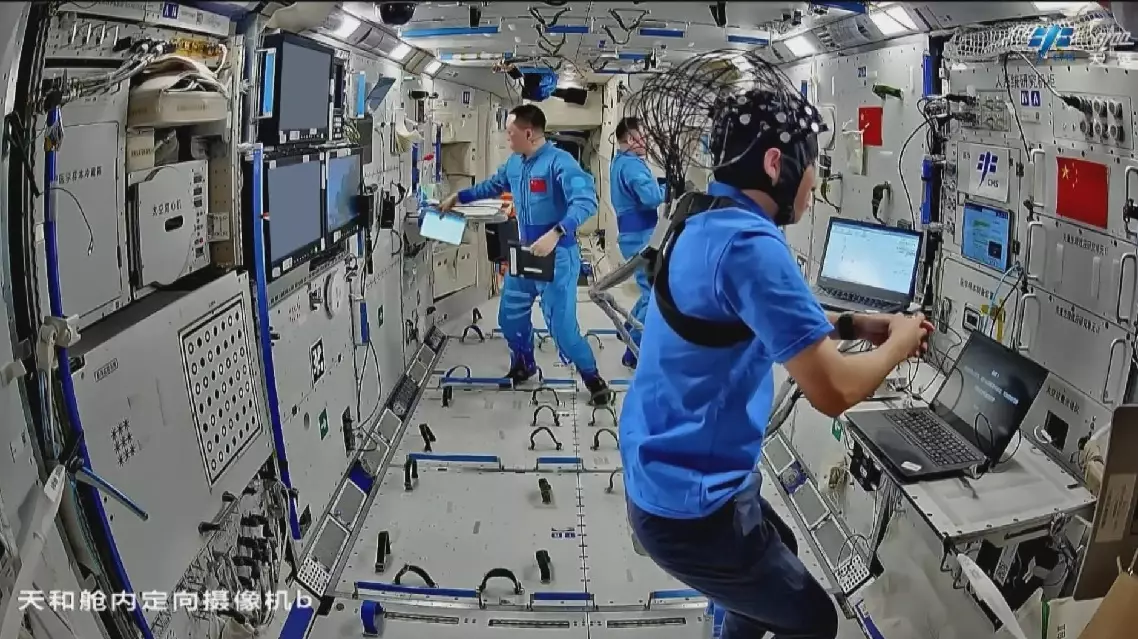
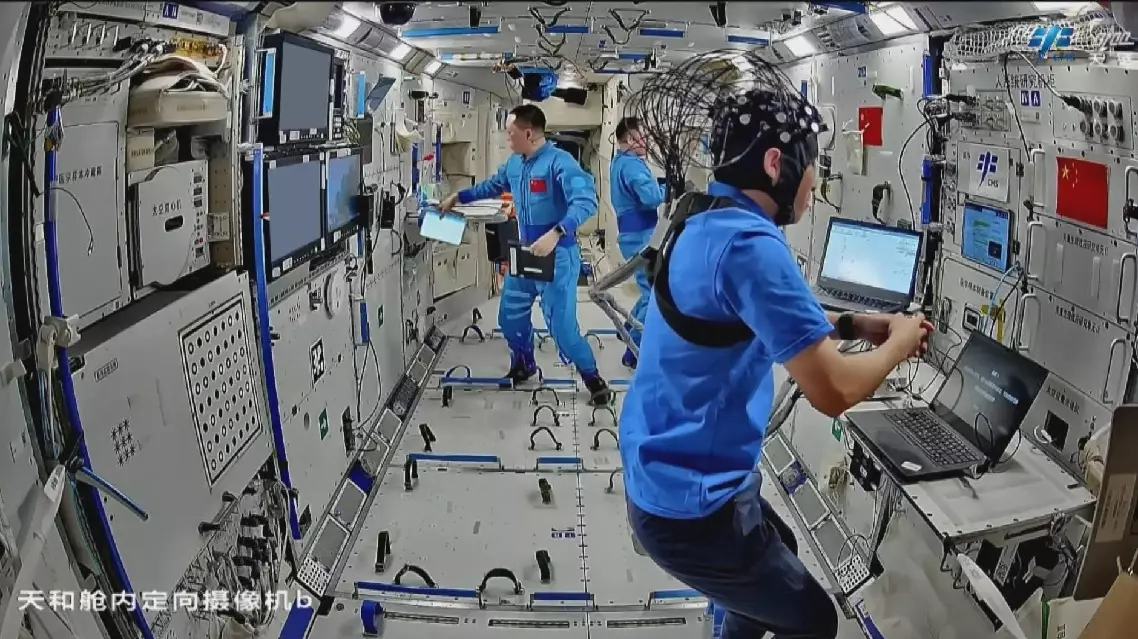
The crew advanced the in-orbit electroencephalogram (EEG) tests as scheduled. They conducted experiments on the time-varying characteristics of brain networks in space using near-infrared brain functional imaging equipment.
They investigated the effects of long-term spaceflight environments on astronauts' brain functional networks, as well as the brain's spontaneous adjustment and adaptation mechanisms in response to external environmental changes.
In the field of microgravity physics, the astronauts completed multiple tasks, including replacing experimental samples in the fluid physics cabinet, swapping out experimental plug-ins in the combustion cabinet, and cleaning experimental chamber samples in the containerless cabinet.
They also completed maintenance of the regenerative life support system equipment, performed cabin environment cleaning and upkeep, and replaced the cabin foot restraints.
Shenzhou-21 crew advances key spaceflight research on Tiangong
Shenzhou-21 crew advances key spaceflight research on Tiangong
South China's Guangdong Province is accelerating its transformation into an international medical tourism hub, positioning itself as a destination for patients worldwide seeking affordable, high-quality care.
The push follows a joint initiative announced in late March by nine Chinese government departments, including the Ministry of Commerce, aimed at boosting spending by foreign tourists and enhancing exports of tourism services as part of broader efforts to expand the country's service sector.
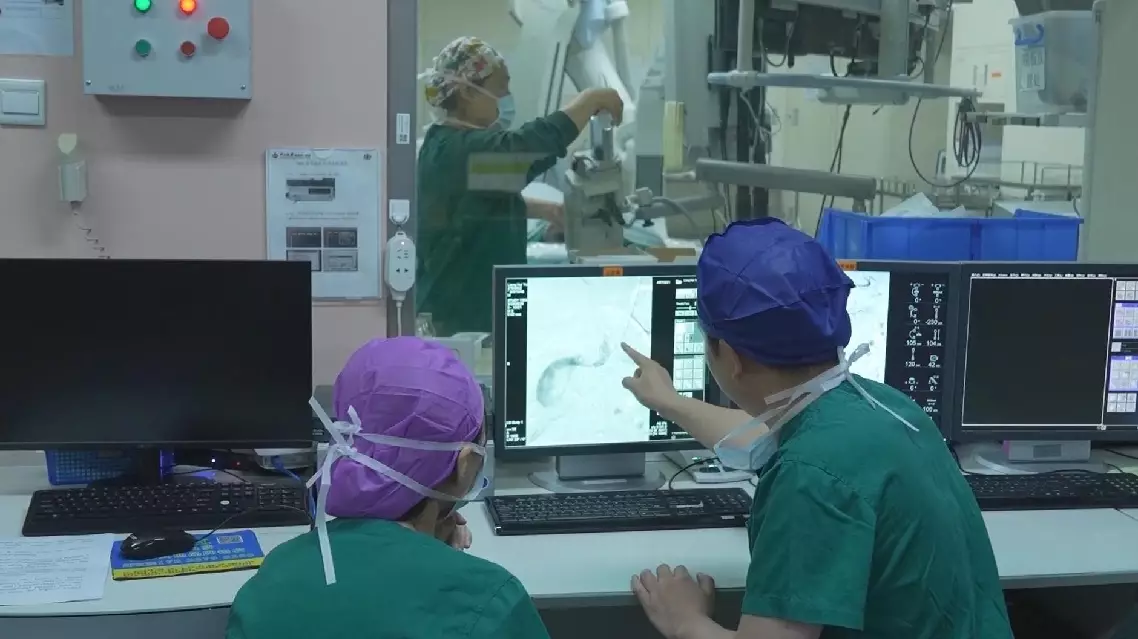
Every day, some of the most complex surgeries are performed here. Li Zilun, deputy director of the division of vascular surgery at the First Affiliated Hospital of Sun Yat‑sen University, is among the doctors capable of carrying out these intricate procedures.
He recently completed surgery on a patient with an aortic aneurysm, a condition often described as a "time bomb" in the body’s main artery, increasingly common in aging societies around the globe. Li also specializes in highly difficult and pioneering procedures, including repairing leaks caused by failed grafts.
"This was a very challenging case. And then, we implanted the covered stent to eliminate the endoleak. Actually, the outcome was pretty good. The patient will be discharged today," said Li Zilun.
The ability to handle such complex cases -- combining international techniques with domestically produced devices -- is drawing patients from around the world to seek treatment. In addition, high safety standards and low costs are also major draws.
"Our government is encouraging innovation. So, lots of physicians -- including our vascular surgeons -- we are actively involved in the innovation that helps to increase the effectiveness and safety, and also bring down the cost," said Li.
This hospital is one of the first in Guangdong to be designated by the provincial health commission as a pilot site for building an international medical service hub.
The growing number of patients has pushed the hospital to explore new ways to transform every step -- from treatment to payment and everything in between -- into a seamless experience, reducing waiting times and delivering better care for patients.
"I think it's fast. When the patient come here for just about, I think, one week, you can solve the problem," said Xiao Haipeng, president of the First Affiliated Hospital of Sun Yat-sen University.
The hospital is also deepening its international cooperation with top-tier medical institutions, including those at Harvard University.
"Not just for China, for the whole globe, we are facing health care challenges -- emerging infectious disease and chronic, lung infectious diseases, and also the aging population, also the shortage of healthcare workforce," said Xiao.
In response to these challenges, China is promoting its own solutions, including aggressive innovation in artificial intelligence (AI)-driven workflows, while stepping up research and development investment and global engagement along the way.
"In recent years, the innovation in Western medicine is dramatically growing. An example of my hospital -- in the past few years, we have 140 innovations and seven of them are international leading innovations," said Xiao.
As global demand for medical tourism grows, China is positioning itself as a new destination. Official data shows that the number of foreign patients in Guangdong increased by 20 percent last year. Among them, the growth in inpatient admissions was even faster, rising by 76 percent.
Guangdong fast-tracks pilot for int'l medical service hub