Conservationists at Dongting Lake in Yueyang, central China's Hunan Province, are working dedicatedly to ensure a record number of migratory birds can safely spend the cold season at the wetland this year.
As the country celebrates the Chinese New Year, the lake has also become more alive with flocks of migratory arriving from Siberia, while Chen Xinkai, a 59‑year‑old veteran conservationist at South Dongting Lake Nature Reserve, marked his last Spring Festival spent on duty before retirement.
At dawn, Chen started up his mud-splattered pickup truck, his loyal companion through years of patrols across the sprawling wetlands.
"I drive 100 kilometers a day on average, adding up to over 30,000 kilometers a year, all within this reserve," said Chen.
The wetland Chen and his team protect spans over 100,000 hectares, serving as a vital stopover on the East Asian-Australasian migratory route. Each autumn and winter, more than 200 bird species, including Siberian white cranes and lesser white-fronted geese, rest and overwinter here.
Growing up by Dongting Lake, Chen remembers when locals relied on the lake for their livelihoods, from reed harvesting to cattle grazing and poplar planting. But as ecological protection efforts advanced, Chen realized the importance of conservation. In 2018, he made a career change to become a full-time migratory bird protector. Despite the hardships, he has remained committed for eight years.
Chen's patrol team includes his son, Chen Yu. In 2021, Chen Yu returned home from working out of town and, inspired by his father, joined the patrol.
"I saw him patrolling with stomach medicine and hypertension pills. I wondered how he could persist like this. But when I saw the sky filled with swans, Oriental storks and other birds, I was amazed. Now that my father is about to retire, I want to take over and protect Dongting Lake's ecosystem," said Chen Yu.
Patrol work changes with the seasons. In summer, when the lake swells, birds gather in open waters and patrols are done by speedboat. In winter, as water recedes and mudflats emerge, the team must drive and boat into every corner. Vehicle breakdowns and boats running aground are common, and wading through marshes is perilous.
Fortunately, technology has boosted their efforts. Drones now greatly improve patrol efficiency. During one patrol, a drone spotted a young swan trapped in the water.
Chen quickly led his team to the scene, carefully wading into the lake to cut away the net tangled around the swan's wing.
Chen explained that most of these nets were left behind before the comprehensive 10-year fishing ban implemented in the Yangtze River Basin. Despite cleanup efforts, some remain buried and hard to detect. Patrol members must search meticulously, removing nets whenever they find them. The rescued swan was then transported over 80 kilometers to the Yuanjiang Forestry Bureau for treatment.
As night fell, Chen and his team returned to the wetlands for another patrol. Using drones in thermal imaging mode, they watched flocks of birds settling in for the night.
"The main migratory birds now are bean geese, swan geese, greylag geese, and whooper swans. The improved environment gives them plenty of food and resources, they love staying here," said Chen.
Over eight years, Chen has witnessed great changes from solitary, on-foot patrols to integrated land-and-air monitoring with technological support. Bird expert Niu Yandong, who has long observed the area, said that the number of overwintering waterbirds at Dongting Lake has reached a record high of over 470,000 this year.
"Unlike previous years, the birds are now spread across more suitable habitats, which increases the workload for the patrol team. Grassroots protectors are an indispensable link in the chain of migratory bird conservation," said Niu, an expert at the Hunan Academy of Forestry.
As Chen prepares for retirement, he has repeatedly advocated for more high-altitude monitoring equipment at key lake locations. Just before the Chinese New Year, his wish was granted, with several new devices being installed and tested.
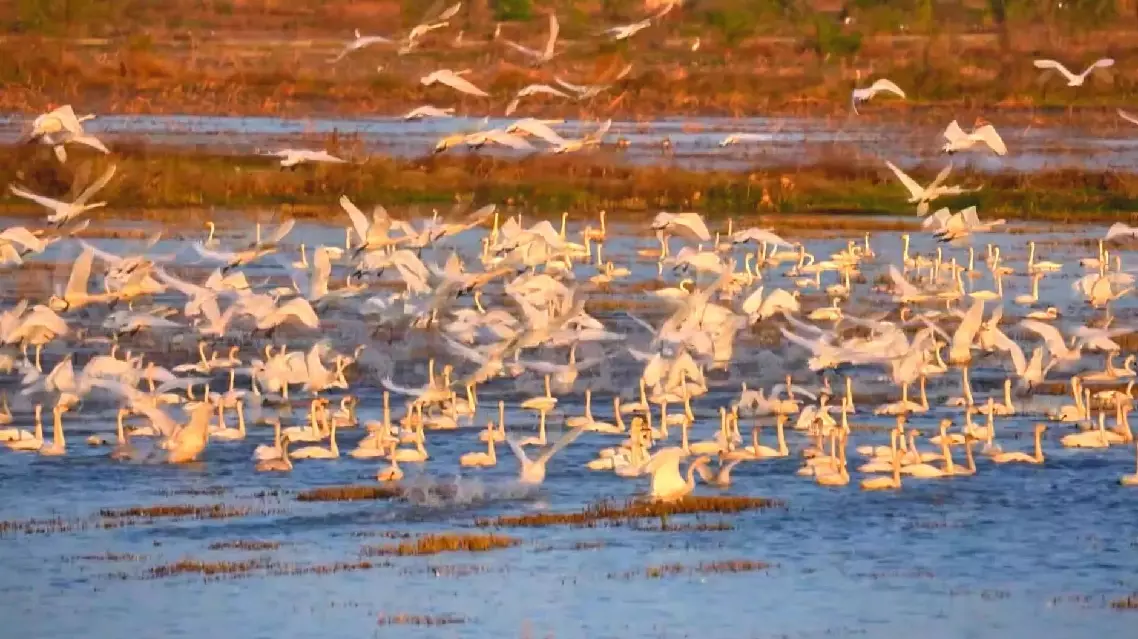
Chinese conservationists work dedicatedly to ensure safe winter for record migratory bird populations