People of the Tibetan ethnic group marked the first day of the Tibetan Fire Horse New Year on Wednesday with lively cultural performances.
The Tibetan New Year, or Losar, is the most significant celebration for people of the Tibetan ethnic group. This year, it coincides with the Spring Festival, which fell on Tuesday and ushered in the Year of the Horse, the seventh animal in the 12-year cycle of the Chinese zodiac.
In Kangding City of Garze Tibetan Autonomous Prefecture in western Sichuan Province, local residents celebrated the Tibetan New Year with colorful parades and folk performances. A series of performances including Tibetan operas, folk dances, and music performed on traditional instruments, took to the stage, winning warm applauses from locals and visitors.
Meanwhile, in Gannan Tibetan Autonomous Prefecture, northwest China's Gansu Province, local families dressed in festive attire gathered to share festive delicacies. They danced together while performing traditional Tibetan Balang drums, an intangible cultural heritage item of Gansu Province, to pray for peace and well-being in the coming year.
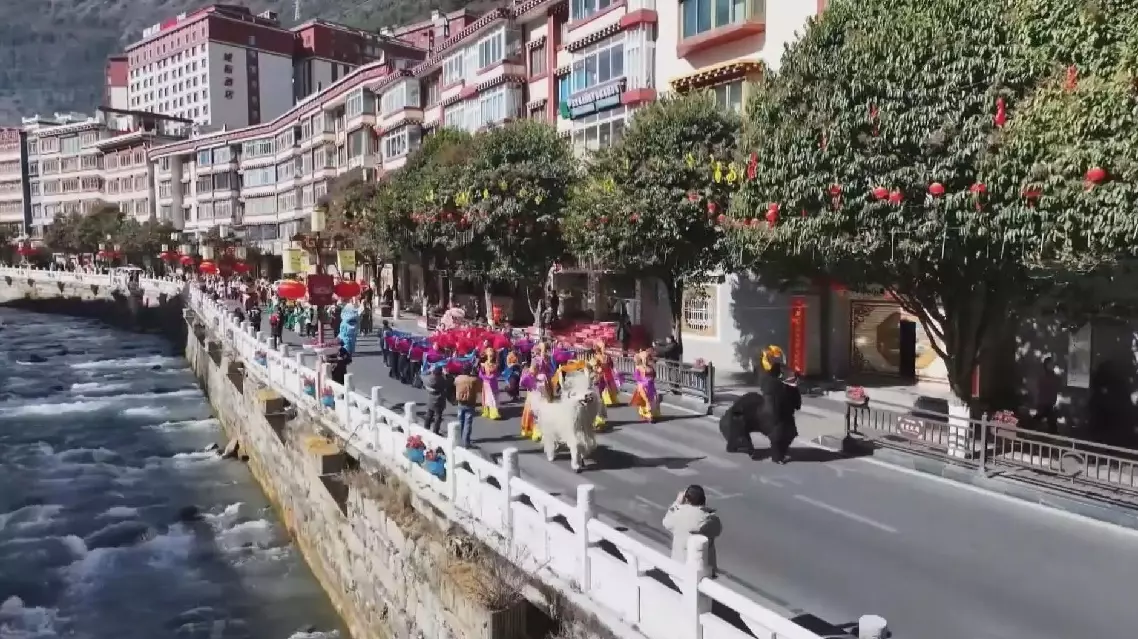
People of Tibetan ethnic group celebrate New Year
Police in Shenzhen City of south China's Guangdong Province have deployed 24-hour drone patrols around the Shenzhen Sports Center to enhance public safety control during the 2026 Chinese Super League season.
The Shenzhen Xinpengcheng Football Club has officially made the Shenzhen Sports Center its home ground for the 2026 Chinese Super League season. Football matches have attracted more than 10,000 fans per match, leading to intense crowd density and severe traffic congestion, which places immense pressure on security.
Amid the excitement of tens of thousands, the calmest "guards" aren't in the stands, but stationed over 100 meters above, in the sky.
Before a match began, police officer Wang Yiyuan and two teammates would be already deployed with well-defined roles: one would pilot the drones, another would keep an eye on the spectrogram to monitor the drone activity, and the third would coordinate with other ground police via his walkie-talkie.
Just before the end of the second half, a sudden alert for crowd flow popped up at the south square, where a large number of spectators had begun to gather as they leave the site. As this area served as the only passage for leaving the stadium, the crowd pressure could easily lead to a stampede.
From the initial alert to the loudspeaker broadcast and then to the arrival of police reenforcements on the scene, it took Wang and his colleagues just three minutes to complete the communication, and the crowds began to disperse.
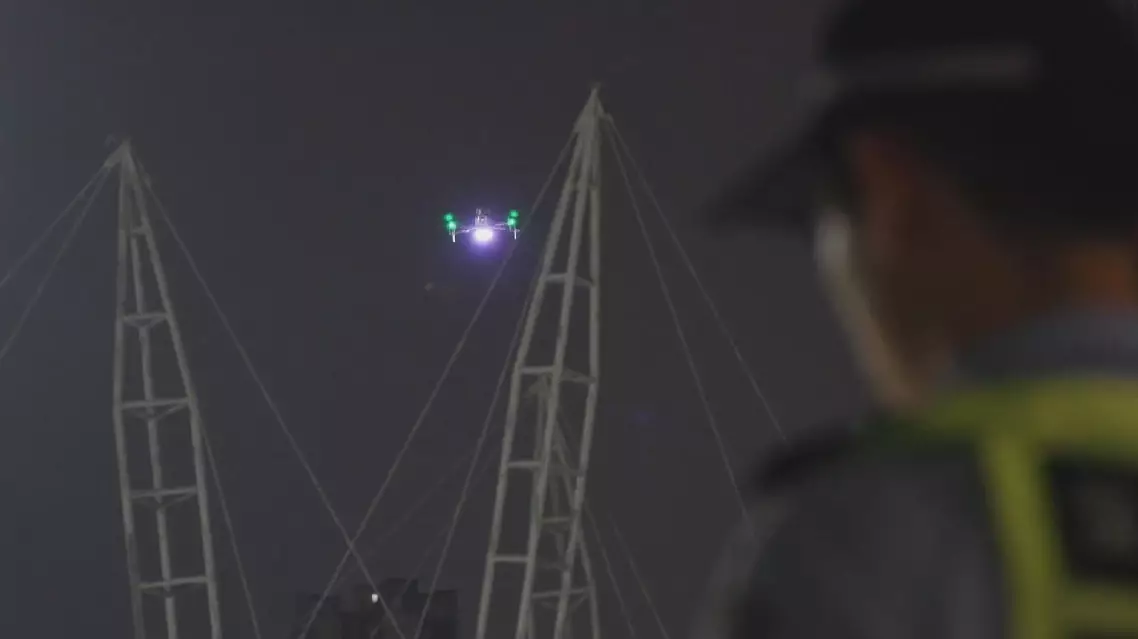
Police deploy 24-hour drone patrols during football matches in south China's Shenzhen
Police deploy 24-hour drone patrols during football matches in south China's Shenzhen