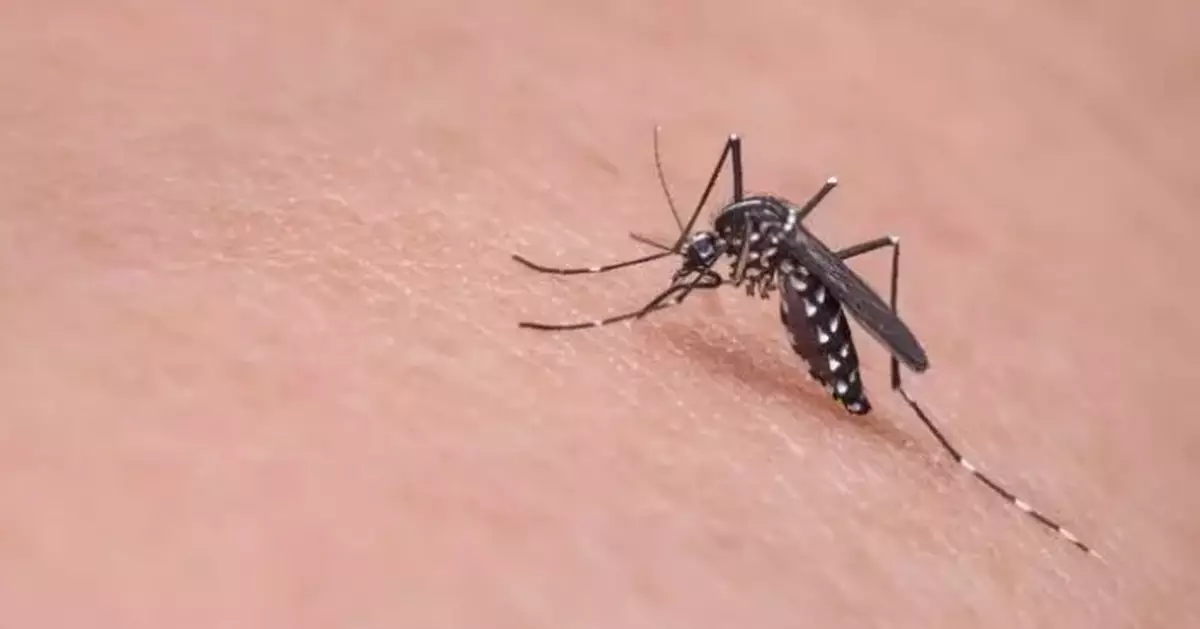
FEHD releases fourth batch of gravidtrap indexes for Aedes albopictus in February
The Food and Environmental Hygiene Department (FEHD) today (February 23) released the fourth batch of gravidtrap indexes and density indexes for Aedes albopictus in February, covering 13 survey areas, as follows:
District
Survey Area
February 2026
First Phase Gravidtrap Index
First Phase Density Index
Central and Western
Kennedy Town and Shek Tong Tsui
0.0%
N/A
Sha Tin
Ma On Shan
0.0%
N/A
Tuen Mun
Tuen Mun South
0.0%
N/A
District
Survey Area
February 2026
Area Gravidtrap Index
Area Density Index
Eastern
Shau Kei Wan and Sai Wan Ho
0.0%
N/A
Wan Chai
Happy Valley and Tai Hang
0.0%
N/A
Islands
Tung Chung
0.0%
N/A
Kowloon City
Ho Man Tin
0.0%
N/A
Kowloon Tong
1.7%
1.0
Sham Shui Po
Cheung Sha Wan
0.0%
N/A
Yau Tsim
Tsim Sha Tsui and Yau Ma Tei
0.0%
N/A
North
Sheung Shui
0.0%
N/A
Tsuen Wan
Ma Wan and Sham Tseng
0.0%
N/A
Yuen Long
Yuen Long Town
0.0%
N/A
Among the fourth batch of First Phase Gravidtrap Indexes covering three survey areas and Area Gravidtrap Indexes covering 10 survey areas in February, most of the areas recorded 0 per cent, indicating that the distribution of Aedes albopictus mosquitoes was not extensive.
The FEHD has so far released four batches of gravidtrap indexes for Aedes albopictus in February 2026, covering 51 survey areas. Among these 51 survey areas, 50 recorded a decrease or remained unchanged in the individual gravidtrap index as compared to the Area Gravidtrap Index last month, i.e. January 2026, representing that the areas' mosquito infestation improved or maintained a low level. Only one area recorded a slight increase, but the index was lower than 10 per cent.
The eggs of Aedes albopictus can withstand long periods of desiccation and will hatch when the temperature becomes suitable and water is present. Members of the public should continue to take mosquito control measures during winter to eliminate mosquito eggs.
Public participation is crucial to the effective control of mosquito problems. The FEHD appeals to members of the public to continue to work together in strengthening personal mosquito control measures, including:
- tidy up their premises and check for any accumulation of water inside their premises;
- remove all unnecessary water collections and eliminate the sources;
- check household items (those placed in outdoor and open areas in particular), such as refuse containers, vases, air conditioner drip trays, and laundry racks to preventstagnant water;
- change the water in flower vases and clear the water in saucers of potted plants at least once every seven days;
- properly cover all containers that hold water to prevent mosquitoes from accessing the water;
- properly dispose of articles that can contain water, such as empty lunch boxes and cans; and
- scrub drains and surface sewers with alkaline detergent at least once a week to remove any mosquito eggs.
Starting in August 2025, following the completion of the surveillance of individual survey areas, and once the latest gravidtrap index and the density index are available, the FEHD has been disseminating relevant information through press releases, its website and social media. It aims to allow members of the public to quickly grasp the mosquito infestation situation and strengthen mosquito control efforts, thereby reducing the risk of chikungunya fever (CF) transmission.
Following recommendations from the World Health Organization and taking into account the local situation in Hong Kong, the FEHD sets up gravidtraps in districts where mosquito-borne diseases have been recorded in the past, as well as in densely populated places such as housing estates, hospitals and schools to monitor the breeding and distribution of Aedes albopictus mosquitoes, which can transmit CF and dengue fever. At present, the FEHD has set up gravidtraps in 62 survey areas of the community, with a surveillance period of two weeks. During the surveillance period, the FEHD will collect the gravidtraps once a week. After the first week of surveillance, the FEHD will immediately examine the glue boards inside the retrieved gravidtraps for the presence of adult Aedine mosquitoes to compile the Gravidtrap Index (First Phase) and Density Index (First Phase). At the end of the second week of surveillance, the FEHD will instantly check the glue boards for the presence of adult Aedine mosquitoes. Data from the two weeks of surveillance will be combined to obtain the Area Gravidtrap Index and the Area Density Index. The gravidtrap and density indexes for Aedes albopictus in different survey areas, as well as information on mosquito prevention and control measures, are available on the department's webpage (www.fehd.gov.hk/english/pestcontrol/dengue_fever/Dengue_Fever_Gravidtrap_Index_Update.html#).

Photo source: reference image
Court of Appeal delivers judgement on appeals of conspiracy to commit subversion case
The Court of Appeal of the High Court today (February 23) delivered its judgment on the appeals in a case of "conspiracy to commit subversion", dismissing the appeals against conviction or sentence lodged by 12 defendants. Furthermore, with regard to one defendant against whom the evidence was insufficient for the trial court to be sure of his participation in the conspiracy offence, the Court of Appeal upheld the trial court's verdict.
The Court of Appeal, in its judgment on the appeals in this case, rejected each of the grounds of appeal against conviction or sentence raised by the respective defendants. With regard to the appeals against conviction, the Court of Appeal noted that the relevant provisions of the Basic Law establish an executive-led system headed by the Chief Executive (CE), recognises that the CE, the Government, the Legislative Council (LegCo), and the Judiciary have different constitutional roles. Interaction and co-ordination between them is inevitable in areas where both the executive and legislative authority are required. As seen from the budgetary process, examining the merits of a budget by reference to fiscal considerations to see if it warrants approval must form the core of the LegCo's powers and functions under Article 73(2) of the Basic Law. The LegCo must exercise its powers and functions in accordance with, and not in contravention of, the provisions of the Basic Law. In particular, it cannot act in contravention of the fundamental provisions of the Basic Law which establish the constitutional order in the Hong Kong Special Administrative Region (HKSAR), and the LegCo members cannot contravene the constitutional duty to uphold the constitutional order in the HKSAR under the LegCo Oath. In this case, as envisaged and publicised by the first defendant Tai Yiu-ting and known to any participant who chose to join it, the "Project 35+" was a "constitutional mass destruction weapon" aiming to compel the CE to resign, to paralyse the Government and to force the Central People's Government to declare an end to the "one country, two systems" policy, which constituted an unlawful means of subverting the constitutional order of the HKSAR. Pursuing that aim in the pretext of examining budgets necessarily amounted to a breach of a LegCo member's duty to uphold the constitutional order in the HKSAR. The defendants agreed to join the "Project 35+" and participate in the relevant course of conduct with the intent to achieve the subversive consequences, and therefore constituted the offence of "conspiracy to commit subversion".
The Court of Appeal also considered that the trial court was entitled to make the impugned findings based on the totality of the evidence adduced. With all the evidence considered in context, the conclusions that each defendant was a party to the conspiracy could not be faulted. The Court of Appeal further held that there was no unfairness in the conduct of the trial proceedings.
Regarding the appeals against sentence, the Court of Appeal pointed out that the trial court's categorisation of all defendants who ran for the "primary election" as "actively participants" could not be faulted. The goal of the "Project 35+" was to cause havoc to the constitutional order in the HKSAR, by getting the concerned defendants elected. The Court of Appeal further pointed out that the defendants exploited the system in such a way intending to bring about potentially devastating consequences to the HKSAR. Therefore, "ignorance of the law" was not a valid mitigating factor in this case. All the discounts that had been given by the trial court under this head must be regarded as entirely gratuitous.
A spokesman for the HKSAR government said, "45 defendants have been convicted in this case. The trial court pointed out clearly in its reasons for verdict handed down earlier that by March and April 2020, the ultimate aim and purpose of the so-called 'Project 35+' had been very clear and made known to the public, which was to undermine, destroy or overthrow the existing political system and structure of the HKSAR established under the Basic Law and the 'one country, two systems' principle. The court pointed out that the defendants, led by Tai Yiu-ting, have invested a great deal of time and money in premeditating and planning the so-called 'primary election'. The other defendants all participated actively and made every effort to ensure the success of the 'Project 35+'. Had the plan been fully implemented, it would have given rise to profoundly far-reaching negative consequences, the severity of which would have been no less than the overthrow of the HKSAR Government."
"During the trial, it was revealed that the persons concerned put forward the '10 Steps to mutual destruction' which would bring Hong Kong society to a standstill through large-scale street riots and other means at the same time. Coupled with international political and economic sanctions, 'mutual destruction' would be achieved, causing suffering to members of the public. The severity of the crime in this case was supported by irrefutable evidence. The convicted individuals deserved their punishment. The Court of Appeal's dismissal of relevant appeals against conviction and sentence demonstrates that any person who intends to commit subversion and endanger national security will be punished in accordance with the law."
"As for the decision to uphold the verdict of a defendant against whom the evidence was insufficient for the trial court to be sure of his participation in the conspiracy, the Department of Justice will study the judgment carefully and consider whether to lodge an appeal."
The spokesman pointed out, "Hong Kong is a society underpinned by the rule of law. The Hong Kong National Security Law (HKNSL) and the Safeguarding National Security Ordinance (SNSO) clearly stipulate that the principle of the rule of law shall be adhered to in preventing, suppressing and imposing punishment for offences endangering national security. The court’s judgment in this appeal case shows that the Judiciary of the HKSAR exercises judicial power independently in accordance with the law, and everyone charged with a criminal offence will receive a fair trial strictly in accordance with laws applicable and as protected by the Basic Law and the Hong Kong Bill of Rights. The courts decide cases strictly in accordance with the evidence and all applicable laws. Cases will never be handled any differently owing to the profession, political beliefs or backgrounds of the persons involved. The prosecution has the burden to prove beyond reasonable doubt the commission of an offence before a defendant may be convicted by the court."
"Safeguarding national security is the inherent responsibility of every citizen. The HKSAR Government is resolutely determined to crack down on acts and activities that endanger national safety, ensuring that laws are observed and strictly enforced, so as to bring offenders to account. The HKSAR Government will, as always, resolutely, fully and faithfully implement the HKNSL, the SNSO and other relevant laws safeguarding national security in the HKSAR, to effectively prevent, suppress and impose punishment for acts and activities endangering national security in accordance with the law, while upholding the rights and freedoms of Hong Kong people in accordance with the law, to ensure the steadfast and successful implementation of the principle of 'one country, two systems'."

Source: AI-found images