Skip to Content Facebook Feature Image

Remote village residents in Yunnan earn better life as ethnic tradition meets fashion

China

China

China

Remote village residents in Yunnan earn better life as ethnic tradition meets fashion

2026-02-23 17:50 Last Updated At:02-24 01:17

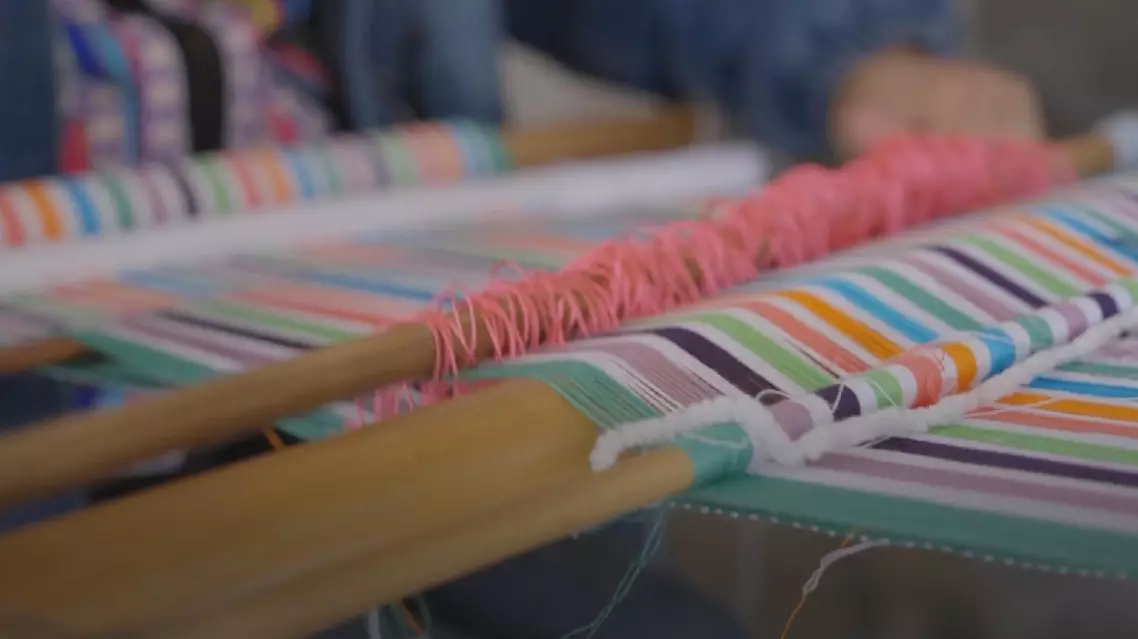
Women from one of China's smallest ethnic groups are improving their livelihoods through traditional Dulong weaving techniques that have been passed down for generations.

The practice is carrying on strong in Dulongjiang, a remote township deep in the southwestern borderlands of China's Yunnan Province and home to around 4,000 members of the Dulong ethnic group.

Although Dulongjiang shook off extreme poverty in 2018 during China's nationwide campaign, its future remains a challenge. With limited arable land and deep isolation, large-scale farming is not viable, and industrial development is difficult to sustain.

However, the tradition of Dulong weaving has become a beam of light, changing the villages once geography-defined destiny. The women who practice the craft have been dubbed "the rainbow weavers." They embrace the concept of weaving deliberately, or "naze naze", which in their language means "slowly."

Recently, a group of designers from a Shanghai-based fashion house visited villager Jin Chunhua's home, to discuss business. Their collaboration with the weavers began in 2015, and Jin was among the first 10 women to join.

"By a coincidence, we discovered that Dulong women were still weaving at home, making clothes or decorations for furniture," said Tu Jiachen, Naze Naze content specialist for Shanghai Suran Brand Management Company.

"We saw their skills could work with our fashion company. They know their techniques best. We work with their fabric, and bring it to a larger market," said product specialist Shao Ruowen.

After that, the fabric began traveling far beyond the mountains, to distant cities, and even to customers overseas.

"At that time, I went from house to house, notebook and pen in hand, convincing other women to join," said Jin.

One by one, more women picked up the loom and began refining their craft. Now, around 500 Dulong women work from their homes.

Each woven piece brings the women around 70 dollars. Their creativity, in turn, is giving the company fresh momentum in the marketplace.

"Our customers really love the colors weaver Qiumei designed. Before, most of the color work was done by us, but this year we're trying something new, letting the women design all the color palettes themselves," said Shao.

"Since I started weaving, I've had the chance to see the world beyond the mountains, traveling to Beijing and Shanghai. Everything at home has been bought with the money we earned ourselves," said Jin.

As a result of their success, new ideas are taking root across the valley.

"I've also started my own social media account, sharing the stories here, hoping to draw more tourists to our valley," said Yang Weibin, first Party secretary of Dizhengdang Village of Dulongjiang Township.

At present, effort is visible across the region, as construction projects hire locals close to home, the electricity grid continues to expand, roads are being upgraded, drones deliver supplies deep into the mountains, and more partnerships appear on the horizon.

Tu and Shao also distributed red envelopes of cash -- a Spring Festival holiday tradition in China -- to the villagers who have been cooperating with them for over 10 years, expressing their gratitude for their sincere cooperation.

"I hope the next 10 years will be even better than today. And in the next decade, we’ll keep working hard and striving forward," said Jin.
Remote village residents in Yunnan earn better life as ethnic tradition meets fashion
Remote village residents in Yunnan earn better life as ethnic tradition meets fashion
China stands ready to work with all countries to improve global human rights governance and promote the sound development of the international human rights cause, Chinese Foreign Minister Wang Yi said on Monday.

Wang, who is also a member of the Political Bureau of the Communist Party of China Central Committee, made the remarks in a speech delivered via video link during the high-level segment of the 61st session of the United Nations Human Rights Council.

Wang noted that the international situation is complex and intertwined, and that global human rights governance and the post-World War II international order are facing new tests of the times. The Global Governance Initiative proposed by China has received support and responses from more than 150 countries and international organizations, he added.

Wang called for upholding sovereign equality and safeguarding the original aspirations of global human rights governance. The only path that can lead to ever-broader prospects is one of human rights development, rooted in a country's specific national conditions and responsive to the needs of its people, he said.

All parties should abide by the international rule of law and consolidate the foundations of global human rights governance, Wang noted. Together, all countries should uphold the "golden rule" of non-interference in one another's internal affairs, and firmly reject words and deeds that create double standards in the name of human rights, he said.

He called for practicing multilateralism and addressing the challenges to global human rights governance. All countries should reject all forms of colonialism or racial discrimination, and respond properly to rising issues such as artificial intelligence, as well as climate change and human rights.

Wang emphasized that all parties should advocate a people-oriented approach to global human rights governance and enrich the connotations of such governance. The international community should also position the right to development in a more prominent position on the multilateral human rights agenda, he said.

Calling for action-oriented approaches to and the enhanced efficacy of global human rights governance, Wang said that China is willing to coordinate its actions with the international community to collectively chart a new blueprint for this global cause.

Noting that 2026 marks the start of China's 15th Five-Year Plan period, he said the country will continue advancing its whole-process people's democracy, ensuring the achievements of Chinese modernization benefit all people in a more equitable manner.

China stands ready to work with all countries to promote common development and prosperity, safeguard international fairness and justice, uphold the common values of humanity, and build a community with a shared future for all, with the aim of ensuring that the progress of human rights civilization benefits the whole world, he stressed.

China ready to work with all countries to improve global human rights governance: Chinese FM

China ready to work with all countries to improve global human rights governance: Chinese FM

Recommended Articles