Smart systems, faster logistics, and access to global markets have been reshaping the citrus economy of a village in southwest China's Chongqing Municipality, mirroring the changes in once-impoverished rural areas upgrading to smart farming.
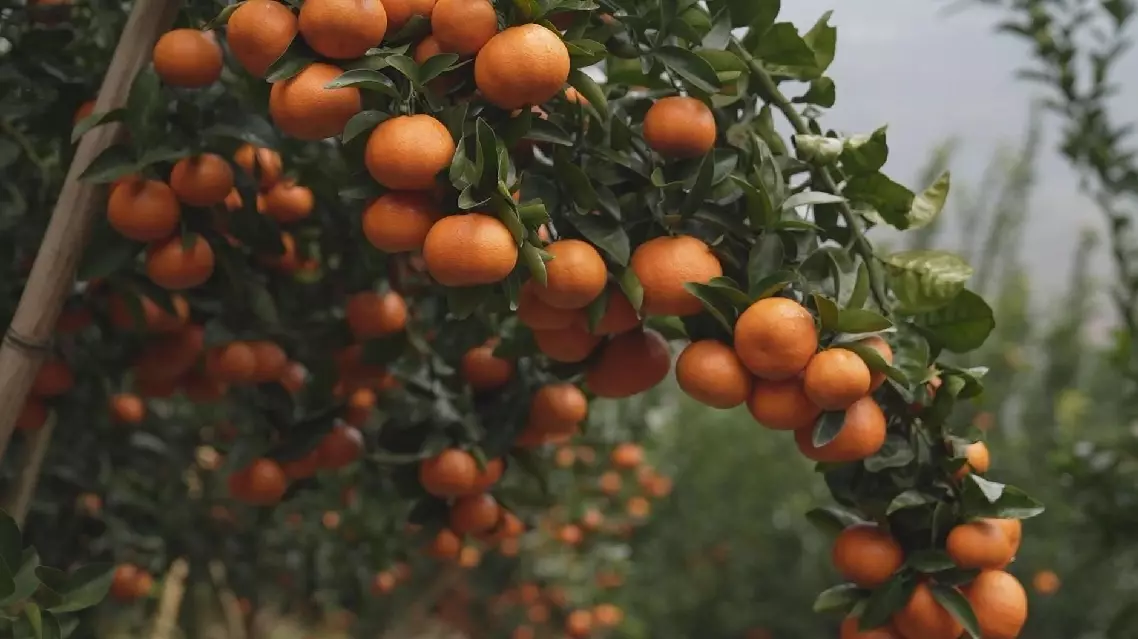
It's harvest season in Chongqing's Fucheng Village, where mandarins ripen across thousands of hectares, the fruit hanging heavy on the branches and perfuming the air. Drones, automated conveyors, pre-cooled containers, and real-time data have now joined the harvesting by farmers.
Seventy-year-old Chen Guoxiu has spent most of her life in these orchards. Since the 1960s, these golden fruits have become a source of steady income for thousands of villagers here.
The region's soil, hilly terrain, and favorable climate produce a fruit that's sweet and juicy. But they also make farming and transport physically demanding.
"In the past, we had to climb the hills before dawn. By the time we filled a basket and carried it down, the sun had just risen," said Chen.
For experienced growers like Chen, carrying a full crate down the hillside once took nearly an hour.
Drones now transport the fruit from hills about 500 meters high to processing facilities below, and the trip takes just two minutes, costing only half a U.S. cent per kilogram.
But drone delivery is only part of the industry's upgrade.
At the foot of the hill, the mandarins move swiftly onto automated conveyor belts for washing, sorting and waxing while pre-cooled containers stand ready at zero degrees Celsius.
In less than an hour, these freshly picked fruits from China's southwestern hills begin their journey overseas.
"Last year, we exported around 400 containers. This year, we expect a 10 percent increase. Our main markets are Southeast Asia, Kazakhstan and Russia. This year, we've also expanded to India and Bangladesh," said Xie Xiaojun, manager of a local citrus company.
Industry data from the Chinese Society of Citriculture shows that China remains the world's largest citrus producer, with annual output topping 65 million tons.
Fucheng Village is a typical example of the once-impoverished rural areas that have shifted to developed industries tailored to local strengths, boosted by citrus farming since 2015, when China's campaign to eliminate extreme poverty achieved overall success and has seen higher incomes and faster growth than the national average for five consecutive years.
Since then, the challenge for Fucheng Village has shifted: how to stay competitive in the increasingly saturated market. They resort to innovation and upgrading.
To stay ahead, growers are cultivating late-ripening varieties to stagger market timing and investing in smart agriculture.
Data-driven systems have helped improve quality and manage risks.
"Agriculture often depends on the weather. We can't change the climate, but with real-time data we can respond earlier, whether to temperature shifts or pests," said Xiong Bingjun, orchard owner in Kaizhou District of Chongqing.
From drone logistics to export expansion, the transformation of the mandarin industry in this small village mirrors a broader shift underway across China's countryside.
"All 832 formerly impoverished counties have developed leading industries that are strong, distinctive, and drive local growth," said Han Jun, Minister of Agriculture and Rural Affairs of China.
As China's rural revitalization moves forward, the focus is no longer simply on building industries, but on making them more efficient, innovative, and competitive.
President Xi Jinping has emphasized developing what China calls "new quality productive forces" in agriculture. Fucheng Village showcases how that works out by combining experience in the orchards with smart systems, faster logistics and access to global markets.
Tech, exports reshape citrus farming in southwest Chinese village