Flocks of mute swans have gathered at ponds in Yining County, northwest China's Xinjiang Uygur Autonomous Region, to prepare for their spring migration.
On the sapphire-blue surface of the Equan (Swan Spring) Wetland Park in the county, wintering mute swans were spotted foraging, preening their feathers, and practicing flight.
The vibrant moment when these graceful creatures take flight lightly from the water is particularly captivating for tourists and photography enthusiasts.
The park is located in the middle of the Ili River Valley in Xinjiang. Because of the underwater hot springs, the lake surface does not freeze extensively in winter, making it an ideal habitat for mute swans.
The swans arrive here in early October every year, and begin their migration between late February and early March in the following year.
With the continuous improvement of the local ecological environment in recent years, the number of wintering mute swans has been increasing year by year in the region. Currently more than 800 mute swans are staying in the wetland park.

Mute swans spotted prepareing for spring migration in Xinjiang wetland park

Mute swans spotted prepareing for spring migration in Xinjiang wetland park
A 20-story vertical super-plant factory in Chengdu, southwest China's Sichuan Province, is exploring ways to support the country's modernized agriculture, focusing on intelligent and industrialized crop cultivation.
It is the world's first ultra-high-rise smart vertical plant factory production system, developed by the Institute of Urban Agriculture under the Chinese Academy of Agricultural Sciences.
Wang Sen, chief executive of the institute, said that with automated equipment, plants can be provided with an environment even better than nature, resulting in improvements in both quality and yield.
"As the name suggests, the plant factory grows crops using industrial methods. Light, temperature, water and nutrients are fully automated to create optimal conditions. Land-use efficiency is also extremely high. This 20-story facility can deliver up to 120 times the yield of traditional open-field farming," Wang said.
By minimizing dependence on land and climate conditions, the facility incorporates technological safeguards that allow production to continue even in extreme scenarios. It is also speeding up seed development, a critical pillar of long-term food security.
"This is a wheat breeding accelerator. Traditionally, developing such a new variety takes eight to 12 years. Here, it can be done in just one to one and a half years. In the future, we will expand from staple crops to fruits and vegetables," Wang said.
In Wenjiang District of Chengdu, a base run under the plant factory is in full operation, cultivating strawberries.
"Planted outdoors, a strawberry plant produces about 300 grams a year. In our plant factory, it can reach 1,500 grams. Our technology is globally competitive. More and more countries, such as Uzbekistan, are showing strong interest in our technology. Our future direction of agricultural development is towards an infrastructure-based and intelligent system," said Peng Jie, chairwoman of FutureFarms, an agricultural technology company in Sichuan.
As China looks ahead to the next Five-Year Plan period (2026-2030), experts said smarter, facility-based farming in the plant factories is expected to move beyond pilot demonstrations and play a bigger role in the country's long-term food strategy.
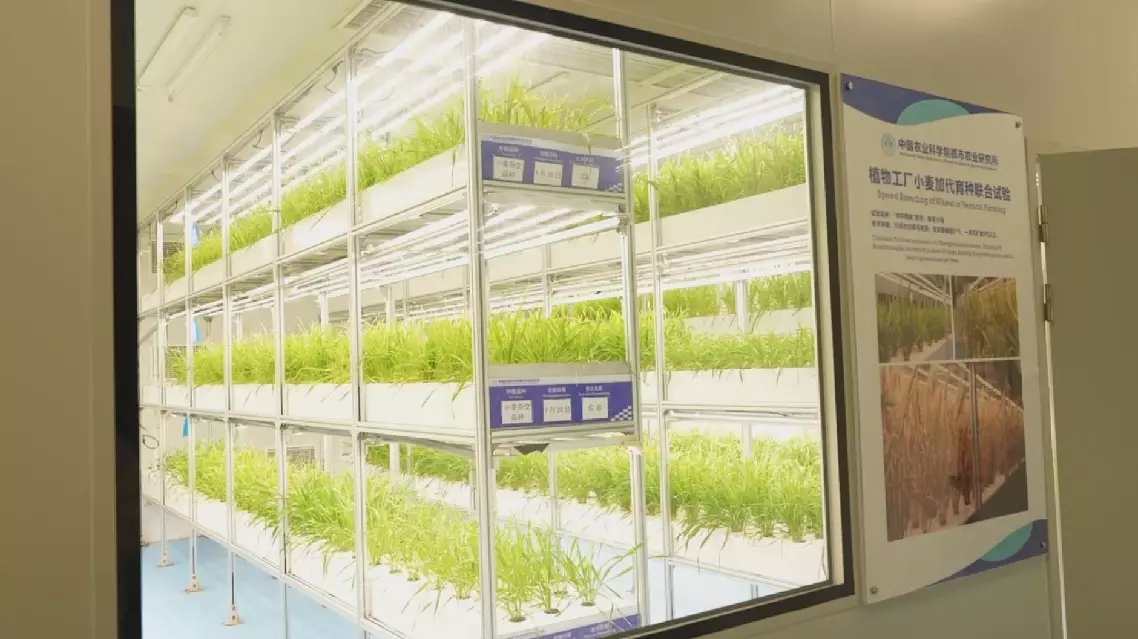
20-story plant factory in Sichuan explores ways to modern agriculture