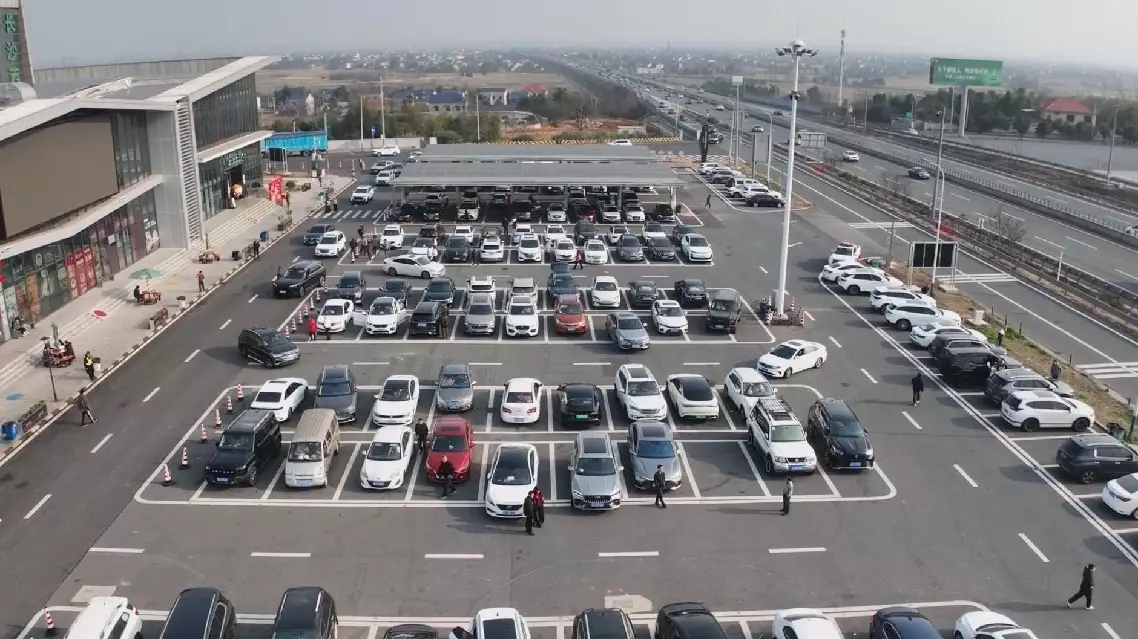
Charging stations for new energy vehicles on Chinese highways handled record charging volume during the nine-day Spring Festival holiday from Feb 15 to 23 this year, as NEV travel continued to grow, according to the National Energy Administration.
The holiday sees the world's largest annual migration as millions travel for family reunions, and most cross-regional trips in the country are by car. With the booming popularity of NEVs in recent years, China has bolstered its charging infrastructure in preparation for peak charging times.
Statistical analysis of 53,300 highway charging piles included in the national charging facility monitoring and service platform shows that during the holiday period, the charging volume of electric vehicles on highways reached 149.7675 million kilowatt-hours, with an average daily charging volume of 16.6408 million kilowatt-hours, an increase of 52.01 percent compared to the volume during the Spring Festival last year.
Data from the State Grid Smart Vehicle Networking Platform shows that during the holiday, the top five provinces in terms of expressway charging volume were Zhejiang, Jiangsu, Anhui, Shandong, and Henan. While the Changchun-Shenzhen Highway registered the highest charging volume on the platform among all expressways.
Total NEV charging volume during Spring Festival holiday hits record high
Chinese Premier Li Qiang on Thursday presided over a State Council executive meeting that studied work on building a unified national market and reviewed and approved a plan for the development of a modern emergency response system during the 15th Five-Year Plan period (2026-2030).
Noting that building a unified national market is essential to advancing high-quality development, the meeting called for deepening institutional frameworks in areas such as property rights protection, market access, fair competition, social credit and market exit mechanisms.
The meeting also urged efforts to advance high-standard connectivity of market infrastructure to facilitate smooth economic circulation and effectively reduce logistics costs across society.
Emergency management is critical to protecting people's lives and property, the meeting said. It called for accelerating the development of a modern emergency response system, deepening reform and innovation in emergency management, and improving coordinated response mechanisms.
Efforts should be made to strengthen risk prevention at the source, enhance monitoring, forecasting and early warning, and accelerate a shift in governance toward proactive prevention, according to the meeting.
A draft revision of the Law on the People's Bank of China was also discussed and approved in principle at the meeting, which decided to submit the draft to the Standing Committee of the National People's Congress for deliberation.

Chinese premier chairs State Council executive meeting