WASHINGTON (AP) — American sympathies in the Middle East have shifted dramatically toward the Palestinians, according to new Gallup polling, after decades of overwhelming support for the Israelis.
That shift accelerated during the war in Gaza. Three years ago, 54% of Americans sympathized more with the Israelis, compared with 31% for the Palestinians.
Click to Gallery
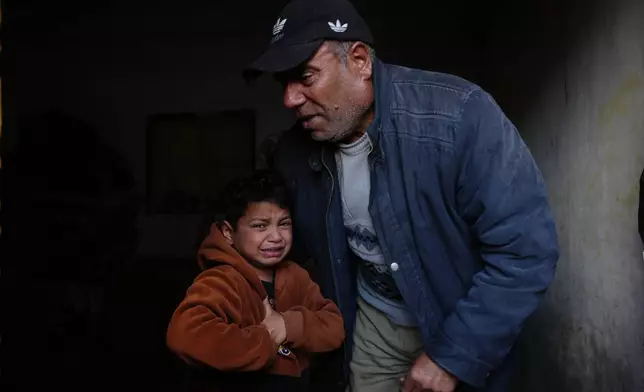
Yazid Al-Zayan, 9, mourns during the funeral of his father Khaled Al-Zayan, a Palestinian policeman, who was killed in an Israeli military strike, in Khan Younis, southern Gaza Strip, Friday, Feb. 27, 2026. (AP Photo/Abdel Kareem Hana)

Mourners carry the body of the Palestinian policeman, Khaled Al-Zayan, who was killed in an Israeli military strike, during his funeral in Khan Younis, southern Gaza Strip, Friday, Feb. 27, 2026. (AP Photo/Abdel Kareem Hana)

An injured child is treated at Nasser Hospital, following an Israeli military strike in Khan Younis, Gaza Strip, Friday, Feb. 27, 2026. (AP Photo/Abdel Kareem Hana)

Palestinians gather for iftar, the fast-breaking meal, during the Muslim holy month of Ramadan amid the rubble of destroyed buildings in Gaza City, Thursday, Feb. 26, 2026. (AP Photo/Abdel Kareem Hana)
Now, their support is about evenly balanced, with 41% saying their sympathies lie more with the Palestinians, and only 36% saying the same about the Israelis.
The numbers reflect how support for Israel has become deeply contentious in the U.S., with profound implications for American politics and foreign policy. The changing sentiment has been largely driven by Democrats, who are now much more likely to sympathize with Palestinians. U.S. assistance to Israel has been a major dividing line in the party’s primaries this year.
Gallup’s data indicates that the shift was already happening before Hamas attacked Israel on Oct. 7, 2023, then increased during Israel’s subsequent military operations in Gaza. The polling has a margin of error of plus or minus 4 percentage points, meaning sentiment toward Israelis and Palestinians are roughly even.
“It’s the first time they have reached parity, which is really quite striking,” said Benedict Vigers, a senior global news writer at Gallup. “In not many years, that very significant gap in public opinion has now completely closed.”
About two-thirds of Democrats now say their concerns lie more with the Palestinians, while only about 2 in 10 sympathize more with the Israelis. As recently as 2016, the picture looked very different: About half of Democrats sympathized more with the Israelis and only about one-quarter sympathized with the Palestinians.
The shift began even before the Israel-Hamas war turned the issue into a flash point within the Democratic Party. Palestinian militants killed around 1,200 people, mostly civilians, in the initial attack and took another 251 hostage, but the Israeli response has been widely seen as disproportionate, with Gaza health officials reporting more than 72,000 Palestinians killed, nearly half of them women and children, and wide swaths of the territory reduced to rubble. Many progressive politicians and activists now describe Israel’s actions in the war as genocide — a charge Israel vehemently denies.
Democrats have expressed greater sympathy for the Palestinians than the Israelis since 2023 — in a Gallup poll that was conducted before the Oct. 7 attacks — but Gallup’s surveys show their support in the conflict has been tilting toward the Palestinians and away from the Israelis since around 2017.
Some of that early decline in sympathy appeared to be tied to disapproval of the right-leaning Israeli leader, Prime Minister Benjamin Netanyahu, whose favorability in the U.S. fell nearly 15 percentage points between 2017 and 2024, according to separate Gallup polling.
Netanyahu clashed with former President Barack Obama in the last year of his administration, then forged a warmer relationship with President Donald Trump, who delivered several victories to Netanyahu in his first term, including recognizing Jerusalem as the capital of Israel and Israel’s sovereignty over the Golan Heights. Trump also persuaded three Arab countries to establish commercial and diplomatic ties with Israel. The closeness between Trump and Netanyahu has continued into Trump’s second term.
The conflict between the Israelis and Palestinians was a point of tension for Democrats during President Joe Biden’s administration, as well as during the 2024 presidential election. An AP-NORC poll conducted toward the end of 2023, just a few months into the war in Gaza, found that Democrats were sharply divided on whether the U.S. was too supportive of Israel, and another AP-NORC poll from 2024 found that Democratic voters were more likely to say the Israeli government held “a lot” of responsibility for the war’s escalation.
Democrats’ sympathy for the Palestinians intensified as the war progressed, Gallup’s polling shows, and independents’ views also shifted. This year, independents expressed more sympathy for the Palestinians than the Israelis for the first time in Gallup’s trend. About 4 in 10 independents are more sympathetic toward the Palestinians. That’s compared to about 3 in 10 for the Israelis, a new low.
Most Republicans continue to side with Israel — about 7 in 10 say they are more sympathetic to the Israelis — but that is a slight downtick from about 8 in 10 before the start of the war. Some figures in the Republicans’ isolationist “America First” wing are also increasingly questioning traditional U.S. support for Israel.
Younger adults — those 18 to 34 in this poll — are also increasingly sympathetic toward the Palestinians, according to the Gallup survey.
Younger Americans’ sympathies have been shifting toward the Palestinians since around 2020, and reached a new high this year. About half of 18 to 34 year olds say they have more sympathy for the Palestinians, compared to about a quarter who say that about the Israelis.
Student protests against the Israel-Hamas war appeared on college campuses around the country during the war, asking colleges to cut investments supporting Israel.
But the shift is only “partly a generational story,” according to Vigers.
The new poll also found for the first time that middle-aged Americans, those 35 to 54, expressed more sympathy for the Palestinians than the Israelis — a reversal from last year. And while Americans over 55 are more sympathetic toward Israel, that gap is narrowing, too.
“With adults over 55, they are more sympathetic to Israelis, but it’s as low as it’s been since 2005,” Vigers said.
About 6 in 10 U.S. adults, 57%, favor the establishment of an independent Palestinian state in the West Bank and the Gaza Strip, according to the new polling. That is not significantly different from recent years, as at least half of U.S. adults have supported an independent Palestinian state since 2020.
Vigers notes that “party polarization is at or near its record high” on this question, even though it hasn’t been sharply increasing year over year.
In recent years, Americans’ have also grown less likely to say they have a favorable view of Israel, while their positive views of the Palestinian territories have improved. Still, Americans remain more positive toward Israel: Some 46% of Americans have a favorable opinion of Israel, compared with 37% who say that about the Palestinian territories.
In the past few years, there’s been an uptick among Democrats and independents in support for the two-state solution. Now, about three-quarters of Democrats and roughly 6 in 10 independents say they support an independent Palestinian state. Only about one-third of Republicans say the same.
The opinions of the people who would be directly affected by a two-state solution are quite different. Only about 3 in 10 Israelis living in Israel and Palestinians living in the West Bank and east Jerusalem said they supported a two-state solution in which an independent Palestinian state existed alongside Israel, according to the Gallup World Poll conducted in 2025.
“On the ground, in the region, far fewer Israelis and Palestinians tell us that they are in favor of the two-state solution than Americans when asked a very similar question,” Vigers said. “There is that interesting sort of disconnect between the region itself and Americans’ views toward it.”
Associated Press writer Aamer Madhani contributed to this report.
The Gallup poll was conducted Feb. 2-16, 2026, among 1,001 U.S. adults, aged 18 and older, using a sample drawn from Gallup’s probability-based panel. The margin of sampling error for adults overall is plus or minus 4.0 percentage points.
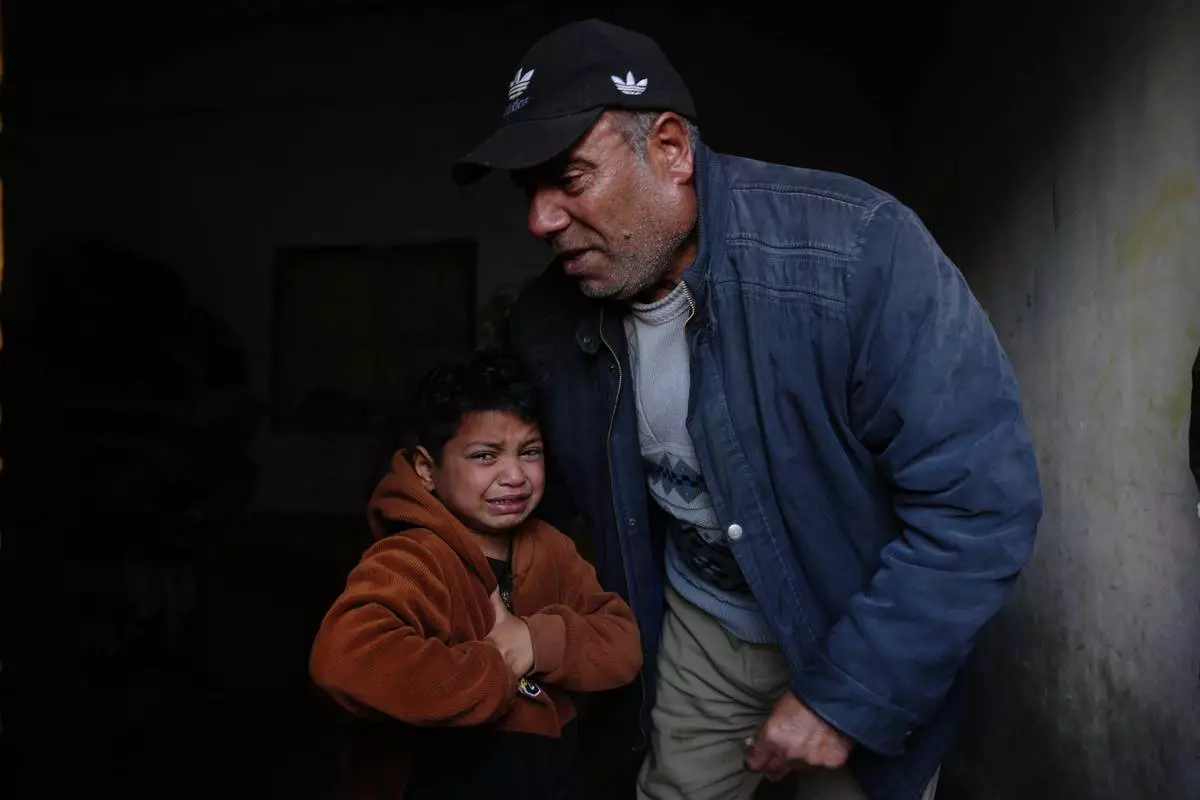
Yazid Al-Zayan, 9, mourns during the funeral of his father Khaled Al-Zayan, a Palestinian policeman, who was killed in an Israeli military strike, in Khan Younis, southern Gaza Strip, Friday, Feb. 27, 2026. (AP Photo/Abdel Kareem Hana)

Mourners carry the body of the Palestinian policeman, Khaled Al-Zayan, who was killed in an Israeli military strike, during his funeral in Khan Younis, southern Gaza Strip, Friday, Feb. 27, 2026. (AP Photo/Abdel Kareem Hana)

An injured child is treated at Nasser Hospital, following an Israeli military strike in Khan Younis, Gaza Strip, Friday, Feb. 27, 2026. (AP Photo/Abdel Kareem Hana)

Palestinians gather for iftar, the fast-breaking meal, during the Muslim holy month of Ramadan amid the rubble of destroyed buildings in Gaza City, Thursday, Feb. 26, 2026. (AP Photo/Abdel Kareem Hana)