A green waste incineration plant in Shenzhen City of south China's Guangdong Province helps turn waste into electricity and resources, as the tech hub makes greater efforts to pursue green development.
The Longgang Energy Eco-Park, with a designed daily household waste treatment capacity of 5,000 tonnes, is one of the world's largest single-site municipal waste incineration facilities.
Every day, over 600 trucks carry garbage into the facility, where the waste will then be processed and turned into electricity and eco-friendly bricks.
"Inside our incinerator, we must make sure the temperature always stays above 850 degrees-Celsius so that harmful substances are destroyed," said Jiao Jianwei, operations director and senior engineer at the Shenzhen Energy Environment Protection East, Co. Ltd.
Jiao said that with a self-developed treatment system, the facility is able to release highly clean gas.
"This is our flue gas treatment system. It has seven stages in total. From denitrification to dioxin removal, each stage targets different pollutants. Look at these real-time readings. The gas we release is cleaner than EU standards," Jiao said.
He said that the waste incineration plant can generate 60 percent of the electricity that local communities need.
"We burn 5,000 tonnes of waste daily, generating three million kilowatt hours of energy - enough to cover 60 percent of Pingdi subdistrict's total electricity needs," he said.
The burned waste is also used to produce eco-friendly bricks which are used to pave roads and build residential buildings, said Li Qiang, general manager at the Shenzhen Xijiang Environmental Protection Company.
"After dry screening, the ashes are crushed, washed, and classified into what we call 'eco-sand.' Mixed with cement, it becomes eco-friendly building blocks," Li said.
Across Shenzhen, broader efforts have also been made to help the city pursue green development.
In 2023, Shenzhen's energy consumption and carbon emission intensity per 10,000 yuan (1,460 U.S. dollars) worth of the GDP fell to one-third and one-fifth of the national average, respectively.
By the end of 2024, the city has built a total of 1,320 parks.
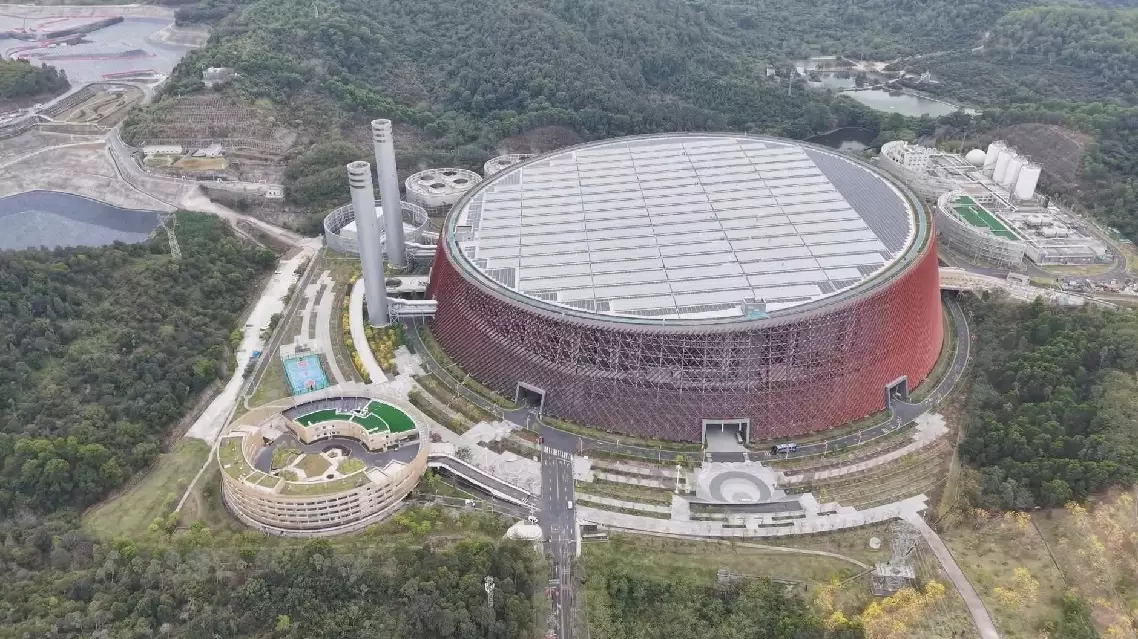
Green waste incineration plant in south China's Shenzhen turns trash into energy, resources