HOUSTON--(BUSINESS WIRE)--Mar 2, 2026--
On Thursday, February 19, the Port Commission of the Port of Houston Authority met for its regular monthly meeting.
This press release features multimedia. View the full release here: https://www.businesswire.com/news/home/20260302132294/en/
Chairman Ric Campo opened the meeting by welcoming Michel Bechtel to the Port Commission and also recognizing the succession of former Commissioner Stephen H. DonCarlos, who completed his maximum 12-year term limit.
During the meeting, it was also noted that Port Houston CEO Charlie Jenkins recently traveled to Europe to meet with key container customers. During these meetings, port leadership further outlined current infrastructure investments, strategic priorities, and long-term plans to support growth and competitiveness, while also engaging customers on their needs and opportunities to collaborate for shared success. He noted that if you look over the past 10 years, Port Houston’s container volumes are growing two times faster than the second-fastest growing port, and the port anticipates continued strong growth in containers. For that reason, continued investment in infrastructure is critical.
Port Houston also reported the biggest January container volume on record, reflecting a 4% increase from the same month last year. Additional details are available in Port Houston’s press release that was issued on February 23.
Also in January, Port Houston successfully offloaded four new fully electric ship-to-shore (STS) cranes, and additionally, ten of its 16 new rubber-tired gantry (RTG) cranes reached provisional acceptance and are now in service.
During the meeting, the Commission awarded a professional services contract to John C. Martin Associates, LLC for the development of a new economic impact study report. The previous study was issued in 2022 and provides valuable information and statistics Port Houston needs and uses for its daily engagement with industry and community partners as well as in its advocacy for federal, state, and local investment.
Port Houston’s ongoing infrastructure investments at Bayport and Barbour’s Cut Container Terminals, as well as its multi-purpose facilities, continue to add capacity and support the port’s strategy of building ahead of demand and sustaining long-term growth. The Commission approved construction of Wharf 1 at the Bayport Container Terminal, adding 1,300 linear feet of wharf space. Wharf 1 is scheduled to be completed in 2028. This expanded berth will accommodate the largest vessels capable of calling Houston and will be fitted with the largest cranes at the port to date.
The Commission also approved a series of technology investments to further strengthen operational resiliency, security, and system reliability across Port Houston. These actions support enhanced terminal operations, improved data governance and reporting, and expanded network redundancy and bandwidth.
The Port Commission will meet next on Monday, March 23, 2026.
About Port Houston
For more than 100 years, Port Houston has owned and operated the public wharves and terminals along the Houston Ship Channel, including the area’s largest breakbulk facility and two of the most efficient container terminals in the country. Port Houston is the advocate and a strategic leader for the Channel. The Houston Ship Channel complex and its more than 200 private and eight public terminals is the nation’s largest port for waterborne tonnage and an essential economic engine for the Houston region, the state of Texas and the U.S. The Port of Houston supports the creation of nearly 1.5 million jobs in Texas and 3.37 million jobs nationwide, and economic activity totaling $439 billion in Texas and $906 billion in economic impact across the nation. For more information, visit the website at PortHouston.com.
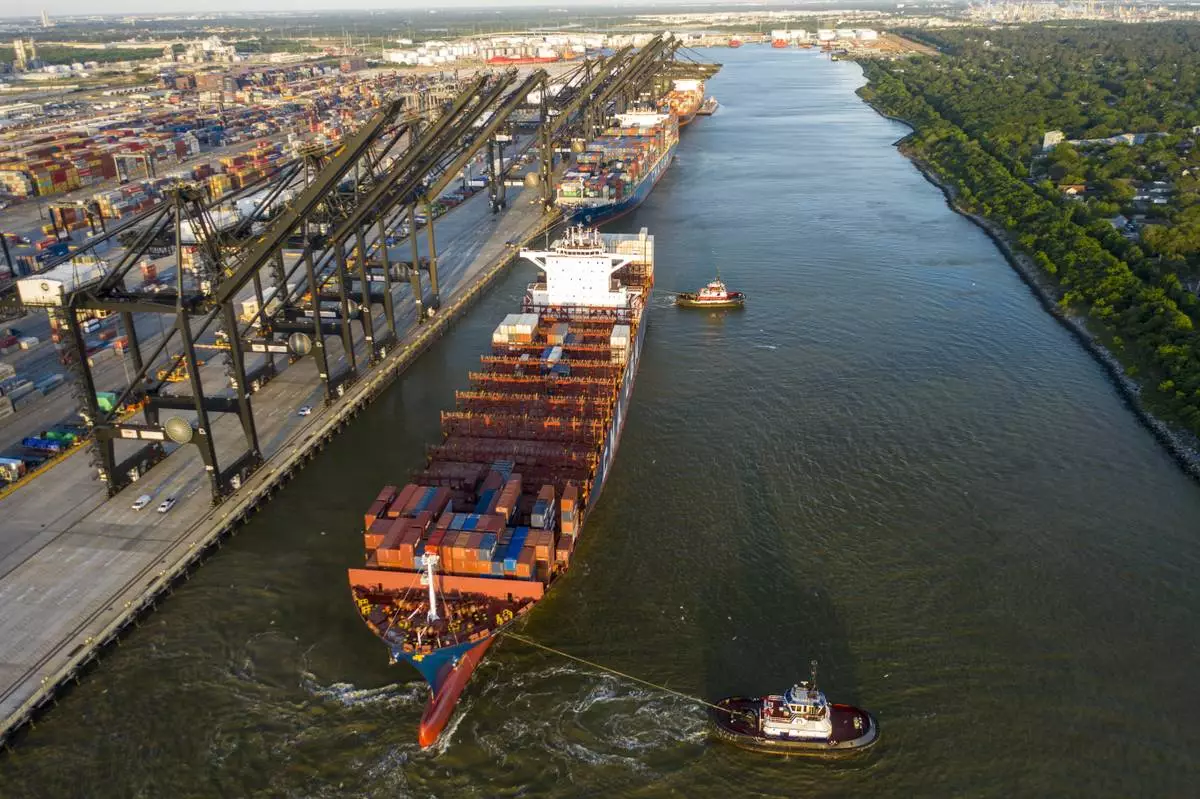
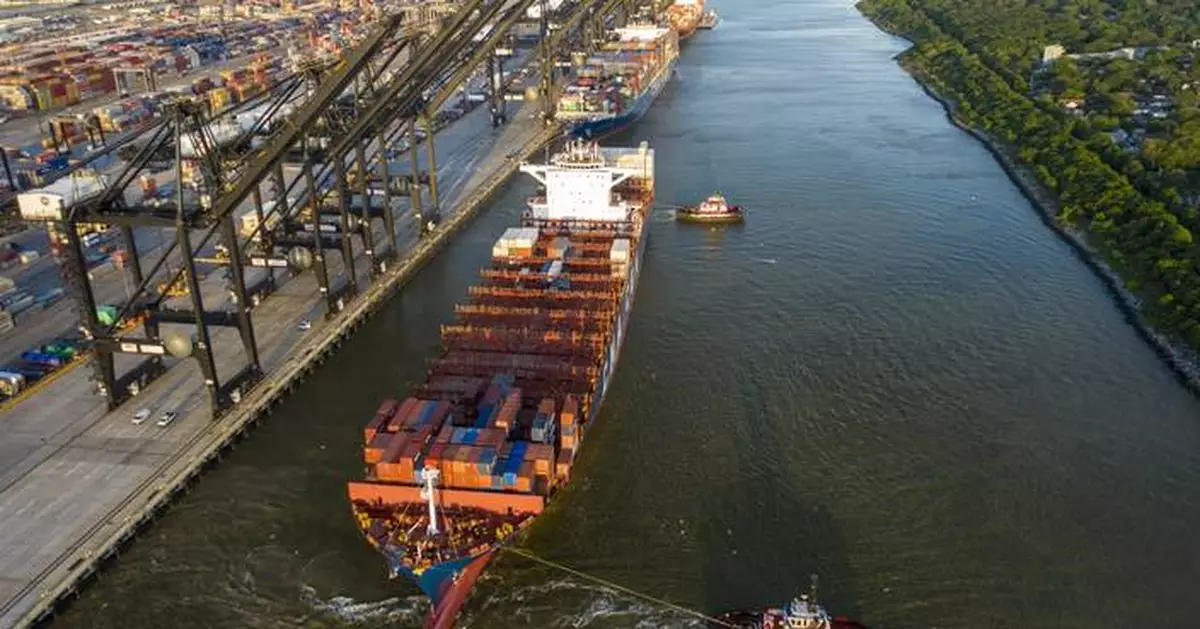
Busy activity at Port Houston's Bayport Container Terminal.
DUBAI, United Arab Emirates (AP) — Oil prices jumped Monday as the widening war in Iran disrupted tanker traffic through the Strait of Hormuz, highlighting how important the passageway is to the world's oil supply.
The Strait of Hormuz is the narrow mouth of the Persian Gulf through which about a fifth of the world's oil passes. Tankers traveling through the strait, which is bordered in the north by Iran, carry oil and gas from Saudi Arabia, Kuwait, Iraq, Qatar, Bahrain, the UAE and Iran. Most of that oil goes to Asia.
Any disruption to traffic through the Strait of Hormuz is highly disruptive to the oil trade.
“The scale of what is at stake cannot be overstated,” said Hakan Kaya, senior portfolio manager at investment management firm Neuberger Berman. He said a partial slowdown lasting a week or two could be absorbed by oil companies. But a full or near full closure lasting a month or more would push crude oil prices, trading around $70 on Monday, “well into triple digits” and European natural gas prices “toward or above the crisis levels seen in 2022.”
Here’s what to know about the strait and the widening Iran war.
The Strait of Hormuz is a bending waterway, about 33 kilometers (21 miles) wide at its narrowest point. It connects the Persian Gulf to the Gulf of Oman. From there, ships can then travel to the rest of the world. While Iran and Oman have their territorial waters in the strait, it's viewed as an international waterway all ships can ply. The United Arab Emirates, home to the skyscraper-studded city of Dubai, also sits near the waterway.
The Strait of Hormuz through history has been important for trade, with ceramics, ivory, silk and textiles moving from China through the region. In the modern era, it is the route for supertankers carrying oil and gas from Saudi Arabia, Kuwait, Iraq, Qatar, Bahrain, the UAE and Iran. The vast majority of it goes to markets in Asia, including Iran's only remaining oil customer, China.
While there are pipelines in Saudi Arabia and the UAE that can avoid the passage, the U.S. Energy Information Administration says “most volumes that transit the strait have no alternative means of exiting the region.”
Threats to the route have spiked global energy prices in the past, including during the Israel-Iran war in June.
The strait is not officially closed, but tanker traffic has dropped sharply as satellite navigation systems were disrupted, data and analytics firm Kpler said on X on Sunday. The U.K. Maritime Trade Operations Center reported attacks on several vessels in the area on either side of the strait and warned of elevated electronic interference to systems that show where ships are.
A bomb-carrying drone boat struck a Marshall Islands-flagged oil tanker in the Gulf of Oman, which leads into the strait from the east, killing one mariner, Oman said.
Iran has been threatening vessels approaching the Strait of Hormuz and is believed to have launched multiple attacks.
Global shippers have issued service alerts saying they have suspended operations in the area. Danish shipping company Maersk, the world’s biggest shipping company, said Sunday it is suspending all vessel crossings in the Strait of Hormuz until further notice. Other ocean carriers including Hapag-Lloyd, CMA-CGM and MSC made similar announcements.
“No one is wanting to navigate it, and there’s no insurer who’s willing to stand behind any transport going through there right now.,” said Tom Goldsby, logistics chairman in the Supply Chain Management Department at the University of Tennessee. “Those ships that got stuck in the Gulf are not going anywhere. ... There’s also a whole host of ships that were heading into the Gulf to replace them, and of course they’re anchored or going elsewhere now."
Data and analytics firm Kplr estimated there are 70 laden oil tankers and 75 clean tankers, which carry refined oil products, in the Mideast Gulf, seemingly waiting to pass through. That’s roughly twice as many as usual, according to Kplr. Meanwhile, about 60 tankers are sitting just outside the Mideast Gulf, east of the Strait of Hormuz, in a holding pattern.
Iran temporarily shut down parts of the strait in mid-February for what it said was a military drill. Oil prices jumped about 6% in the following days.
The decision was a rare, perhaps unprecedented shutdown of the strait.
In past times of tension and conflict, Iran has at times harassed shipping though the narrows, and during the 1980s’ Iran-Iraq war, both sides attacked tankers and other vessels, using naval mines to completely shut down traffic at points. But Iran has not carried out repeated threats to close the waterway altogether since the 1980s, even during last year’s 12-day war when Israel and the U.S. bombarded Iran’s key nuclear and military sites.
__
Anderson reported from New York.
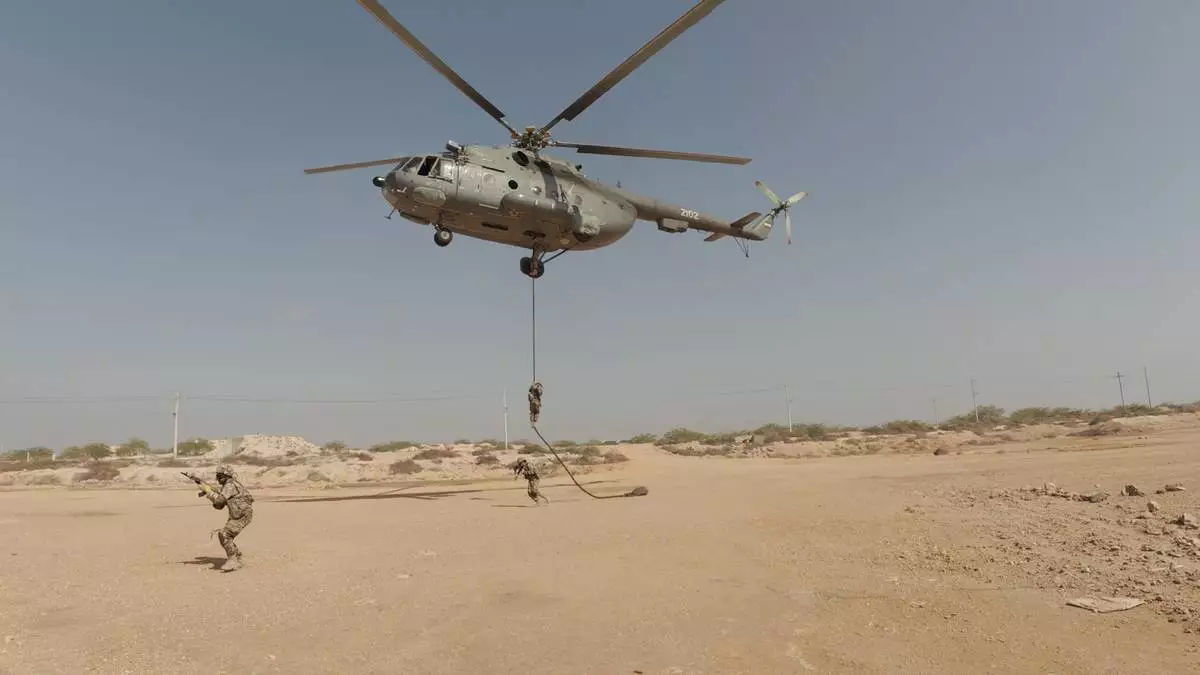
In this image provided by Sepahnews of the Iranian Revolutionary Guard on Feb. 16, 2026, shows the Iranian Revolutionary Guard's drill in the Persian Gulf on Monday, Feb. 16, 2026. (Sepahnews via AP)
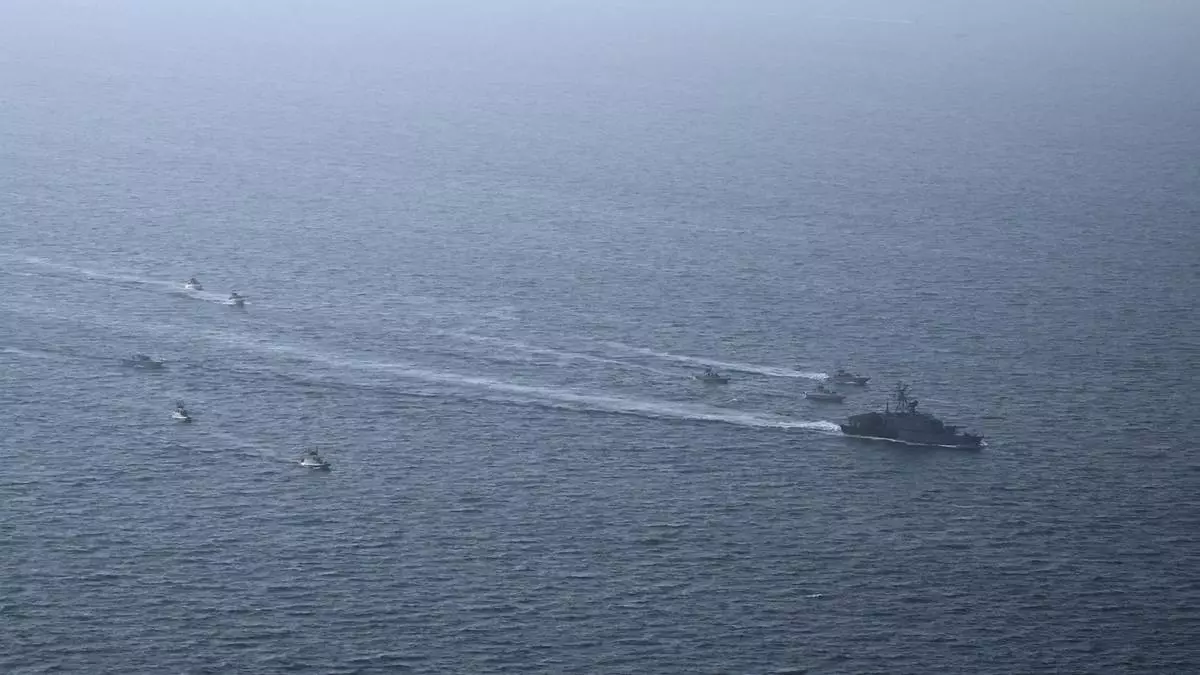
In this image provided by Sepahnews of the Iranian Revolutionary Guard on Feb. 16, 2026, shows the Iranian Revolutionary Guard's drill in the Persian Gulf on Monday, Feb. 16, 2026. (Sepahnews via AP)
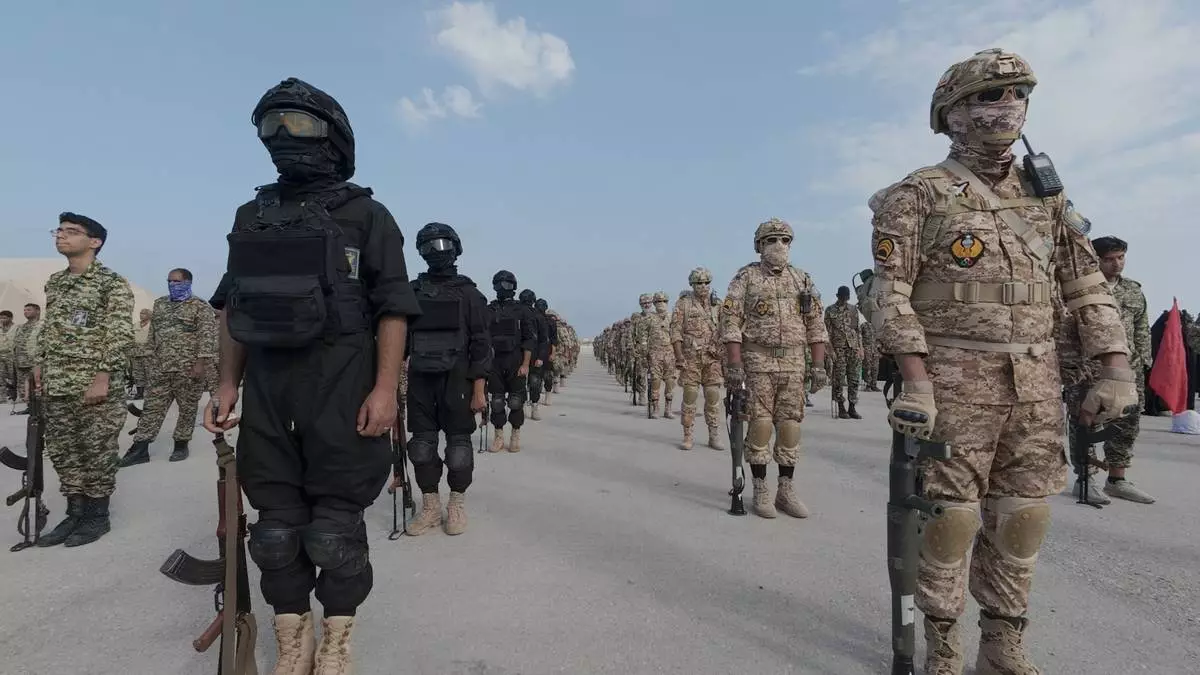
In this image provided by Sepahnews of the Iranian Revolutionary Guard on Feb. 16, 2026, shows troops standing at attention during the guard's drill in the Persian Gulf on Monday, Feb. 16, 2026. (Sepahnews via AP)
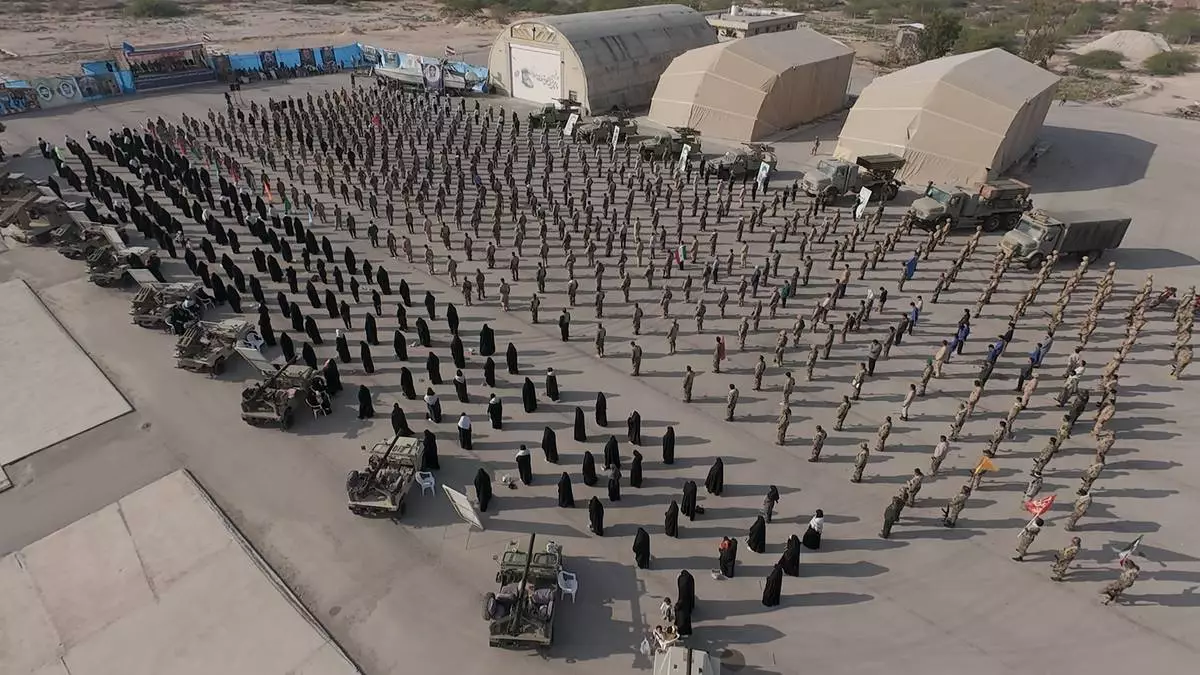
In this image provided by Sepahnews of the Iranian Revolutionary Guard on Feb. 16, 2026, shows troops standing at attention during the guard's drill in the Persian Gulf on Monday, Feb. 16, 2026. (Sepahnews via AP)