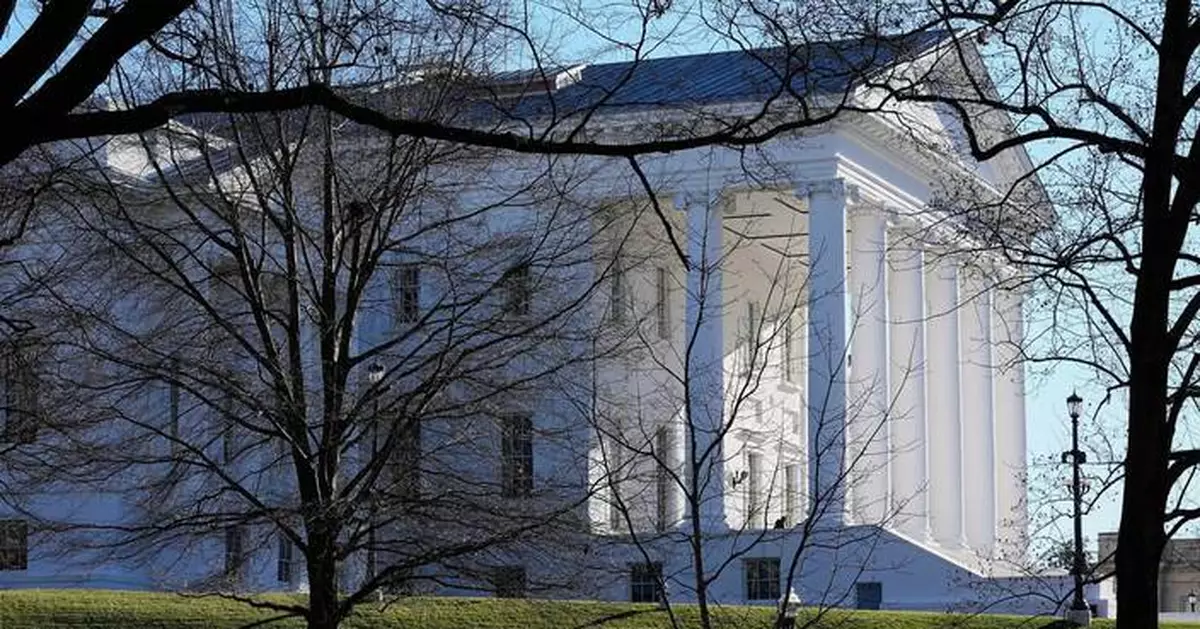
RICHMOND, Va. (AP) — For the second time, Virginia’s Supreme Court ruled Wednesday that voters can cast ballots on a Democrat-led congressional redistricting plan that could help the party win four more U.S. House seats, as the justices review legal challenges to the effort.
The court ruled that a statewide referendum can be held on April 21 on whether to authorize mid-decade redistricting, upending a temporary restraining order put in place by a Tazewell County judge last month. It comes after the top court made a similar ruling last month in a related case.
The court still has not ruled on whether the mid-decade redistricting amendment and referendum are legal, indicating that the scheduled April vote could be all for nothing if the top court upholds a lower court ruling blocking the effort. Early voting on the referendum is supposed to begin Friday.
“It is the process, not the outcome, of this effort that we may ultimately have to address,” the ruling said. “Issuing an injunction to keep Virginians from the polls is not the proper way to make this decision.”
Since late February, officials in Tazewell County have refrained from preparing for the referendum in light of the restraining order. On Wednesday, Tazewell Director of Elections Brian Earls said he would work hard to ensure early voting would start in his county come Friday.
“I believe we will be ready,” he said in an email. “If not, it will not be for lack of effort.”
The National Republican Congressional Committee, which filed the initial request for a restraining order, did not immediately respond to a request for comment on the case.
Virginia House Republican Minority Leader Terry Kilgore expressed confidence Wednesday in winning the case and at the ballot box.
“If we can throw this constitutional amendment out, what other constitutional amendments can we throw out over the next few years?” he told reporters following the ruling. “That’s not the way Virginia should be.”
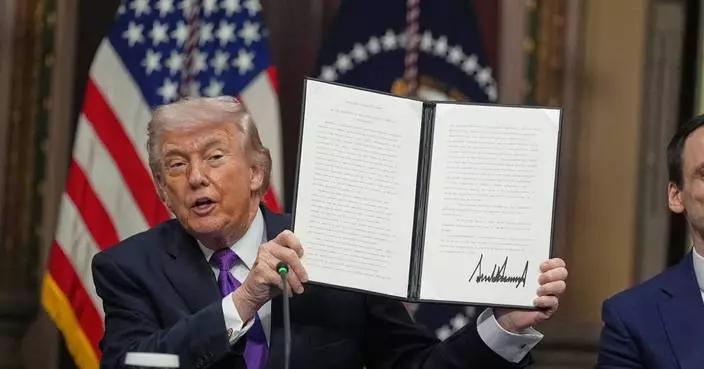
President Donald Trump launched an unusual mid-decade redistricting battle last year by pushing Republican officials in Texas to redraw districts to help his party win more seats. The goal was for the GOP to hold on to a narrow House majority in the face of political headwinds that typically favor the party out of power in midterms.
Instead, it created a burst of redistricting efforts nationwide. So far, Republicans believe they can win nine more House seats in Texas, Missouri, North Carolina and Ohio. Democrats think they can win six more seats in California and Utah, and are hoping to fully or partially make up the remaining three-seat margin in Virginia.
In February, Virginia Democrats released a new congressional map that aims to give their party four more seats. Since then, the Democratic-led Legislature passed the proposed map and Gov. Abigail Spanberger signed the document into law.
Still, the map only goes into effect if it’s backed by voters and the amendment process is approved by the top court.
Virginia Democratic House Speaker Don Scott said Wednesday that the top court's decision gives voters an opportunity to decide whether the map gets used.
“The Supreme Court of Virginia’s decision ensures that this referendum will move forward and that Virginians will have the opportunity to make their voices heard,” he said.
Democratic lawmakers in Virginia have sought to portray their redistricting push as a response to Trump’s overreach. Republicans have sounded aghast at the proposed district map, describing it as a way for liberals in northern Virginia to commandeer the rest of the state.
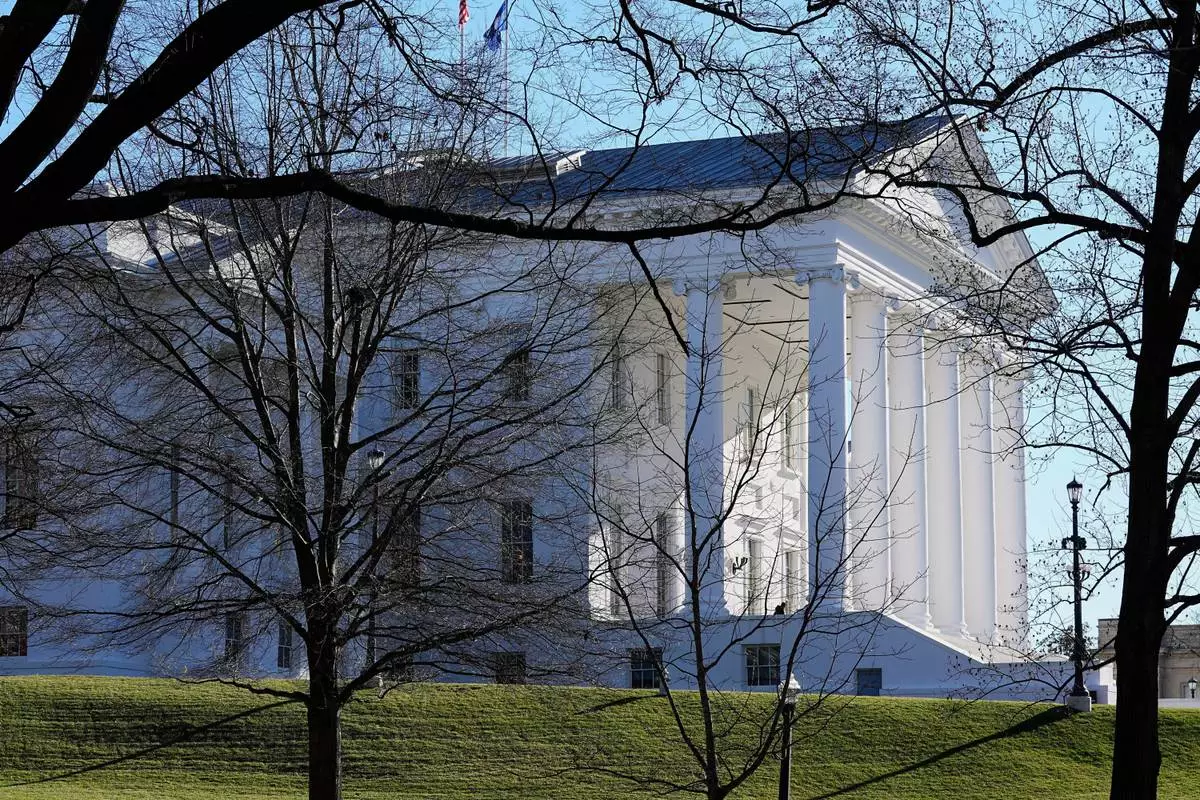
FILE - The state and U.S. flags fly over the Virginia State Capitol at the start of the 2024 session of the Virginia General Assembly in Richmond, Va., on Jan. 10, 2024. (AP Photo/Steve Helber, File)
Lou Holtz never met an opponent that couldn't beat him. Somehow, he squeaked out nearly 250 wins and a national title while cementing himself both as one of the most lovable and unlikable characters in college football — a one-of-a-kind iconoclast in a profession brimming with originals.
The pint-sized motivator who restored greatness at Notre Dame and demanded it everywhere else he went died in Orlando, Florida, Notre Dame announced Wednesday. He was 89.
Spokeswoman Katy Lonergan said the family did not provide a cause of death.
“Notre Dame mourns the loss of Lou Holtz, a legendary football coach, a beloved member of the Notre Dame family and devoted husband, father and grandfather,” Notre Dame president the Rev. Robert A. Dowd said in a statement.
His son, Skip, who followed Holtz into coaching, said in a post on X that his father had passed away and was "resting peacefully at home.”
“He was successful, but more important he was Significant," Skip Holtz wrote.
Holtz went 249-132-7 over a career that spanned 33 seasons and included stops at Minnesota, Arkansas, South Carolina and, most notably, Notre Dame.
It was there that he won his lone national championship, in 1988, capped with a win over West Virginia in the Fiesta Bowl but highlighted by a 31-30 victory earlier in the season over Miami — one of the notable meetings in the so-called “Catholics vs. Convicts” rivalry of the '80s.
For all the big personalities coarsing through college football during the day, none stood bigger than Holtz. He was only 5-foot-10, but commanded the sideline like someone much bigger. The lead-up to the big games were sometimes his best theatre.
Armed with a homespun brand of folksiness that could trickle into corny but always contained a kernel of truth, Holtz lit up bulletin boards and motivational posters with dozens of memorable quotes and pithy observations, virtually all of them constructed to inspire:
—“Life is ten percent what happens to you and ninety percent how you respond to it.”
—"When all is said and done, more is said than done."
—“You’re never as good as everyone tells you when you win, and you’re never as bad as they say when you lose.”
He could make any team — from Akron to Army to Alabama — sound like a world beater on any given week. More often than not, his Fighting Irish figured out a way to scratch out the wins.
Before Holtz arrived in South Bend, Notre Dame was wallowing in mediocrity — a mere shell of the program built on a foundation of Knute Rockne, Ara Parseghian, the Golden Dome and Touchdown Jesus. Holtz turned things around quickly and had the Irish in the Cotton Bowl in Year 2 and winning the national title the season after that.
His 1988 and 1989 teams won a school-record 23 consecutive games and he beat three teams ranked No. 1 — Miami in 1988, Colorado in 1989 and Florida State in 1993.
The Irish finished No. 2 in the AP poll in 1993. Holtz left South Bend after the 1996 season with a record of 100-30-2.
“Lou and I shared a very special relationship," said current Notre Dame coach Marcus Freeman, who led the Irish back to the national title game in 2025 — a contest Holtz attended and spiced up with some trolling of the Ohio State program that beat the Irish that day. "Our relationship meant a lot to me as I admired the values he used to build the foundation of his coaching career: love, trust and commitment.”
Notre Dame was the highlight of a head-coaching career that began at William & Mary and North Carolina State and also included a one-year stop in the NFL.
Like so many who mastered the college game in his profession, he failed up there, resigning with one game left in a 3-10 campaign with the New York Jets in 1976 and proclaiming “God did not put Lou Holtz on this earth to coach in the pros."
That opened the door at Arkansas, which was one of the four schools he led into the AP Top 25. His teams made 18 appearances there; eight of those were in the top 10.
After Notre Dame, Holtz transitioned into the TV booth with CBS, promising he would never coach again.
“I said, ‘You could put it in granite.’ I’ve got the granite stone,” Holtz said. “It wasn’t very good granite.”
He took an open job at South Carolina, where he had once served as an assistant coach. Despite posting a career-worst 0-11 mark in his first season with the Gamecocks, Holtz went 17-7 over the next two seasons, beat then No. 9 Georgia in the second game of 2000 and also beat Ohio State twice in the Outback Bowl.
He left the sideline for good following the 2004 season and returned to the airwaves, working 11 more seasons with ESPN.
On the field, each program he led reached new heights in part because he never wavered from his core values of trust, a commitment to excellence and caring for others.
“I think you have to go in there with a vision of where you want to go and a plan of how you’re going to get there,” Holtz once said. “You have to hold people accountable, and you have to believe it can be done."
The results were impressive, even if he sometimes used unconventional methods.
He once tackled quarterback Tony Rice following a failed play in practice and was widely critiqued in 1991 when he grabbed a player by the facemask, pulling him to the sideline and yelling at him the entire way after the player committed a personal foul. Holtz later apologized.
Holtz suspended his leading rusher, Tony Brooks, and leading receiver, Ricky Watters, in 1988 because they were 40 minutes late to a team meal the night before Notre Dame faced then No. 2 Southern California. The Irish still won 27-10.
At Arkansas, he once suspended three starting offensive players for disciplinary reasons before facing then No. 2 Oklahoma in the Orange Bowl. Arkansas, an 18-point underdog, still won 31-6.
As demanding as Holtz could be, though, he used his charm and eye for good players to recruit top talent. Notre Dame’s 1990 recruiting class included five future first-round NFL draft picks, and he found unique ways to motivate his team.
“The first thing I said at every practice was, ‘Boy, what a great day to work,’” Holtz recounted. “It could be raining. It could be whatever. I’d be, ‘Boy, am I glad to be here. No place I’d rather be than here.’ I used to say to them, ‘I travel all over the world speaking to every major corporation and they’d pay me money. I speak to you for free and you don’t have to take notes.’”
Louis Leo Holtz was born Jan. 6, 1937, in Follansbee, West Virginia, and aspired to be a high school football coach. His future wife broke off their engagement in 1960. That’s when Holtz, a 150-pound linebacker at Kent State, took a graduate-assistant job at Iowa. A year later, he married Beth Barcus, and they were together more than 50 years.
She inspired him again in 1966 when, eight months pregnant with their third child, Holtz was jobless. Beth bought him a book about setting goals, and Holtz created a wish-list of what he wanted to do: attend a White House dinner, appear on “The Tonight Show” and see the Pope.
Holtz said there were 107 entries on the list: “She said, ‘Gee, that’s nice. Why don’t you add get a job.’ So we made it 108,” he said.
In 2008, Holtz was inducted into the College Football Hall of Fame and Notre Dame placed a statue of him outside its home stadium.
He said numerous times that his plan to be buried on that campus, as well. He figured it was only fitting because, as he said in 2015: “The alumni buried me here every Saturday,."
AP Sports Writer Michael Marot in Indianapolis contributed to this report. Tom Coyne is a former AP sports writer.
Get poll alerts and updates on the AP Top 25 throughout the season. Sign up here. AP college football: https://apnews.com/hub/ap-top-25-college-football-poll and https://apnews.com/hub/college-football
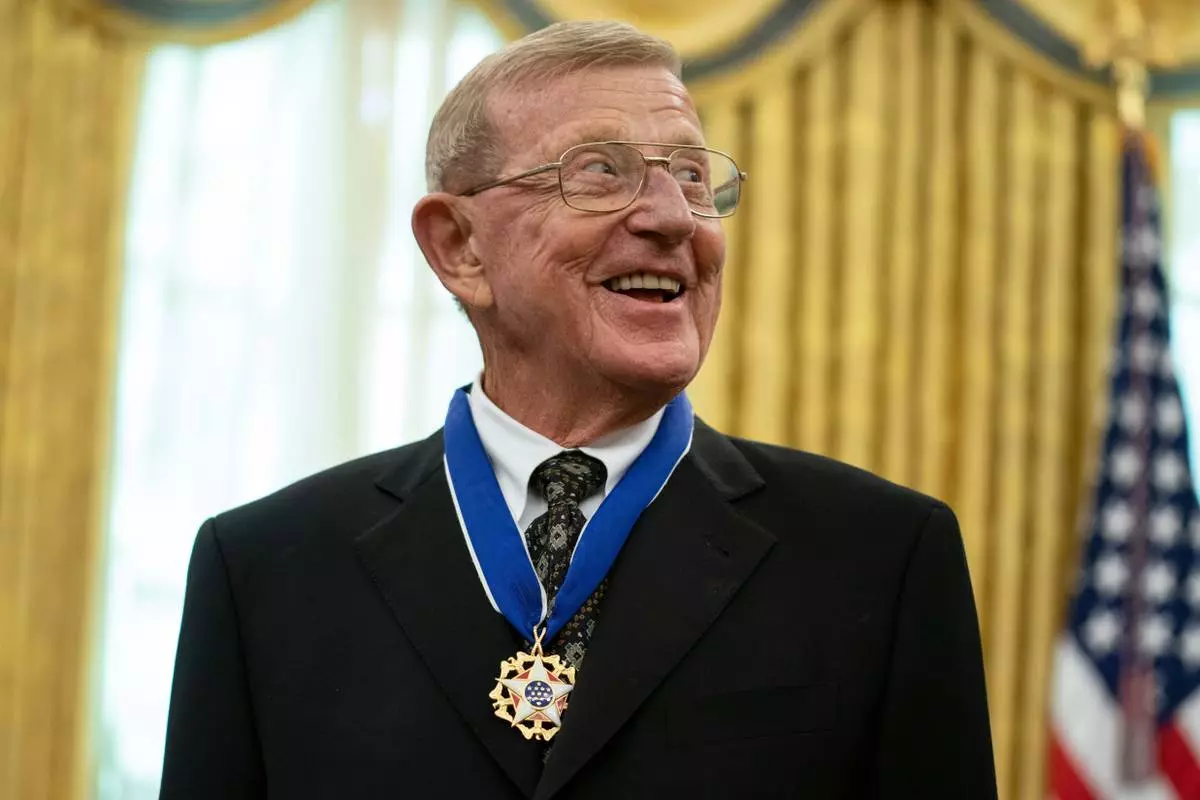
FILE - Former football coach Lou Holtz smiles after receiving the Presidential Medal of Freedom from President Donald Trump, Thursday, Dec. 3, 2020, in the Oval Office of the White House in Washington. (AP Photo/Evan Vucci, File)
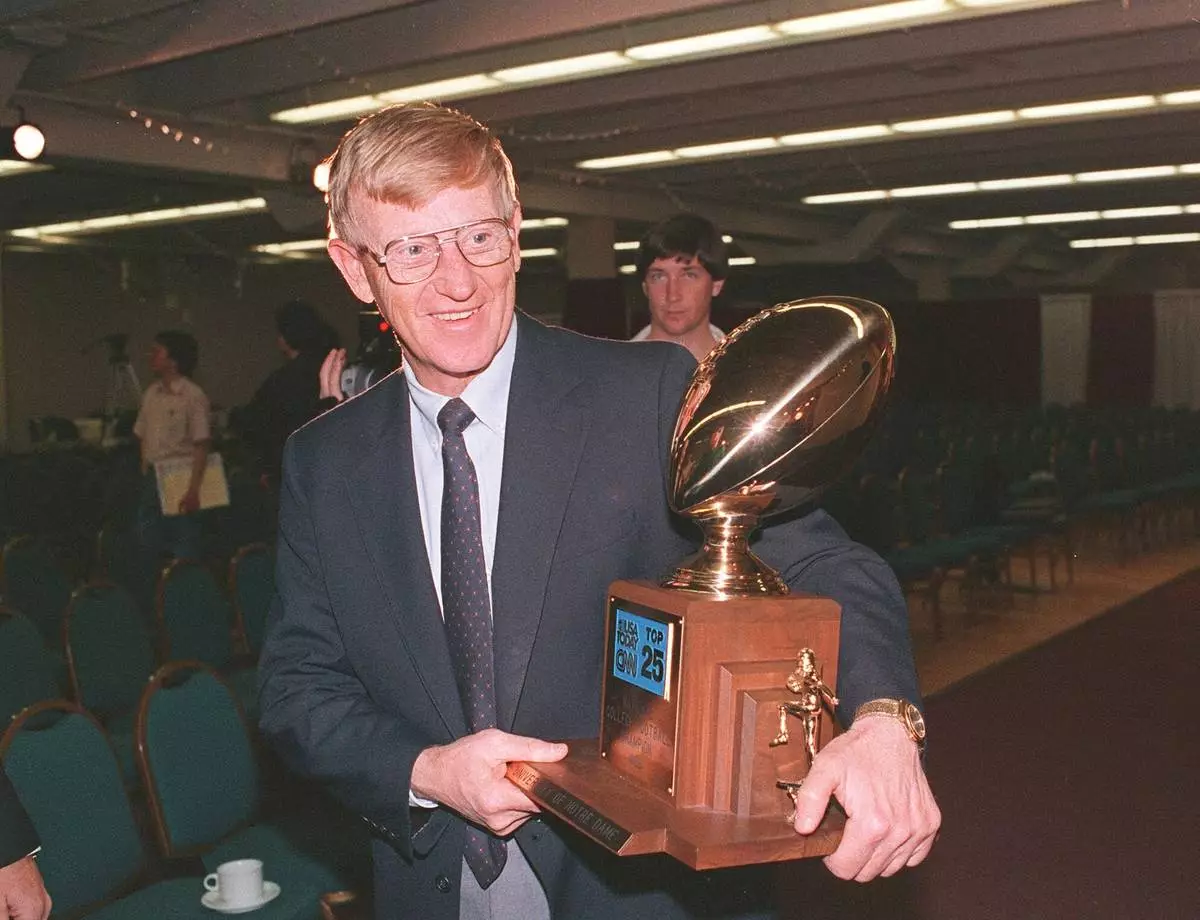
FILE - Notre Dame head coach Lou Holtz carries away the National College Champion Trophy following a news conference in Tempe, Ariz. in this Jan. 3, 1989 photo. (AP Photo/Rob Schmacher, File)
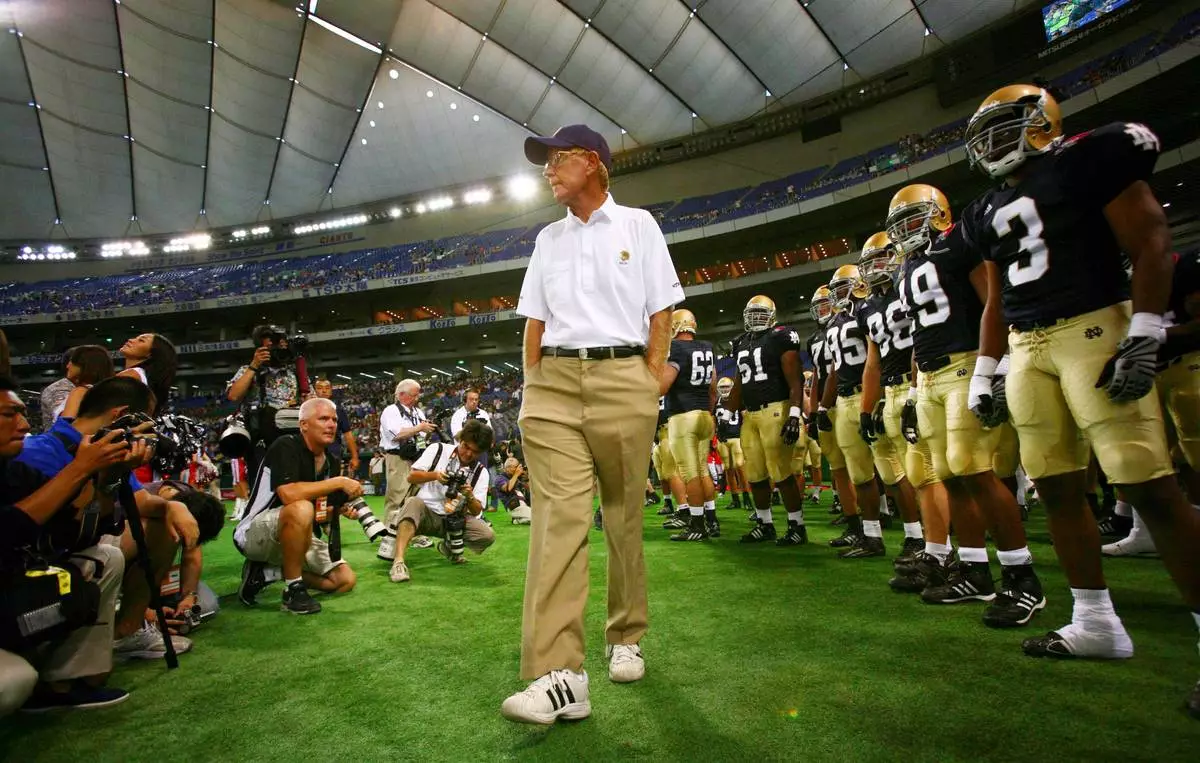
FILE - Notre Dame football coach Lou Holtz and his team players await before the start of their game against Japan's national American football team at the Notre Dame Japan Bowl in Tokyo, Saturday, July 25, 2009. (AP Photo/Junji Kurokawa, File)
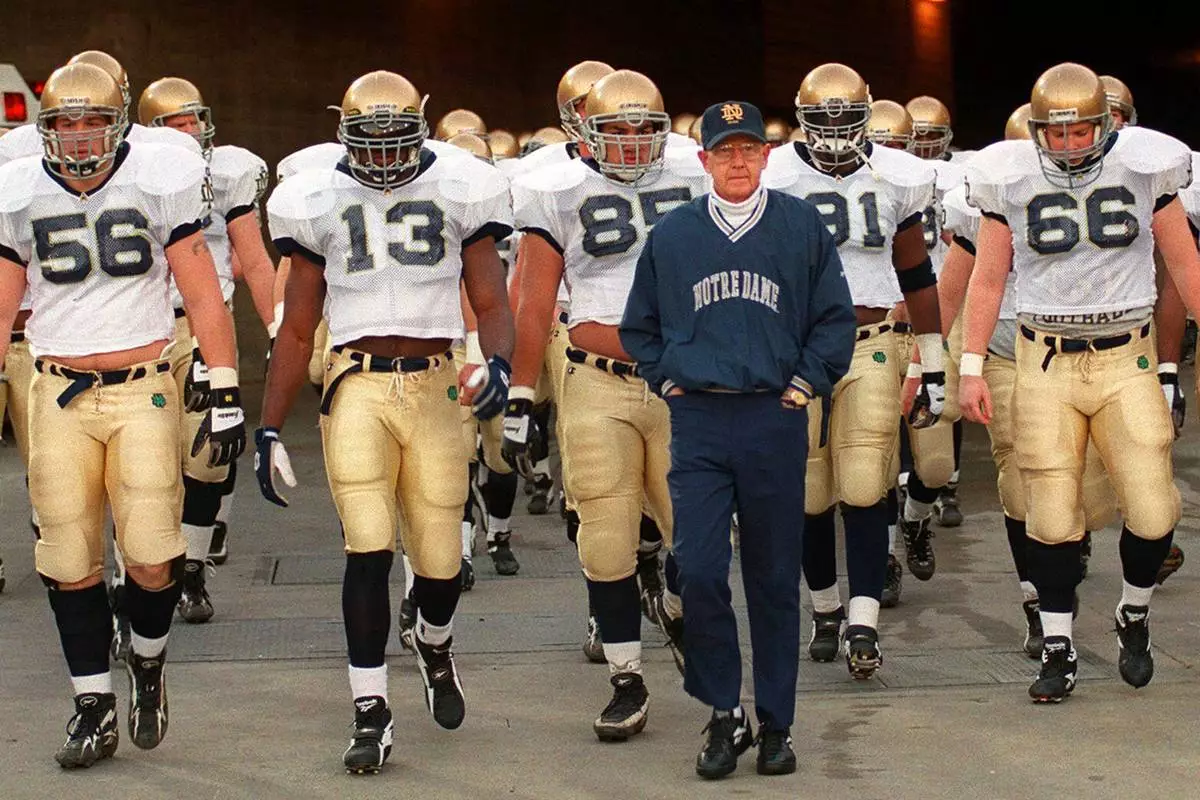
FILE - Notre Dame's head coach Lou Holtz and the Fighting Irish walk onto the field of the Los Angeles Coliseum to warm up for an NCAA college football game against Southern California Saturday, Nov. 30, 1996 in Los Angeles. (AP Photo/Kevork Djansezian, File)
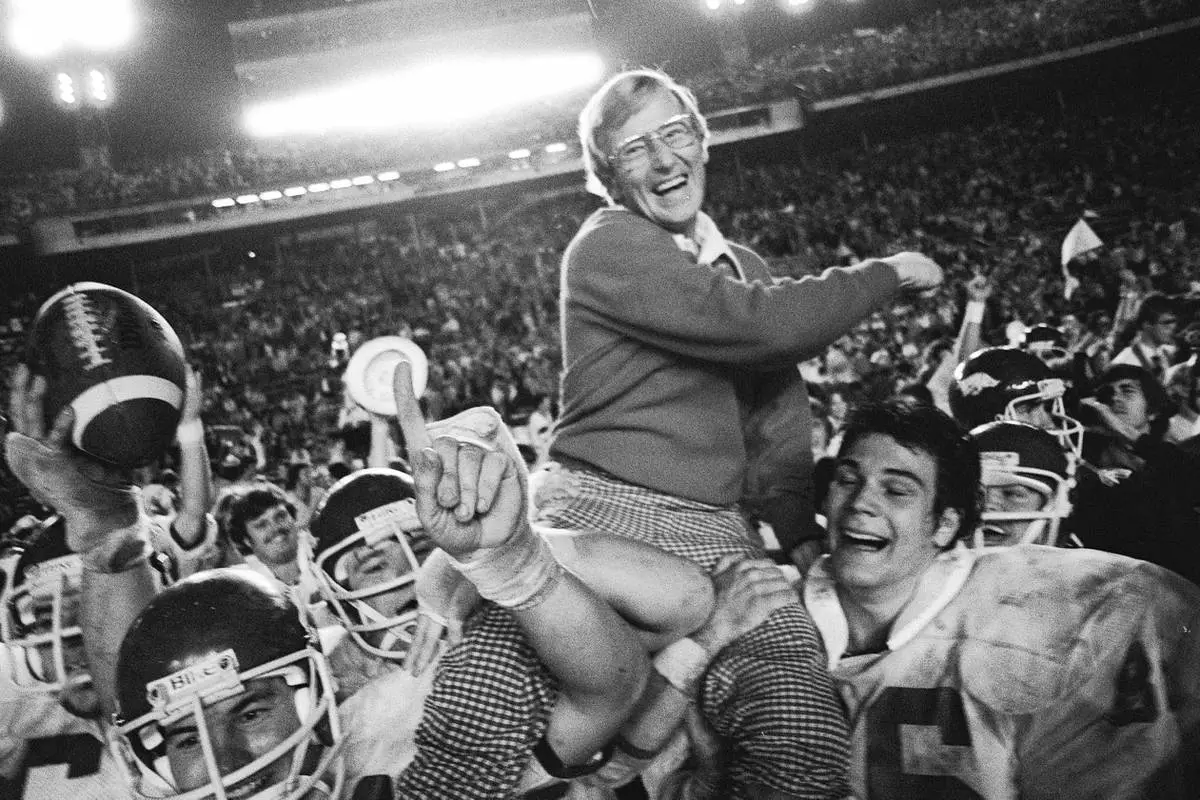
FILE - Arkansas coach Lou Holtz is carried by his players after defeating Oklahoma in the Orange Bowl NCAA college football game, Jan. 2, 1978, in Miami, Fla. (AP Photo/Phil Sandlin, File)