WASHINGTON (AP) — American employers unexpectedly cut 92,000 jobs last month, a sign that the labor market remains under strain. The unemployment rate blipped up to 4.4%.
Hiring deteriorated from January, when companies, nonprofits and government agencies added a healthy 126,000 jobs, the Labor Department reported Friday. Economists had expected 60,000 new jobs in February.
Revisions also cut 69,000 jobs from December and January payrolls.
The surprisingly weak employment picture in February adds to the economic uncertainty over the war with Iran, which has caused oil prices to surge and saddled business and consumers with unforeseen costs.
“The job market is struggling in the face of so many headwinds,” said Heather Long, chief economist at Navy Federal Credit Union. “Companies are going to be even more reluctant to hire this spring until the war ends and they can see consumers still spending. It’s a tense time for the U.S. economy.”
The job market had been expected to rebound this year from a lackluster 2025 when it was buffeted by President Donald Trump's erratic tariff policies, his purge of the federal workforce and the lingering effects of high interest rates. In 2025, employers added just 15,000 jobs a month. Hopes for a 2026 rebound rose after January hiring came in above expectations.
“Just when it looked like the labor market was stabilizing, this report delivers a knock-down blow to that view,'' said Olu Sonola, head of U.S. economics at Fitch Ratings. ”It’s bad news whichever way you look at it.''
The job losses were widespread.
Construction companies cut 11,000 jobs last month, which likely reflects frigid weather. And healthcare firms shed 28,000 jobs after a four-week strike by more than 30,000 nurses and other front-line workers at Kaiser Permanente in California and Hawaii. Health care has been one of the job market's strong points.
Factories cut 12,000 jobs and have now lost jobs for 14 of the last 15 months. Restaurants and bars lost nearly 30,000 jobs. Administrative and support services firms cut nearly 19,000 jobs and courier and messenger services almost 17,000.
Financial firms added 10,000 jobs, though job cuts continue to hit that sector as well this year.
Average hourly wages rose 0.4% from January and 3.8% from a year earlier.
The outlook for the job market – and the entire economy – is clouded by the war with Iran.
The combination of weak hiring and increasing inflationary pressures arising from the war creates a nightmare for the Federal Reserve, which must decide whether to cut interest rates to help the job market or hold off to help keep a lid on prices. “This is probably the worst scenario for monetary policy,″ said Eugenio Aleman, chief economist at Raymond James.
Employers were reluctant to hire last year because of uncertainty over Trump’s tariffs – and the unpredictable way he rolled them out.
The impact of Trump’s aggressive trade policies may recede in 2026. His import taxes became smaller and less erratic after he reached a trade truce last year with China and deals with leading U.S. trade partners such as Japan and the European Union. A lot of businesses have also learned how to offset the costs of the tariffs, often by passing them along to customers via higher prices.
Brian Bethune, an economist at Boston College, said that Trump’s 2025 tariffs were a shock to companies’ business plans. Now, just as they’ve adjusted to them, “Guess what! All of a sudden their 2026 business plans are upended by an increase in fuel costs’’ caused by the war with Iran.
Jay Foreman, CEO of the toy company Basic Fun, expects to get some relief from Trump’s tariffs after the Supreme Court last month struck down the biggest ones and potentially created a path for importers to get refunds for the levies they paid. The refunds would allow Foreman to invest more in his Boca Raton, Florida, company, which makes Lincoln Logs and Care Bears. He can also hand out more generous raises to employees and hire new people.
“We are expecting a record year,’’ he said.
Yet under new tariffs sought by Trump, Foreman estimates that Basic Fun’s tariff bill will more than double this year to $15 million. That is partly because the firm will be paying for a full year of Trump tariffs in 2026. Tariffs last year were not rolled out until spring or later.
AP Economics Writer Christopher Rugaber contributed to this report.
Anne D'Innocenzio reported from New York.

FILE - Construction workers install a lumber roof at a new home build Tuesday, April 1, 2025, in Laveen, Ariz. (AP Photo/Ross D. Franklin, File)
NEW YORK (AP) — The U.S. stock market is rising toward records Tuesday after an easing of oil prices let Wall Street turn its focus back to the big profits that companies keep producing.
The S&P 500 rose 0.6% and was on track to top its all-time high set at the end of last week. The Dow Jones Industrial Average was up 248 points, or 0.5%, as of 10:15 a.m. Eastern time, and the Nasdaq composite was heading toward its own record after climbing 0.7%.
Stocks got a boost after oil prices gave back some of their big jumps from Monday. The price for a barrel of Brent crude, the international standard, fell 3.3% to $110.70 after briefly topping $115 on Monday, though it’s still well above its roughly $70 price from before the war with Iran.
A ceasefire in the war appears to be holding, even after the United Arab Emirates said Monday that Iran fired missiles and drones at it. The U.S. military is trying to force open a path in the Strait of Hormuz, which would allow oil tankers to resume shipments from the Persian Gulf and hopefully bring down the price of crude.
Iran’s powerful parliamentary speaker and chief negotiator, Mohammad Bagher Qalibaf, accused the United States of undermining regional security with the effort to end Iran’s stranglehold on the strait and warned that Tehran will respond.
Even with the war ongoing, the U.S. stock market has remained remarkably resilient on its record-setting run. That’s in large part due to the strong profits that U.S. companies have reported for the start of 2026 despite the rise in oil prices since the end of February.
“This has been a ‘why ask why’ market,'” according to Scott Wren, senior global market strategist at Wells Fargo Investment Institute. “You just have to go with it.”
Even though many risks are still weighing on the market, “investors are looking at earnings” and how much companies are spending on AI data centers and other investments, he said.
DuPont’s stock rallied 8.7% Tuesday after the chemical giant led another cavalcade of companies reporting better-than-expected profits for the latest quarter.
DuPont said its water technologies business felt some impact because of the war with Iran due to logistics disruptions in the Middle East. But it nevertheless raised its forecasts for financial results over the full year due in part to its strong start to 2026.
Other winners included American Electric Power Co., which rose 1.8%, and Cummins, which added 1.7%, after they likewise made more money during the first three months of the year than analysts expected.
Pinterest soared 14% after the online bulletin board topped Wall Street’s first-quarter sales and profit targets as its number of active monthly users jumped 11% to 631 million.
AB InBev likewise topped analysts’ profit forecasts, and it credited growth for its Corona, Stella Artois and Michelob Ultra brands outside of their home markets. “Cheers to beer,” CEO Michel Doukeris said, as the company’s stock that trades in the United States jumped 9.2%.
They helped offset a drop for Palantir Technologies, which fell 4.3% even though it reported stronger results for the latest quarter than analysts expected. Its stock has struggled this year with worries about increased competition, like many software companies have. Its stock is also coming off a huge run where it more than doubled in each of the last three years.
In stock markets abroad, indexes were mixed in Europe. The CAC 40 rose 0.6% in Paris, but the FTSE 100 fell 1.7% in London. Many Asian markets were closed for holidays, as Hong Kong’s Hang Seng fell 0.8%.
Australia’s S&P/ASX 200 slipped 0.2% after the central bank raised its benchmark interest rate to 4.35%, saying conflict in the Middle East had sharply increased fuel and commodity prices that were already adding to inflation.
In the U.S. bond market, Treasury yields eased after oil prices gave back some of Monday’s gains and reports on the U.S. economy came in mixed.
One report said growth for U.S. services businesses unexpectedly decelerated last month, with some companies saying the war is slowing spending. A separate report said U.S. employers were advertising slightly more job openings at the end of March than economists expected, an encouraging signal for the job market.
The yield on the 10-year Treasury fell to 4.42% from 4.45% late Monday.
That’s still well above its 3.97% level from just before the war began. That rise has made mortgages and other kinds of loans for U.S. households and businesses more expensive.
AP Writers Chan Ho-him, Matt Ott and Rod McGuirk contributed.
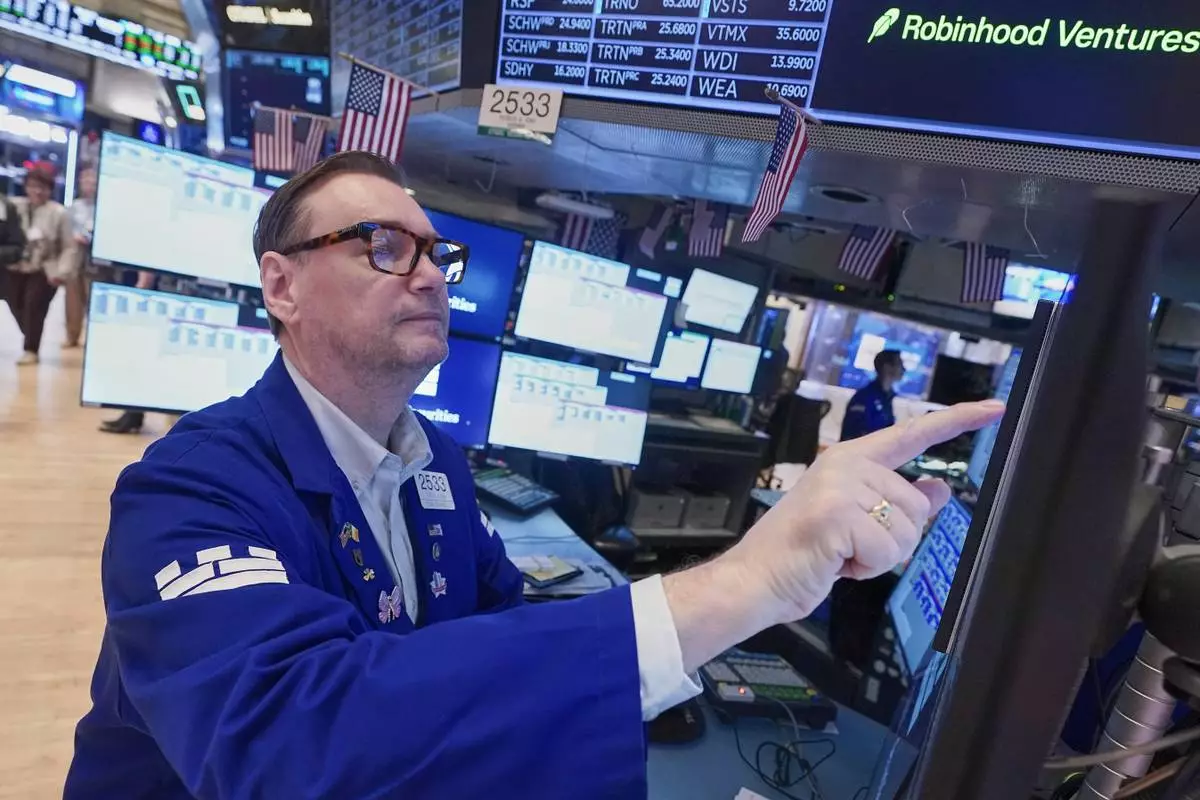
Specialist Patrick King works at his post on the floor of the New York Stock Exchange, Friday, May 1, 2026. (AP Photo/Richard Drew)
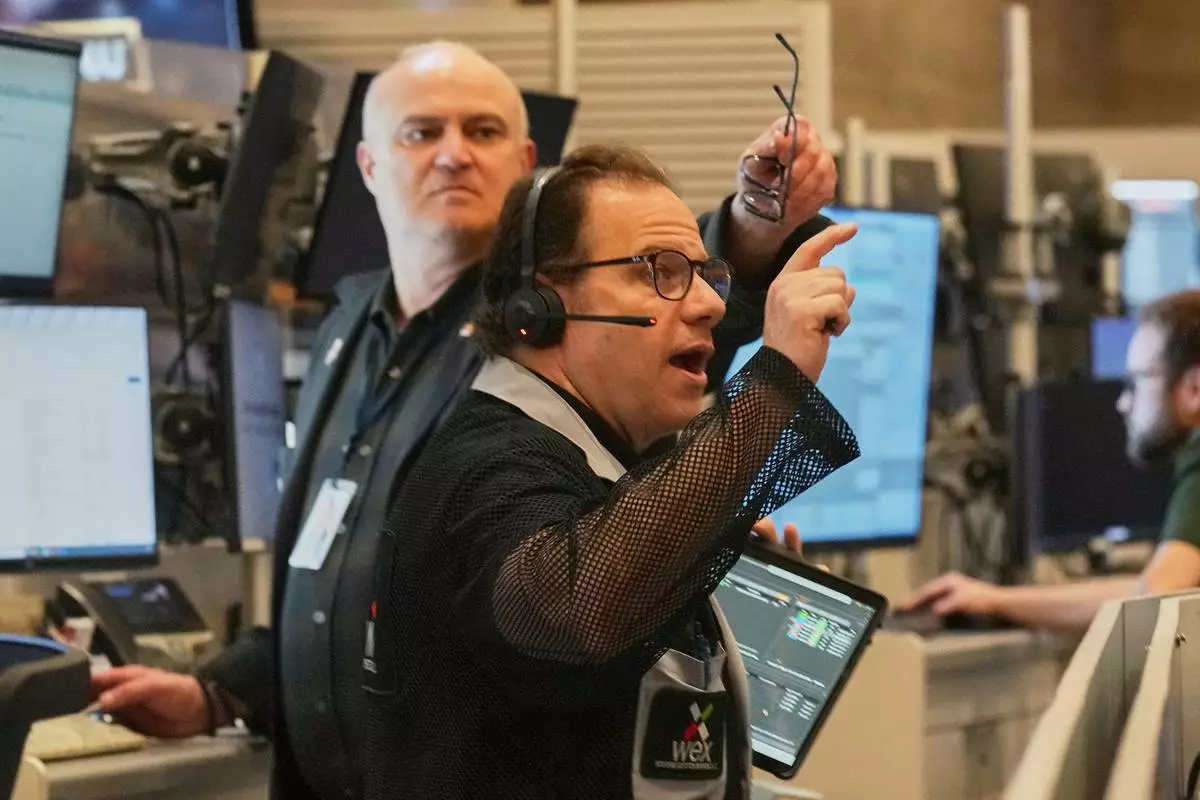
Options trader Anthony Spina, foreground, works on the floor of the New York Stock Exchange, Thursday, April 30, 2026. (AP Photo/Richard Drew)
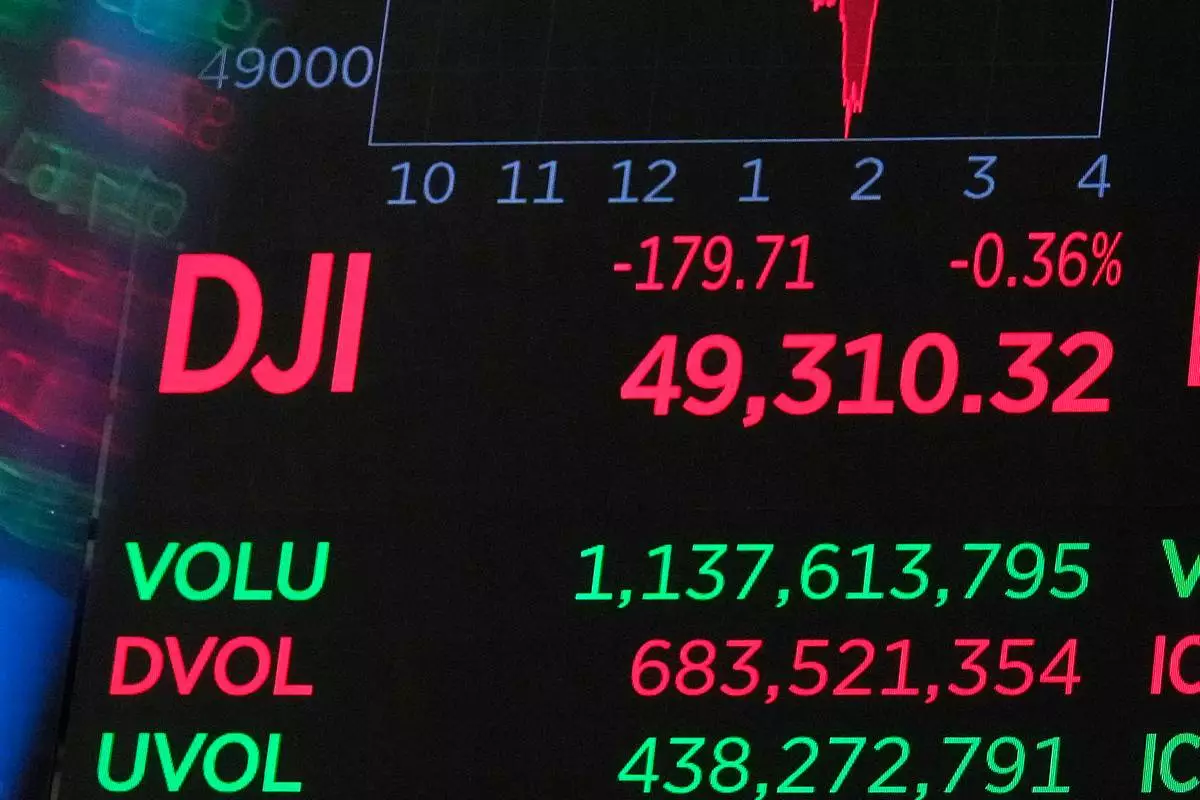
A board above the floor of the New York Stock Exchange displays the closing number for the Dow Jones industrial average, Thursday, April 23, 2026. (AP Photo/Richard Drew)
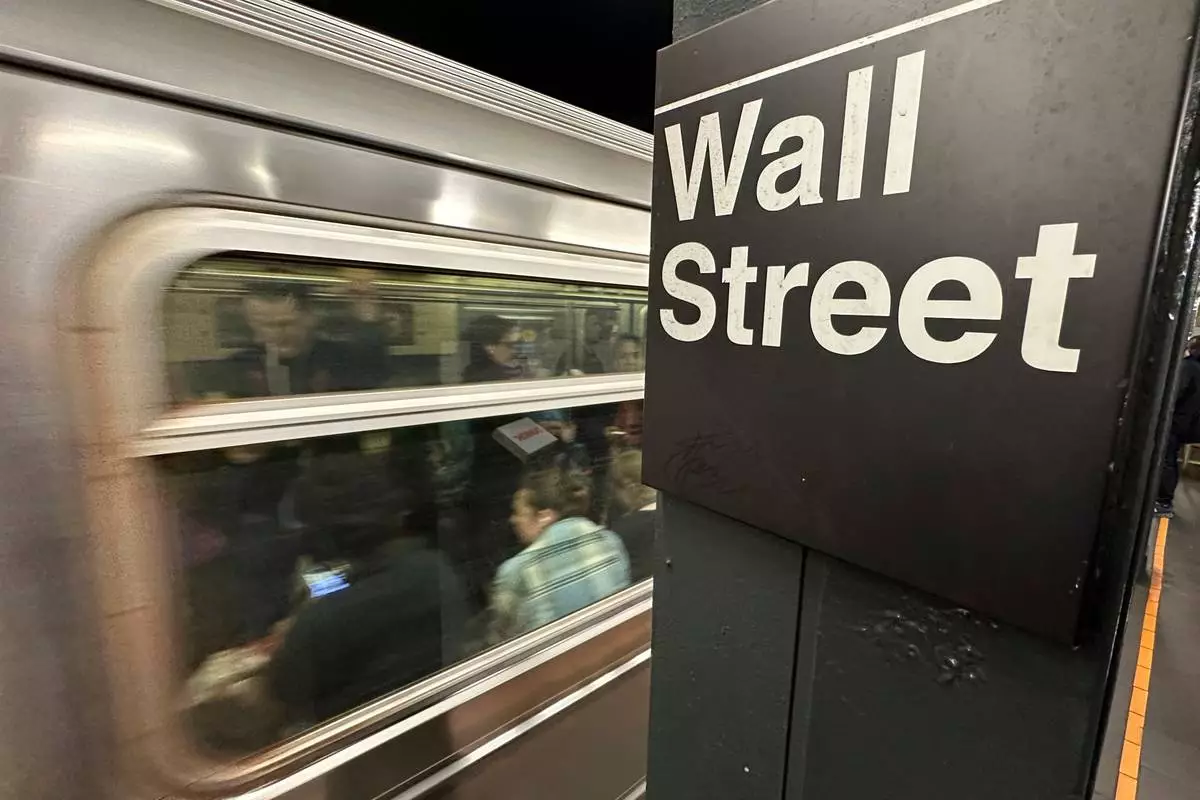
FILE - A train arrives at a Wall Street subway station in New York's Financial District on Nov. 5, 2024. (AP Photo/Peter Morgan, File)