Integrated and coordinated development in the Yangtze River Delta has accelerated the project of Controllable Nuclear Fusion of China, known as the "Artificial Sun" project, as research institutions and manufacturers across the region work together to boost the country's competitiveness in the field.
At the Science Island in Hefei, east China's Anhui Province, China's Experimental Advanced Superconducting Tokamak (EAST) facility, a site of the "artificial sun" project, is undergoing a new round of upgrading. The project relies heavily on collaborative supply chains across the Yangtze River Delta, an eastern China manufacturing hub covering Shanghai Municipality and the provinces of Jiangsu, Zhejiang and Anhui.
A key part of the reactor is its superconducting magnet system, which acts like a magnetic cage to confine and control plasma during fusion reactions.
"Some high-temperature superconducting materials come from Shanghai Superconductor Technology, while our armor materials are from companies in Zhejiang. The insulation materials are produced by enterprises in Jiangsu," said Zhou Chao, Director of the Superconducting Technology Research Center under the Hefei Comprehensive National Science Center.
While the "artificial sun" is extremely demanding for materials, most upstream and downstream manufacturers for the equipment can be found within the Yangtze River Delta region.
"All of our fusion equipment is custom-made and requires the highest performance of them. In a sense, the high requirements we put up have also promoted their industrial upgrading to some extent," said Zhou.
The nuclear industry cluster has facilitated the cooperation between academia and businesses.
In Hefei, installation is underway for a massive D-shaped superconducting coil for the China Fusion Engineering Test Reactor, the largest and most complex fusion coil designed by China. Manufacturers from Zhejiang have been standing by to provide quickest support throughout the process.
In Wuxi City of Jiangsu, a local company has been producing high-end forged metal components which could withstand extreme temperatures, radiation and magnetic fields. Since joining in the nuclear fusion project, the company's revenue from high-end forged components has grown by nearly 50 percent annually.
"About 60 percent of our main reactor components are manufactured in the Yangtze River Delta. The fusion industry alliance has grown from around 60 companies in 2023 to nearly 300 today, with about 80 percent from this region. This trend is very positive and helps shorten the process for commercial fusion applications," said Yang Qingxi, researcher at the Institute of Plasma Physics under the Chinese Academy of Sciences (CAS) in Hefei.
The collaborative advantage has brought in new orders of international projects. A consortium led by China National Nuclear Corporation and the Chinese Academy of Sciences has secured a contract related to the International Thermonuclear Experimental Reactor (ITER), one of the world's largest fusion experiments.
"Our commissions from ITER and our domestic research projects, along with the requirement for capacity building in scientific research, are driving demand that promotes the development of related high-end manufacturing across the Yangtze River Delta," said Yu Xuefeng, vice president of China Fusion Energy Cooperation.
According to the International Atomic Energy Agency, nearly 40 countries are currently pursuing fusion energy programs. The nuclear fusion cluster in the Yangtze River Delta has secured China's advancement in a full-chain ecosystem in the field.
China's roadmap suggests fusion burning experiments could begin around 2027, with the capability to build the country's first engineering test reactor around 2030. Plans envision completing that reactor by around 2035 and constructing China's first commercial demonstration fusion reactor by roughly 2045.
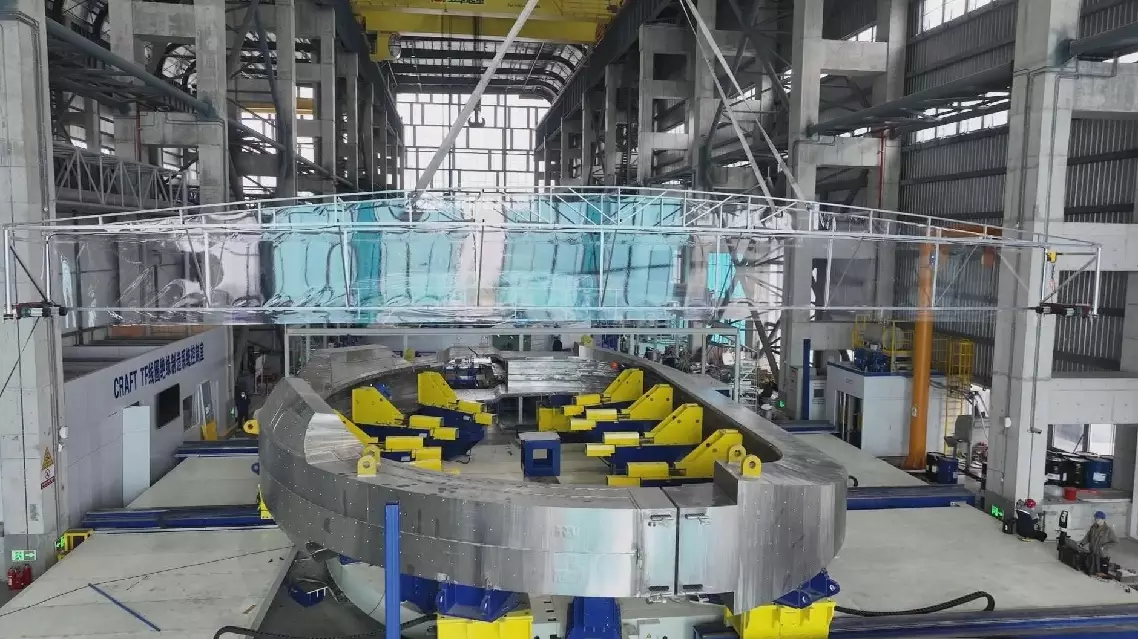
"Artificial Sun" project paces up in Yangtze River Delta