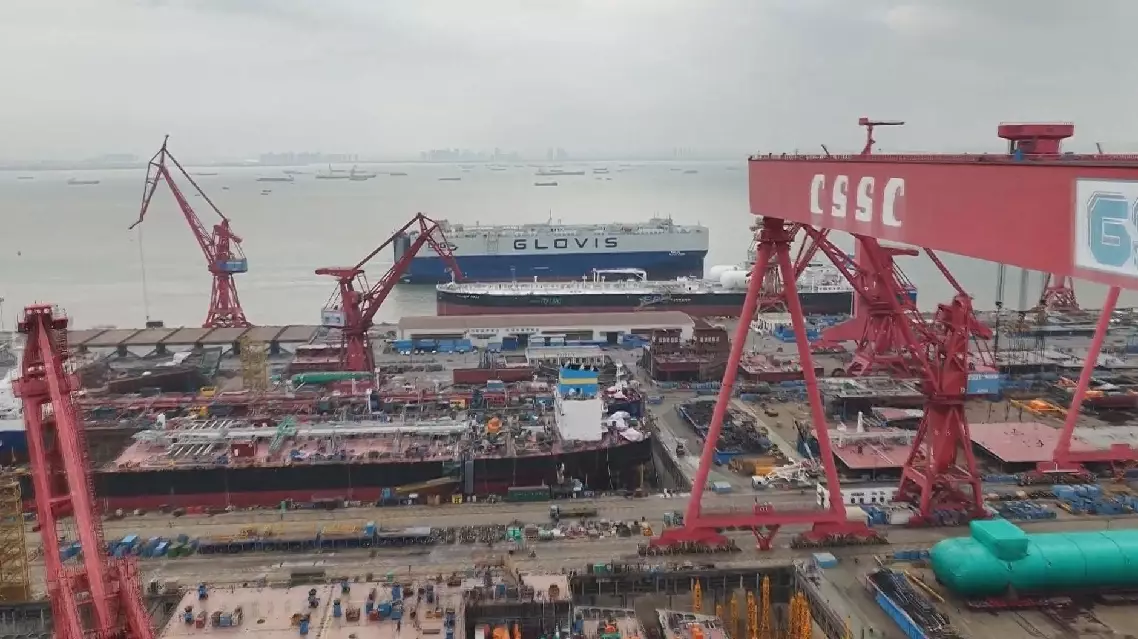
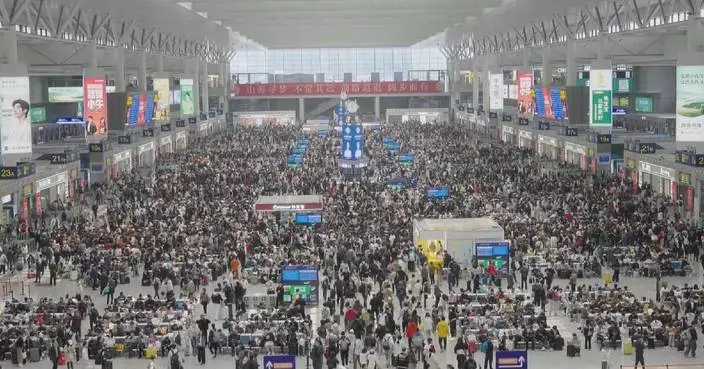
China's high-quality development not only prioritizes people's well-being but also brings more cooperation opportunities to the world, according to international observers who are closely watching the ongoing "two session" political meetings in Beijing.
The "two sessions" -- which refer to the annual meetings of China's top legislature, the National People's Congress (NPC), and its top political advisory body, the National Committee of the Chinese People's Political Consultative Conference (CPPCC) -- are a key event on the country's political calendar.
Global observers are keeping a keen eye on the event for signals on the development trajectory of the world's second-largest economy. The "two sessions" have also unveiled more insights into the key policy goals of China 15th Five‑Year Plan (2026‑2030), a blueprint which maps out China's socioeconomic development priorities for the coming years following the end of the previous five-year planning cycle.
Chib Jitniyom, vice chairman of Thai Senate Foreign Affairs Committee, hailed China's achievements gained during the previous 14th Five-Year Plan period (2021-2025), which he said demonstrated the country's commitments to advancing high-quality development.
"China's Two Sessions placed great emphasis on policy continuity. It is evident that the 14th Five-Year Plan has achieved remarkable progress - for instance, meeting the 5 percent economic growth target and steadily advancing industrial development as planned. In terms of industrial upgrading, the application of robotics has grown notably, with a 28 percent increase in the use of industrial robots. Urban ecological environments continue to improve, with the proportion of days with good air quality rising to nearly 90 percent," he said.
"China has also made remarkable achievements in expanding its green area, becoming the country with the fastest growth rate and largest increase in forest resources globally, with the forest coverage rate exceeding 25 percent. Most noteworthy is the technology sector: China's new energy vehicle industry has achieved remarkable results, with an annual output of 16 million vehicles and the number of charging facilities surpassing 20 million. These can all be seen as concrete manifestations of 'high-quality development'," said Chib.
African observers highlighted China's development of "new quality productive forces" -- which puts a focus on sci-tech innovation -- saying it is essential for long-term economic growth in the digital age.
They further noted that China's consistent commitment to innovation - particularly in digitization and green energy - has had a profound impact not only on Asia but across Africa and the entire world.
"Developing 'new quality productive forces' helps China to shift from labor-intensive manufacturing to high value technology. As you know, China is trying to improve the world in terms of the technology part of the usage in the world. Because we are living now in the digital and modernized space of technology, so this transformation supports the long-term economic growth and the competitiveness of it," said Luyanda Jonas, President of the China-South Africa Youth Federation.
"The consistency and the work ethic and the leadership, its commitment to such novel ideas like digitization, green energy, renewable energy. These were favored in the preceding five-year plan [and] has really impacted not just on Asia, but the entire global space," said Ali Muhammad Ali, managing director and CEO of the News Agency of Nigeria (NAN).
Other international figures noted that China's emphasis on accelerating self-reliance and strength in high-level science and technology has yielded top tech innovations that have captured the world's attention.
"I am deeply impressed by China's achievements in the field of technological innovation. China has developed rapidly in numerous areas, including space science and artificial intelligence. Compared with other countries, China holds a significant advantage in the field of intelligent manufacturing. I had the opportunity to visit a 100 percent automated automobile production line. I have studied many different development models around the world, but the one that has left the deepest impression on me is the Chinese model - particularly the close linkages between China's technology sector, industry, and public sector institutions. China's new five-year plan places special emphasis on self-reliance and strength in high-level science and technology. In the face of the severe challenges posed by the current geopolitical landscape, self-reliance in the technological sphere is particularly crucial," said Marija Gnjatovic, State Secretary of Ministry of Science, Technological Development and Innovation, Serbia.
"The economic data released by China's Premier Li Qiang reflects a reality: the Chinese economy is demonstrating quite surprising resilience. We also see that China continues to innovate - and in areas that are clearly extremely important. From the perspective of innovation value-added, whether it is sustainable development, artificial intelligence, photovoltaics, or nuclear energy, all areas closely related to the transformation of China's economic paradigm are steadily advancing. This point is very clear," said Emmanuel Lincot, senior research fellow of French Institute for International and Strategic Affairs (IRIS).

China's high-quality development brings cooperation opportunities to world: int'l observers