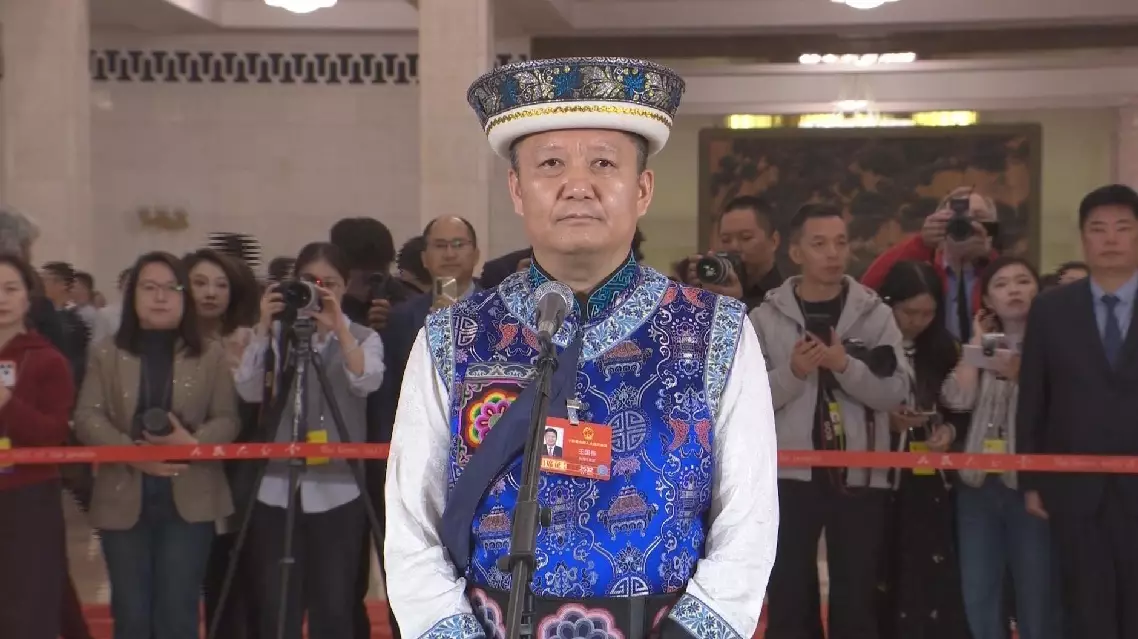
Developing specialty industries and clean energy have boosted rural prosperity in Huzhu Tu Autonomous County in northwest China's Qinghai Province over the past 10 years, Wang Guodong, a deputy to the National People's Congress (NPC), said on Thursday.
Speaking during a group interview on the sidelines of the fourth session of the 14th NPC at the Great Hall of the People in Beijing, Wang, also secretary of the Party Committee of Huzhu Tu Autonomous County, further elaborated on the country's achievements gained in 10 years since Chinese President Xi Jinping visited the place in 2016.
On August 23, 2016, Xi went to Huzhu Tu Autonomous County of Qinghai's Haidong city and visited Banyan Village, a resettlement for poverty alleviation in the county.
During the visit, Xi said that the development of new villages should be integrated with agricultural development and job creation, alongside improvements in basic public services and the preservation of ethnic, local and cultural characteristics.
Supported by the government's favorable policy, villagers in Huzhu County have broadened their income sources through a range of industries, including supplying high-altitude, cool-climate vegetables to the Greater Bay Area.
"With supportive policies from the Party and the country, local residents have rolled up their sleeves to work hard and develop specialized industries. Villagers have begun growing Changbai scallions, opening farm-stays at home, and taking up domestic service jobs elsewhere in the country. As a result, the paths to prosperity have continued to widen," Wang said.
"Take vegetables for example. Huzhu County is a major agricultural county in Qinghai Province. With its high altitude, long hours of sunshine, and large temperature differences between day and night, the vegetables grown here are not only nutritious and delicious but also green, organic, and healthy. Since 2019, we have been building vegetable bases for supply to the Hong Kong and Macao special administrative regions. Our cool-climate vegetables, grown at this plateau county at an altitude of 2,500 meters, travel more than 2,000 kilometers and, after more than 40 hours on the road, arrive on dining tables in the Guangdong-Hong Kong-Macao Greater Bay Area," said Wang.
Wang added that by following the national "dual carbon" strategy, which refers to peak carbon and carbon neutrality, Banyan Village has built a solar-powered microgrid that provides villagers with annual dividends and cleaner, more convenient living conditions.
"In recent years, by closely following the country's strategic deployment to achieve the 'dual carbon' goals, we have fully tapped Banyan Village's clean energy potential. A centralized photovoltaic power station has been built in the new village, creating an integrated microgrid that combines power generation, grid, load and storage. Every year, villagers can receive a dividend of 2,500 yuan just from the surplus electricity generated by the solar panels. Nowadays, every household has access to natural gas and uses electric heated beds. As a result, the lives of the villagers are becoming more and more convenient, and the new village's environment is growing increasingly beautiful!" said Wang.
Developing specialty agriculture, clean energy projects boost rural prosperity in northwest China: NPC deputy