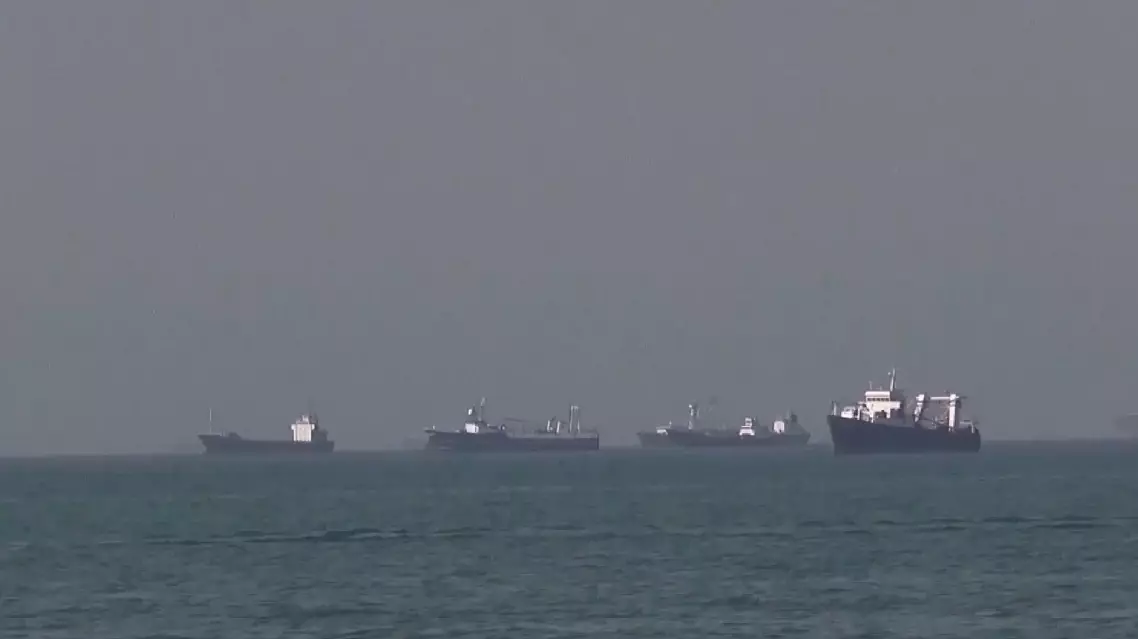
China's newly commissioned Type 055 large guided-missile destroyer Anqing (Hull 110) has successfully completed its first realistic maritime combat training exercises, marking a significant step in the PLA Navy's modernization and operational readiness.
Forming a fleet with several other types of vessels, the Anqing recently headed to a designated sea area to conduct intensive drills focusing on more than 10 specialized training subjects. This inaugural mission was designed to hone the troops' capabilities in executing diversified tasks under realistic combat conditions.
During the voyage, the Anqing and the Type 052D guided-missile destroyer Xigaze (Hull 159) -- both participating in their first sea-based combat training -- carried out exercises including joint maritime search and rescue, maritime replenishment, and damage control. These drills were aimed not only at testing the performance of the ships' advanced equipment but also at accelerating the generation of combat capabilities among the officers and sailors.
"During this training, our focus is on accelerating the operational effectiveness of new equipment, testing new combat tactics, and tapping into new potentials. The motherland has entrusted us with the most advanced equipment. Mastering its use is merely a passing grade; only by pushing its performance to the absolute limit can we be considered outstanding," said Liu Sizheng, a crew member of the Anqing.
The training transitioned seamlessly into anti-submarine warfare (ASW) upon the fleet's arrival in the mission zone. Anti-submarine helicopters were rapidly deployed to establish an integrated sea-air network, searching for underwater targets in coordination with the surface vessels.
As the formation continuously shifted and vessels maintained close coordination, the missile destroyer Suzhou was the first to detect a simulated submarine. Anti-submarine helicopters and the surface vessels quickly occupied advantageous positions, locked onto the target, and executed a simulated strike.
Throughout the exercise, whether performing individual ship operations such as anti-surface strikes and air defense or conducting fleet-wide coordinated maneuvers, all vessels were integrated into a unified information and command system. This networked approach ensured real-time information sharing and allowed for the use of data to evaluate combat effectiveness.
"Throughout the entire exercise, we established a realistic far-sea combat scenario, deeply integrating anti-submarine warfare elements such as ship and aircraft platforms and weapon systems. We successfully overcame challenges like limited search methods and slow target identification encountered during independent anti-submarine operations. This has further validated our capabilities in ship-aircraft coordinated anti-submarine warfare and joint operations," said Zhou Junji, a crew member of the Suzhou.

China's Type 055 destroyer Anqing completes first maritime combat drills