Wildlife patrol teams in the central Chinese province of Hunan have been operating at all hours to fit migratory birds with camera-mounted tags, as part of sustained conservation efforts centered on tracking migration routes and stopovers.
The teams operate around Dongting Lake, the country’s second-largest freshwater lake and a major wintering spot. Each year, it is visited by over 50 million migratory birds. Many travel thousands of kilometers, some from as far as Siberia, to overwinter from November to late March.
At Duoganzhou Protection Station in the South Dongting Lake Nature Reserve, researchers patrol the wetland every day during the season. One of their missions is to track birds and fit them with camera tags after dark.
Recently, a team located a pair of swans using drones equipped with infrared detection and dropped a capture net from above, employing a commonly used capture method worldwide that minimizes harm to the birds.
Once the swans were in the net, the team rushed to reach the swans within 10 to 20 minutes. Leaving them stranded for longer than that would put the birds at risk of hypothermia, said Tang Ning, an expert with the Hunan Global Messenger Technology Company, which supplies equipment for the patrol team.
With the birds located, the team deployed camera tags on the necks of the swans after recording wing length, body weight, and other information. Then, they released them.
The next day, footage began coming back, showing the swans swimming, interacting, and foraging.
"Why do we attach trackers to larger bird species? Because they’re more likely to survive. After two or three years, the data we collect -- migration routes, stopover sites -- can provide important insights. If we share it, that data could really help future conservation efforts," said Niu Yandong, an expert with the Hunan Academy of Forestry.
The patrol teams' efforts are part of a broader national push. As wetland loss across various countries began threatening the flyway, China has enacted its first Wetland Conservation Law in 2022. About 290,000 hectares have been restored, with more than 1,000 key habitats identified.
China has been continuously strengthening the protection of major rivers and lakes, with the proportion of surface water with good quality rising to 91.4 percent. As a result, migratory birds have increasingly returned.
"We've been making small adjustments to the wetland all along, to make the wetland more hospitable for birds, and building sandbars. Because there are many kinds of birds, some with long legs, some with short legs, we want all of them to be able to live here together. So, the whole food chain stays healthy, and everyone gets something to eat," said Long Xianjie, director of the Duoganzhou Protection Station at South Dongting Lake Nature Reserve.
This winter, a record high of more than 480,000 birds are wintering in Hunan, and over 470,000 of them were found in the Dongting Lake area.
Since 1981, China has joined global efforts in migratory bird protection -- from bilateral agreements to the East Asian-Australasian Flyway Partnership and Ramsar Convention.
Today, the country is home to over 1,500 bird species, accounting for 13 percent of the world’s total.
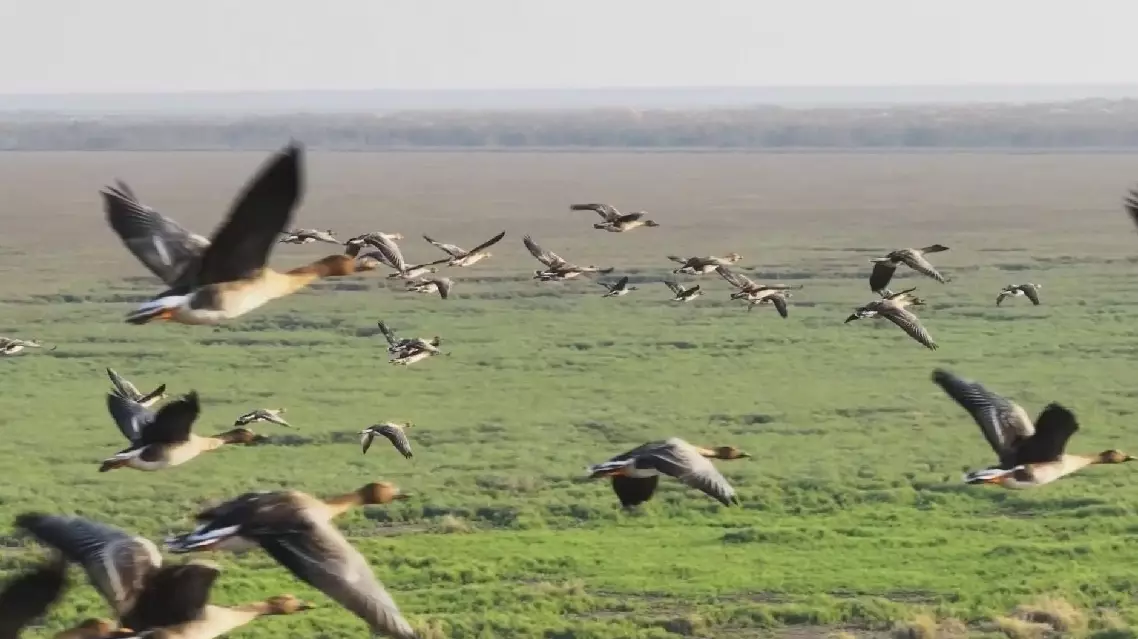
Chinese conservation teams mount cameras on migratory birds to track routes