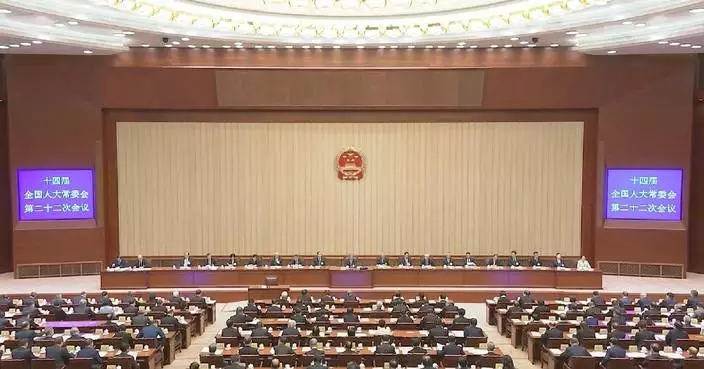
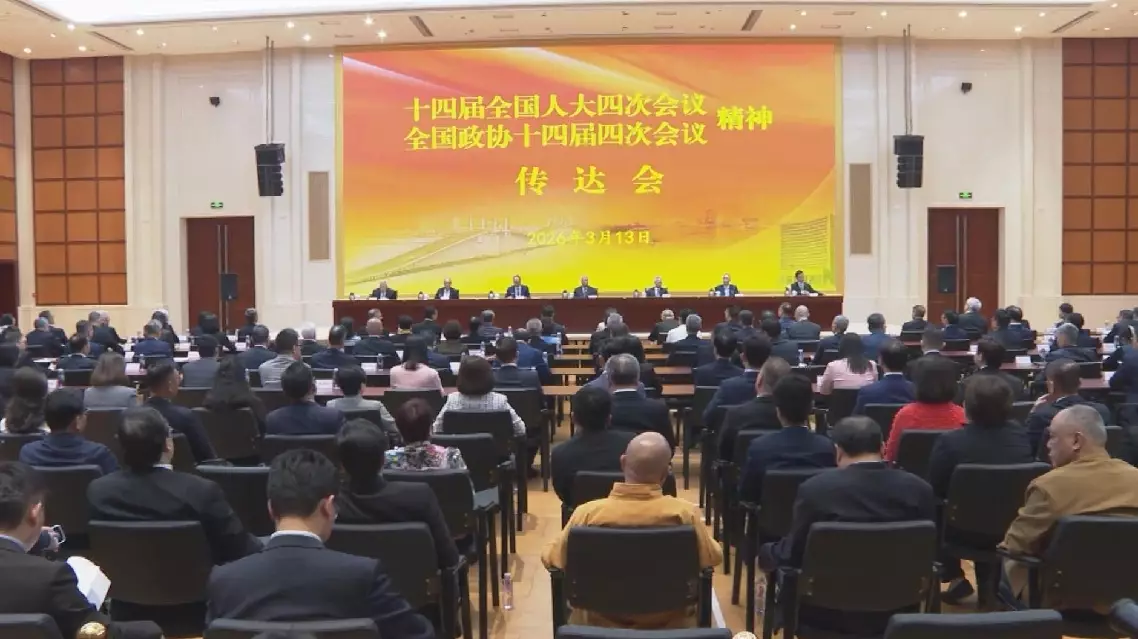
The Liaison Office of the Central People's Government in the Macao Special Administrative Region (SAR) held a meeting on Friday to publicize the guiding principles and policy priorities of the just-concluded "two sessions".
The "two sessions" this year refer to the fourth session of the 14th National people's Congress (NPC), held from March 5 to 12, and the fourth session of the 14th National Committee of the Chinese People's Political Consultative Conference (CPPCC), held from March 4 to 11.
At the meeting, Lao Ngai Leong, head of the Macao delegation to the NPC, briefed the audience on the guiding principles of the NPC's annual session, while Chui Sai Cheong, a member of the CPPCC National Committee, introduced the guiding principles of the CPPCC annual session.
More than 160 government officials and representatives from all sectors in Macao attended the meeting.
Sam Hou Fai, chief executive of the Macao SAR, said the "two sessions" this year carried great significance as a bridge between the past and the future.
He urged efforts to translate the guiding principles of the "two sessions" into concrete actions, and continuously write new chapters in Macao's development by participating in and contributing to the building of a great country and the great cause of national rejuvenation.
"The 15th Five-Year Plan (2026-2030) of our country has brought new and major development opportunities to Macao. As long as we remain confident in development, strengthen our sense of responsibility and practical work, give full play to Macao's unique advantages, proactively align with the national development strategy, and promote high-quality advancement of all construction undertakings in Macao, we will surely realize the beautiful visions of 'Macao Built on the Rule of Law', 'Dynamic Macao', 'Cultural Macao', and 'Happy Macao'. This way, we can continue to write new chapters in the great cause of 'one country, two systems' with Macao's characteristics, and make new and greater contributions to Chinese modernization," said Sam.
Macao officials briefed on policy priorities from "two sessions" as chief executive urges concrete actions
Rising military tensions in the Persian Gulf are casting a heavy shadow over Iraq's economy, raising concerns about the fate of oil exports and maritime trade.
The recent targeting and burning of two foreign tankers carrying Iraqi oil within Iraq's territorial waters marks a significant escalation, signaling that a closure of the Strait of Hormuz is now a tangible threat. Such a scenario would halt Iraq's oil exports to global markets, dealing a severe blow to an economy that relies on oil revenues as its main source of funding for both operational and investment budgets.
With the main maritime route for its oil exports disrupted, Iraq is now looking to the central bank's reserves to cushion the shock of lost oil revenues and to ensure the payment of government employees' salaries.
"The other impact Iraq fears is the economic fallout from the closure of the Strait of Hormuz. This will affect Iraq just as it will other countries, but it will hit Iraq harder, because Iraq relies mainly, almost 90 percent of its resources, on oil sales. So the economic impact on Iraq will be significant. The consequences are both political and economic," said Hamza Mustafa, an Iraqi journalist.
The Iraqi government has few alternatives for exporting oil through other routes. The Ceyhan pipeline, which carries Iraqi oil through Turkey, remains shut, leaving the Gulf, now a conflict zone, as the only outlet. Recently, Iraqi officials have begun discussing the need to boost non-oil revenues to mitigate the economic impact of the ongoing conflict.
"We are doing everything in our power to keep this war away from our country, because Iraq cannot withstand more conflict. Our country has reached a critical economic stage in recent years, both before and after the previous regime. We have learned many lessons. As parliament, we will push for decisions that serve our citizens and our country," said Saqr Al-Muhammadawi, a member of Iraq's parliament.
According to a statement by Alireza Tangsiri, commander of the Iranian Navy, the Strait of Hormuz has not yet been militarily blocked and is merely under control. The strait "is only closed to the tankers and ships belonging to our enemies, to those who are attacking us and their allies. Others are free to pass," he said.
Gulf tensions raise fears for Iraqi's oil-funded economy