WASHINGTON (AP) — Multiple political storylines will converge in Illinois on Tuesday when the state holds primaries shaped by attempted comebacks, the retirement of longtime incumbents and the looming 2028 presidential campaign.
Voters will choose nominees for a full slate of offices, including governor, U.S. Senate, U.S. House, the state Legislature and local offices.
Topping the ballot is the race to succeed Democratic U.S. Sen. Dick Durbin, who is retiring after five terms. Among the Democrats running are U.S. Reps. Robin Kelly and Raja Krishnamoorthi and Lt. Gov. Juliana Stratton, who has Democratic Gov. JB Pritzker’s endorsement. The Republican field includes former state Republican Party chair Don Tracy and attorney Jeannie Evans.
Krishnamoorthi dwarfed both fields in fundraising at the end of February, with about $6.6 million in the bank after transferring more than $19 million from his U.S. House campaign account. Tracy was the top fundraiser among Republicans, with about $1.8 million in the bank.
Unlike the state’s other U.S. Senate seat, which recently ended a streak of five consecutive occupants who served for one term or less, Durbin’s seat has had much less turnover. Durbin took office in 1997 and is only the second person to hold the seat in more than 40 years.
In the race for governor, Pritzker is unopposed in his bid for renomination. President Donald Trump’s return to office in 2025 has heightened Pritzker’s national profile, and the two-term incumbent governor is now among a handful of Democrats dominating speculation about the 2028 Democratic presidential race.
In the Republican primary, four candidates look to thwart Pritzker’s reelection bid in November, including former state Sen. Darren Bailey, who lost to Pritzker in the 2022 governor's race.
The state’s largest counties tend to play a critical role in both Democratic and Republican primaries, with Chicago's Cook County by far the largest prize. In the Senate race, eight of the 10 Democrats running are from Chicago or its nearby suburbs in Cook County, potentially diluting any hometown advantage in the region.
The winners of statewide Democratic primaries typically have an advantage heading into November, considering Democrats have won recent key statewide general elections with more than 55% of the vote.
In the U.S. House primaries, Kelly’s and Krishnamoorthi’s Senate bids and the retirements of longtime Democratic U.S. Reps. Danny Davis and Jan Schakowsky have attracted crowded fields of candidates running to replace them.
Among the hopefuls are two former Democratic members mounting political comebacks. In the 2nd Congressional District, Jesse Jackson Jr. is running to replace Kelly, who replaced Jackson in 2013 following his conviction in a campaign fraud case. He is the son of civil rights leader the Rev. Jesse Jackson, who died Feb. 17. His primary opponents include Cook County Commissioner Donna Miller and state Sens. Robert Peters and Willie Preston.
In the 8th Congressional District Democratic primary, former U.S. Rep. Melissa Bean is running to replace Krishnamoorthi in a field that includes Neil Khot, Junaid Ahmed and Dan Tully. Durbin’s pick in the race is his former aide Yasmeen Bankole.
The Associated Press does not make projections and will declare a winner only when it’s determined there is no scenario that would allow a trailing candidate to close the gap. If a race has not been called, the AP will continue to cover any newsworthy developments, such as candidate concessions or declarations of victory. In doing so, the AP will make clear that it has not yet declared a winner and explain why.
Illinois does not have an automatic recount law. Candidates who receive at least 95% of the first-place candidate’s vote may request and pay for a limited recount, but the recount results are nonbinding and will not change the outcome of the election. A court may also order a recount as part of an election contest case. The AP may declare a winner in a race that is subject to a recount if it can determine the lead is too large for a recount or legal challenge to change the outcome.
Here are some of the key facts about the election and data points the AP Decision Team will monitor as the votes are tallied:
Polls close at 7 p.m. local time, which is 8 p.m. ET.
The AP will provide vote results and declare winners in contested primaries for U.S. Senate, U.S. House, governor, secretary of state, comptroller, state Senate and state House, as well as some local races in Cook, DuPage, Kane and Will counties. Some additional statewide offices, such as state attorney general and treasurer, will also be on the ballot, but the races are uncontested, aside from the write-in option.
Any eligible voter may participate in any party’s primary. Illinois allows voters to register on Election Day.
As of Friday, there were about 8,976,000, registered voters in Illinois. The state does not register voters by party.
About 857,000 votes were cast in the 2022 Democratic U.S. Senate primary and about 715,000 in the Republican primary. Roughly 33% of the total vote was cast before primary day.
More than 535,000 ballots had already been cast in the primary as of Friday.
In the 2024 presidential primaries, the AP first reported results in Illinois at 8:09 p.m. ET, or nine minutes after polls closed. The last vote update of the night was at 2:11 a.m. ET, with about 92% of total votes counted.
While a handful of Illinois counties may release early and absentee vote results at the start of the night, the bulk of counties merge them with Election Day results throughout the night or release them toward the end of the tabulation process.
As of Tuesday, there will be 231 days until the 2026 midterm elections.
Follow the AP’s coverage of the 2026 election at https://apnews.com/projects/elections-2026/.

FILE - Illinois Gov. JB Pritzker, left, and Republican gubernatorial challenger state Sen. Darren Bailey participate in the Illinois Governor's Debate at the WGN9 studios, Oct. 18, 2022, in Chicago. (AP Photo/Charles Rex Arbogast, File)

FILE - Candidates for the U.S. Senate, U.S. Rep. Robin Kelly, D-Ill., left, U.S. Rep. Raja Krishnamoorthi, D-Ill., center, and Democratic Illinois Lt. Gov. Juliana Stratton participate in a Democratic primary debate in Chicago, Feb. 19, 2026. (AP Photo/Nam Y. Huh, File)
WASHINGTON (AP) — The Department of Homeland Security will soon be under new management, an opportunity to reset President Donald Trump’s immigration agenda or to double down on his signature campaign promise to conduct the largest deportation operation in American history.
The White House's political director recently encouraged party lawmakers during a retreat at the Republican president’s golf club in Florida to focus on immigration enforcement against criminals, a pivot from the mass deportation agenda he ran on. House Speaker Mike Johnson said the aggressive operations have created a “hiccup” for the party, which is now embarking on a “course correction.”
Yet all indications are that Trump’s mass deportation operation is not stalling out but intensifying, with billions of dollars being spent to hire Immigration and Customs Enforcement officers, build warehouse detention sites and meet the administration’s goal of rounding up and removing some 1 million immigrants from the U.S. this year.
“We are at an interesting moment where it has been an inflection point — the public has finally seen what mass detention and mass deportation mean," said Sarah Mehta, who tracks the issue at the American Civil Liberties Union.
"This is not an agency that’s slowing down,” she said. “They’re really going forward with some of the cruelest policies.”
White House spokeswoman Abigail Jackson said the president's policies have sent immigrants out of the U.S., either through forced deportations or on their own, and sealed up the U.S.-Mexico border.
“Nobody is changing the administration’s immigration enforcement agenda,” she said.
The questions put Homeland Security at a crossroads. Secretary Kristi Noem is on her way out, and Trump’s nominee to replace her, Sen. Markwayne Mullin of Oklahoma, appears this week for Senate confirmation hearings.
After the intense deportation sweeps in Minneapolis and other cities — and the deaths of at least three U.S. citizens at the hands of officers — Democratic lawmakers are refusing to provide routine funding unless the department changes its policies.
At the same time, those who believe Trump won the White House with his mass deportation agenda are disappointed the administration did not achieve its goals last year and insist he must do better.
“There has been a lot of talk in Congress and now in the White House about kind of backing away from President Trump’s, candidate Trump's, mass deportation promise,” said Rosemary Jenks, co-founder of the Immigration Accountability Project, which argues for deportations.
“We believe that now is an opportunity,” she said. “We've got to get the deportation numbers up.”
The debate is playing out as the United States, celebrating its 250th year, squares its founding as a nation of immigrants with images of masked federal agents breaking car windows and detaining people suspected of being in the U.S. without proper legal standing.
The Congress, controlled by Republicans, provided some $170 billion in last year's tax cuts bill to fuel the effort, more than tripling the budget of ICE.
GOP Sen. Eric Schmitt of Missouri, in a fiery speech, fought back against the Democrats' proposed restraints. “This question about deporting illegal immigrants was on the ballot. President Trump was not bashful," he said. “And the American people supported the idea that we are going to deport people.”
Yet there are signs of cracks in the Trump coalition. Some Republicans prefer what one called a more humane approach and are sharing their views with Mullin.
Sen. Ron Johnson, R-Wis., considered a stalwart against illegal immigration, said in his state it’s immigrants who milk most of the dairy cows, and he’s heard from restaurant groups that rely on immigrants to fill jobs.
“Can we just turn back the clock and have these all these people who came in here illegally, just be back home?” he asked.
“In terms of actually implementing that, it’s a lot tougher — particularly, in fact, when you realize a lot of these people, most of them, came here to seek opportunity, wanting freedom,” he said. “They’re working, supporting their family, contributing to organizations and community.”
The Mass Deportation Coalition, a group of conservative organizations including the Heritage Foundation and Erik Prince, founder of the security firm Blackwater, was formed recently to keep the administration on track.
It calls last year's focus on removing violent criminal immigrants “phase one” and says “phase two” should focus this year on deporting immigrants beyond those with violent criminal histories.
Mark Morgan, who served as acting head of ICE and Customs and Border Protection during Trump’s first term and is part of the coalition, said that doesn’t mean roving patrols through Home Depot parking lots. It's about strategic enforcement focused on immigrants at worksites, those who have overstayed visas and who a judge has already ordered removed, he said.
But they’re facing opposition from within the Republican Party, Morgan said, particularly from those who want to narrow deportation to mainly criminals and from business groups that want to ease up on worksite enforcement.
“The Republicans that are saying that their definition of targeted enforcement is only criminal, they’re wrong. They’re on the wrong side of this,” he said.
“That’s why you see some of the base that’s really becoming apoplectic because they’re like, 'Wait a minute. You’re talking about only removing criminals now?' That’s not what you promised,'” Morgan said.
The deportation advocates as well as those working to protect the rights of immigrants see that the Trump administration’s best chance at reaching its goals is creating an environment so unwelcoming for immigrants that they just leave — what's often called self-deportation.
Mehta, at the ACLU, expects the administration will step up efforts to end temporary permissions that allow immigrants to remain in the U.S. — particularly refugees and asylum-seekers — while their cases are making their way through the system. She called it a “deliberate attempt to make people undocumented — to take away lawful status — and then to be able to enforce against them.”
Sen. Alex Padilla, D-Calif., said he fears more nonviolent immigrants will be rounded up to fill the new warehouses being equipped as the Trump administration tries to reach its deportation goals.
That's unacceptable, he said, and among "the key questions that Senator Mullin will have to answer at his confirmation hearing.”
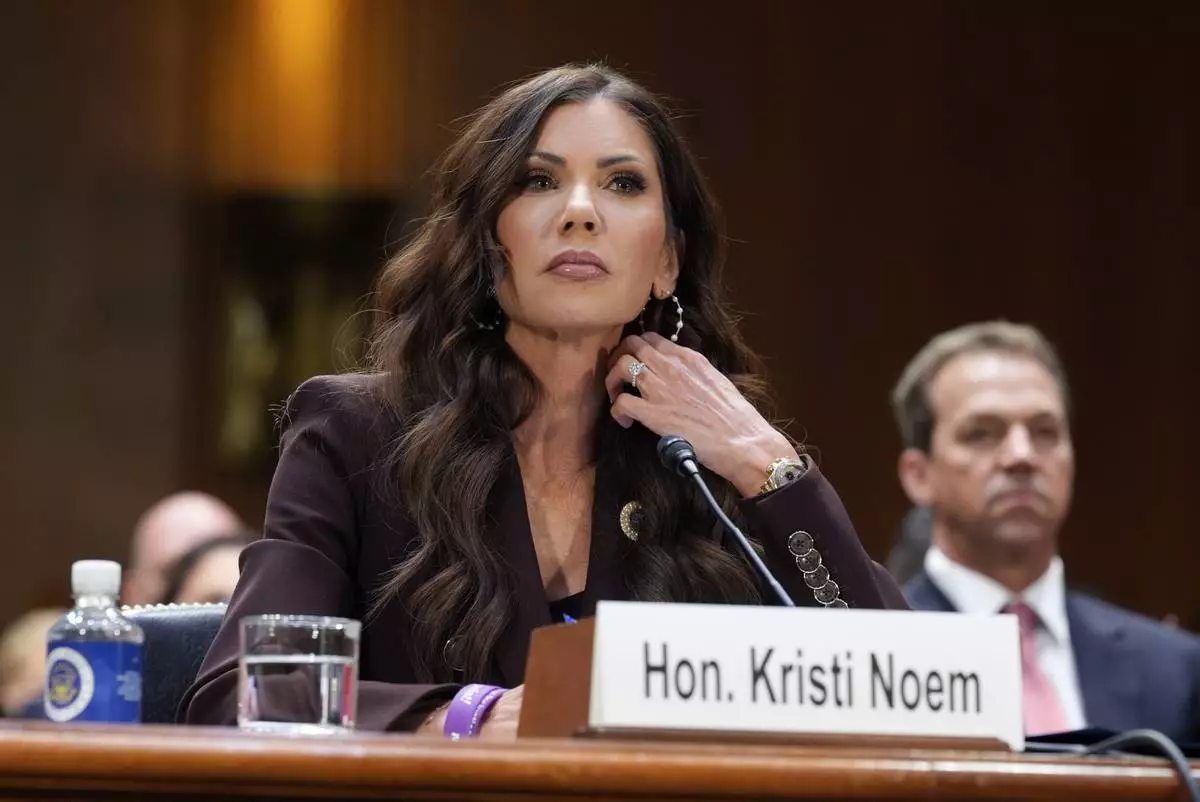
Homeland Security Secretary Kristi Noem, center, with her husband Bryon Noem, right, seated behind her, appears for an oversight hearing before the Senate Judiciary Committee, at the Capitol in Washington, Tuesday, March 3, 2026. (AP Photo/J. Scott Applewhite)

President Donald Trump gestures as Rep. Tom Emmer, R-Minn., House Speaker Mike Johnson of La., Rep. Steve Scalise, R-La., and Rep. Lisa McClain, R-Mich., applaud at the Republican Members Issues Conference, Monday, March 9, 2026, at Trump National Doral Miami in Doral, Fla. (AP Photo/Mark Schiefelbein)

A group of undocumented migrants is deported by U.S. Immigration and Customs Enforcement agents across the McAllen–Hidalgo–Reynosa International Bridge in McAllen, Texas, Friday, March 13, 2026. Dozens of migrants from countries including Cuba, Venezuela, Haiti, China, Guatemala and El Salvador were handed over to Mexican authorities. (AP Photo/Felix Marquez)