WASHINGTON (AP) — U.S. companies will be allowed to do business with Venezuela's state-owned oil and gas company after the Treasury Department eased sanctions, with some limitations, on Wednesday as the Trump administration looks for ways to boost world oil supplies during the Iran war.
The Treasury issued a broad authorization allowing Petróleos de Venezuela S.A, or PDVSA, to directly sell Venezuelan oil to U.S. companies and on global markets, a massive shift after Washington for years had largely blocked dealings with Venezuela’s government and its oil sector.
Separately, the White House said Trump would waive, for 60 days, Jones Act requirements for goods shipped between U.S. ports to be moved on U.S.-flagged vessels. The 1920s law, designed to protect the American shipbuilding sector, is often blamed for making gas more expensive.
The moves highlight the increased pressure that the Republican administration is under to ease soaring oil prices as the United States, along with Israel, wages a war with Iran without a foreseeable end date. Global oil prices have since spiked as Iran halted traffic through the narrow Strait of Hormuz, where one-fifth of the world’s oil typically passes through from the Persian Gulf to customers worldwide.
The Treasury's license is designed to incentivize new investment in Venezuela’s energy sector and is intended to benefit both the U.S and Venezuela, while increasing the global oil supply, a Treasury official told The Associated Press. The official was not authorized to discuss the matter publicly and spoke one condition of anonymity.
Since the ouster and arrest of Nicolás Maduro as Venezuela's president during a U.S. military operation in January, President Donald Trump has said the U.S. would effectively “run” Venezuela and sell its oil.
The U.S. license provides targeted relief from sanctions, but does not lift the penalties altogether. The license allows companies that existed before Jan. 29, 2025, to buy Venezuelan oil and engage in transactions that would normally be banned under American sanctions, reopening trade for a major oil producer to global markets.
There are some limits.
Payments cannot go directly to sanctioned Venezuelan entities such as PDVSA, but must be sent instead to a special U.S.-controlled account. In other words, the U.S. will allow the oil trade but will control the cash flow.
Additionally, deals involving Russia, Iran, North Korea, Cuba and some Chinese entities will not be allowed. Transactions involving Venezuelan debt or bonds will not be allowed.
The license is expected to give a massive boost to Venezuela's oil-dependent economy and help encourage companies that have been apprehensive to invest. The decision is part of the Trump administration’s phased-in plan to turn around Venezuela. But critics of the acting Venezuelan government argue that the move rewards Venezuela’s leadership -– all loyal to Maduro and the ruling party -– while repression, corruption and human rights abuses continue.
Many public sector workers survive on roughly $160 per month, while the average private sector employee earned about $237 last year, when the annual inflation rate soared to 475%, according to Venezuela’s central bank, and sent the cost of food beyond what many can afford.
Venezuela sits atop the world’s largest oil reserves and used them to power what was once Latin America’s strongest economy. But corruption, mismanagement and U.S. economic sanctions saw production steadily decline from the 3.5 million barrels per day pumped in 1999, when Maduro’s mentor, Hugo Chávez, took power, to less than 400,000 barrels per day in 2020.
A year earlier, the Treasury Department under the first Trump administration locked Venezuela out of world oil markets when it sanctioned PDVSA as part of a policy punishing Maduro’s government for corrupt, anti-democratic and criminal activities. That forced the government to sell its remaining oil output at a discount — about 40% below market prices — to buyers such as China and in other Asian markets. Venezuela even started accepting payments in Russian rubles, bartered goods or cryptocurrency.
The new license does not allow payments in gold or cryptocurrency, including the petro, which was a crypto token issued by the Venezuelan government in 2018.
Meantime, White House press secretary Karoline Leavitt said the Jones Act waiver would help “mitigate the short-term disruptions to the oil market” during the Iran war and would “allow vital resources like oil, natural gas, fertilizer, and coal to flow freely to U.S. ports.”
Garcia Cano reported from Caracas, Venezuela. Associated Press writer Seung Min Kim contributed to this report.
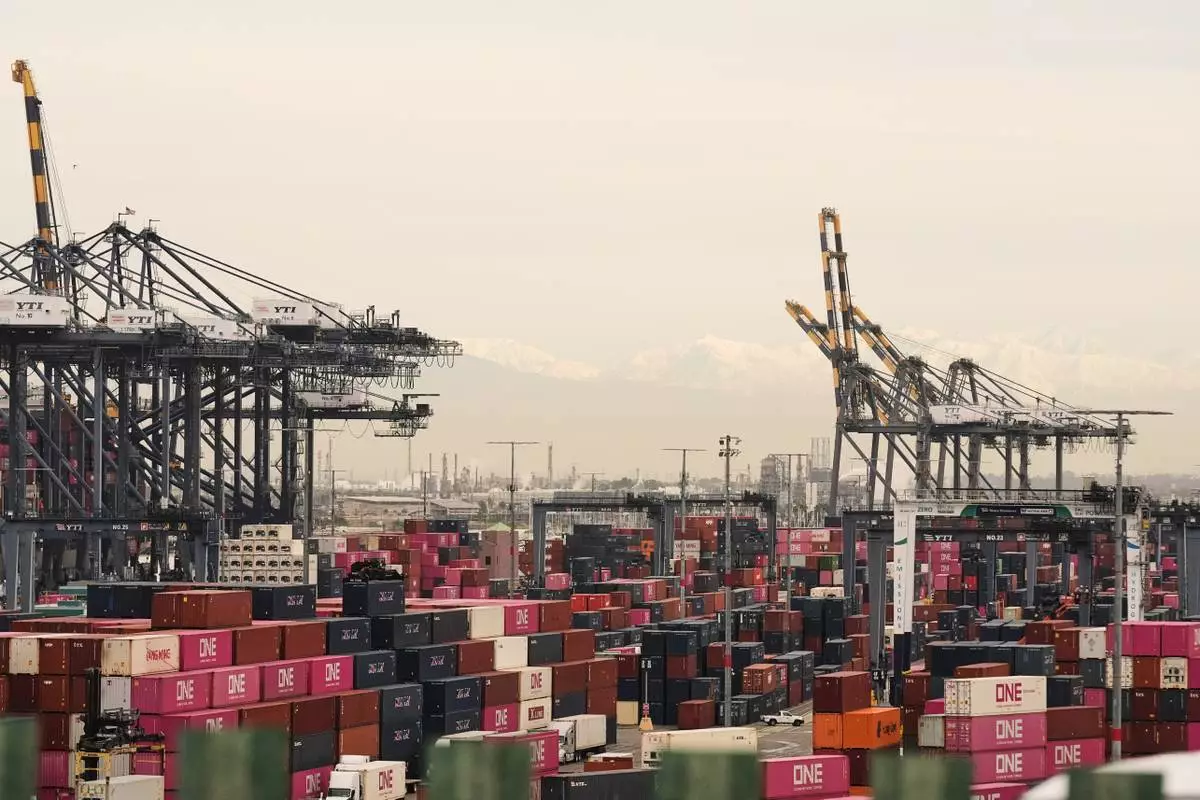
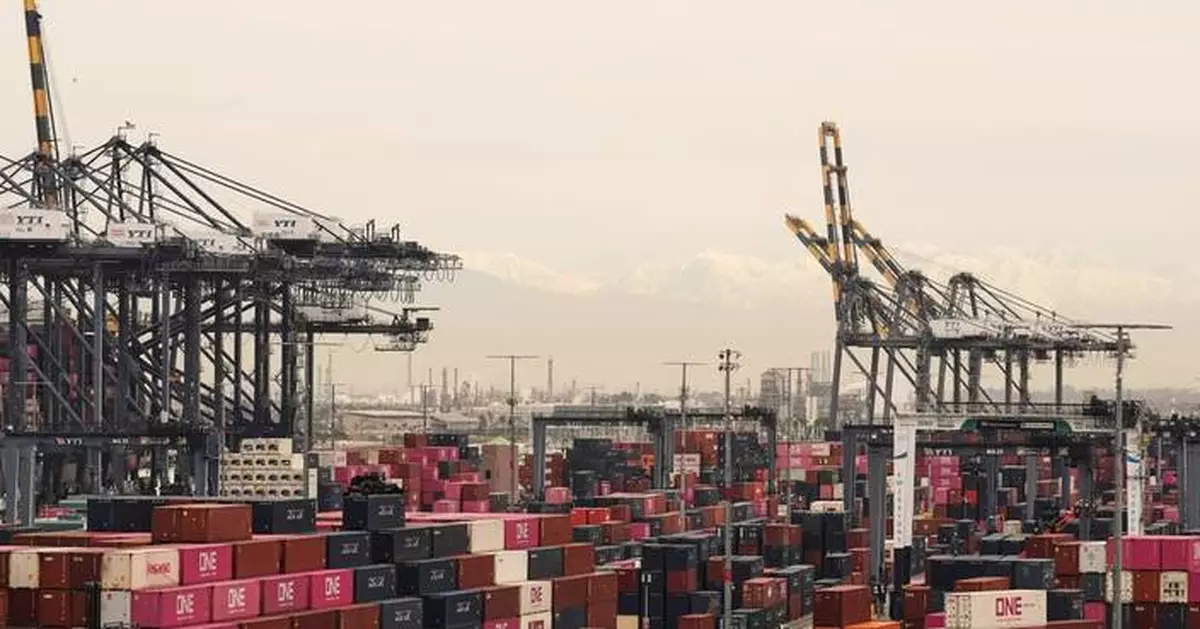
FILE - Containers are stacked at the Port of Los Angeles Friday, Feb. 20, 2026, in Los Angeles. (AP Photo/Damian Dovarganes,File)
NEW YORK (AP) — U.S. stocks are sinking Wednesday after another climb for oil prices raised worries about inflation, which may have been primed to worsen even before the war with Iran began.
The S&P 500 fell 0.5% and was on track for its first loss this week. The Dow Jones Industrial Average was down 377 points, or 0.8%, as of 11 a.m. Eastern time, and the Nasdaq composite was 0.5% lower.
Stocks fell under the pressure of a 6.2% climb for the price of a barrel of Brent crude, the international standard, to $109.84. Benchmark U.S. oil rose 2.3% to $97.70 per barrel.
Oil and natural gas prices have been spiking since the war began because of disruptions to the Persian Gulf's energy industry. Iran’s state television said Wednesday that the Islamic Republic would be attacking oil and gas infrastructure in Qatar, Saudi Arabia and the United Arab Emirates after an attack on facilities associated with its offshore South Pars natural gas field.
If the disruptions keep oil and gas prices high for long, they could send a debilitating wave of inflation crashing into the global economy.
A report released Wednesday morning showed that inflation pressures were already worsening before the war began. It said inflation at the U.S. wholesale level unexpectedly accelerated last month to 3.4%, and those cost increases could hit U.S. households if producers pass them all along.
Such numbers strengthened Wall Street’s consensus that the Federal Reserve will announce that it’s keeping interest rates steady this afternoon following its latest meeting, instead of resuming its cuts.
Cuts would give the job market and investment prices a boost, and President Donald Trump has been angrily calling for them. But lower interest rates would also worsen inflation.
More important for Wall Street is whether Fed officials will say they still think one cut to rates may be possible over the course of 2026. That’s what the median member said in December, the last time Fed officials published such expectations.
The Iran war has made it difficult for anyone to make economic forecasts. Gasoline prices are soaring and will push up inflation for at least the next month or two. The average price for a gallon of gasoline spiked again overnight, reaching $3.84. It was well under $3 last month.
Global oil flows remain largely constrained, ING Bank analysts Warren Patterson and Ewa Manthey wrote in a research note on Wednesday, even as hopes were growing that Iran might be allowing more vessels through the Strait of Hormuz, a key waterway for global oil and gas transport.
Roughly a fifth of the world’s crude oil passes through the strait, which has been largely closed as Iran blocks ships linked to the U.S., Israel and their allies.
On Wall Street, mixed profit reports helped keep the market in check.
Macy’s jumped 4.4% after reporting stronger profit and revenue for the latest quarter than analysts expected. The retailer behind Bloomingdale’s and Bluemercury is in the midst of a turnaround plan to drive growth under CEO Tony Spring.
But General Mills slipped 1.5% after the company behind the Pillsbury, Progresso and Wheaties brands reported a weaker profit for the latest quarter than analysts expected. CEO Jeff Harmening is investing in its brands in hopes of driving growth, and it’s sticking with its forecast for profit over the full fiscal year.
In the bond market, Treasury yields ticked higher following the higher-than-expected update on inflation at the wholesale level. The yield on the 10-year Treasury rose to 4.22% from 4.20% late Tuesday and from just 3.97% before the war with Iran started.
In stock markets abroad, indexes fell in Europe following a stronger finish in Asia. They reacted to the rise in the price of crude, which accelerated as trading headed westward around the world.
Tokyo’s Nikkei 225 rallied 2.9% after the government reported exports in February were higher than expected. South Korea’s Kospi leaped 5%.
AP Business Writers Chan Ho-him and Matt Ott contributed.
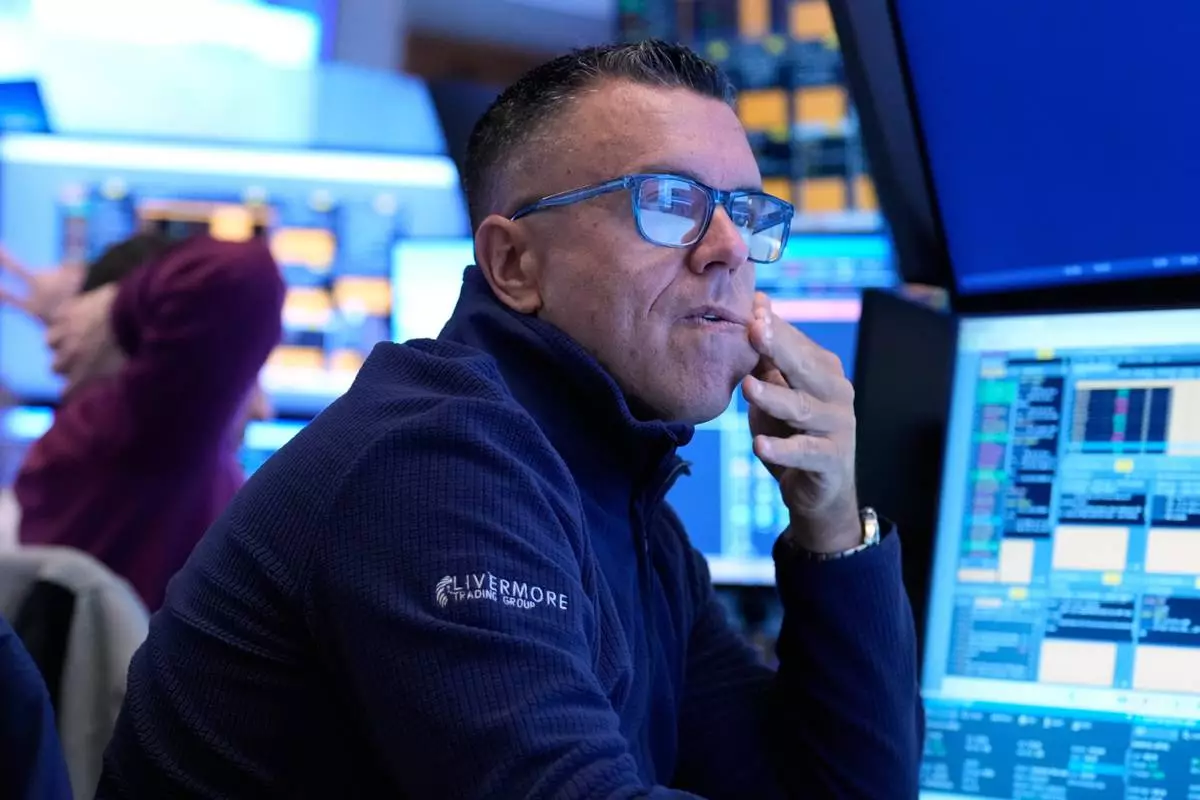
Traders work on the floor at the New York Stock Exchange in New York, Tuesday, March 10, 2026. (AP Photo/Seth Wenig)
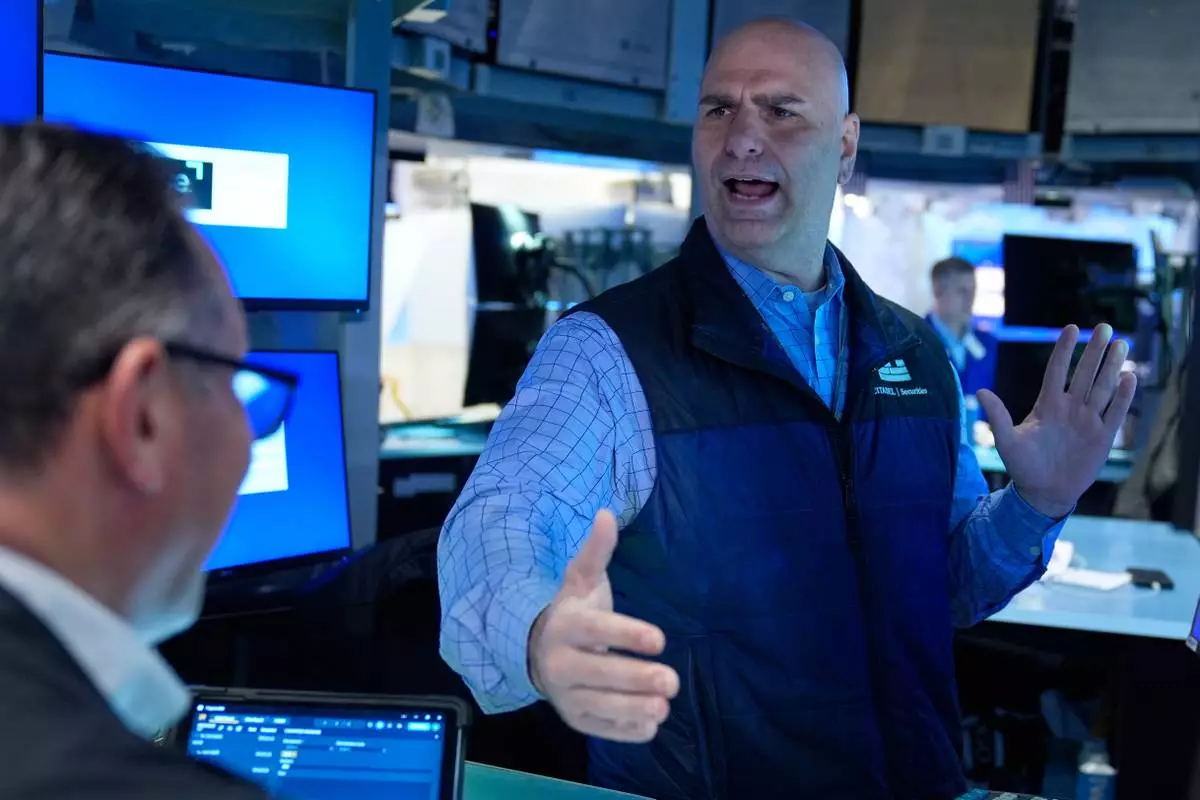
Philip Finale works on the floor at the New York Stock Exchange in New York, Tuesday, March 10, 2026. (AP Photo/Seth Wenig)
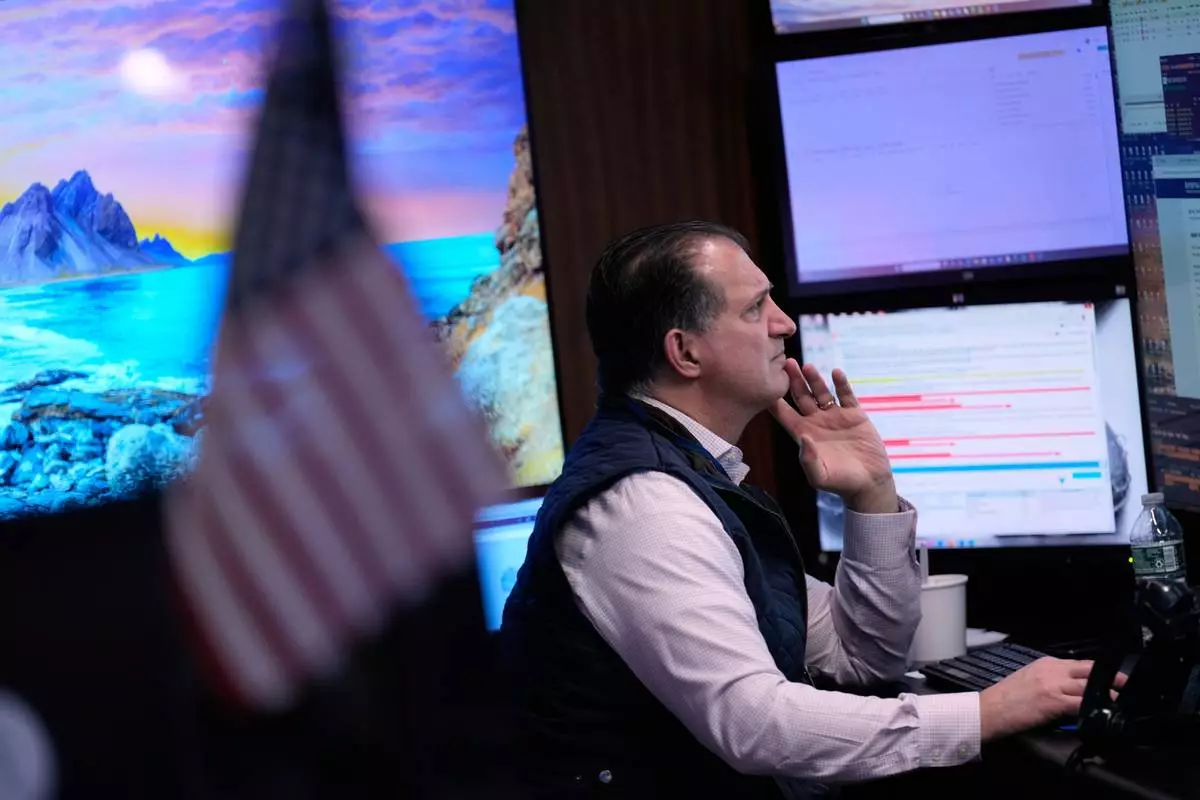
Traders work on the floor at the New York Stock Exchange in New York, Tuesday, March 10, 2026. (AP Photo/Seth Wenig)
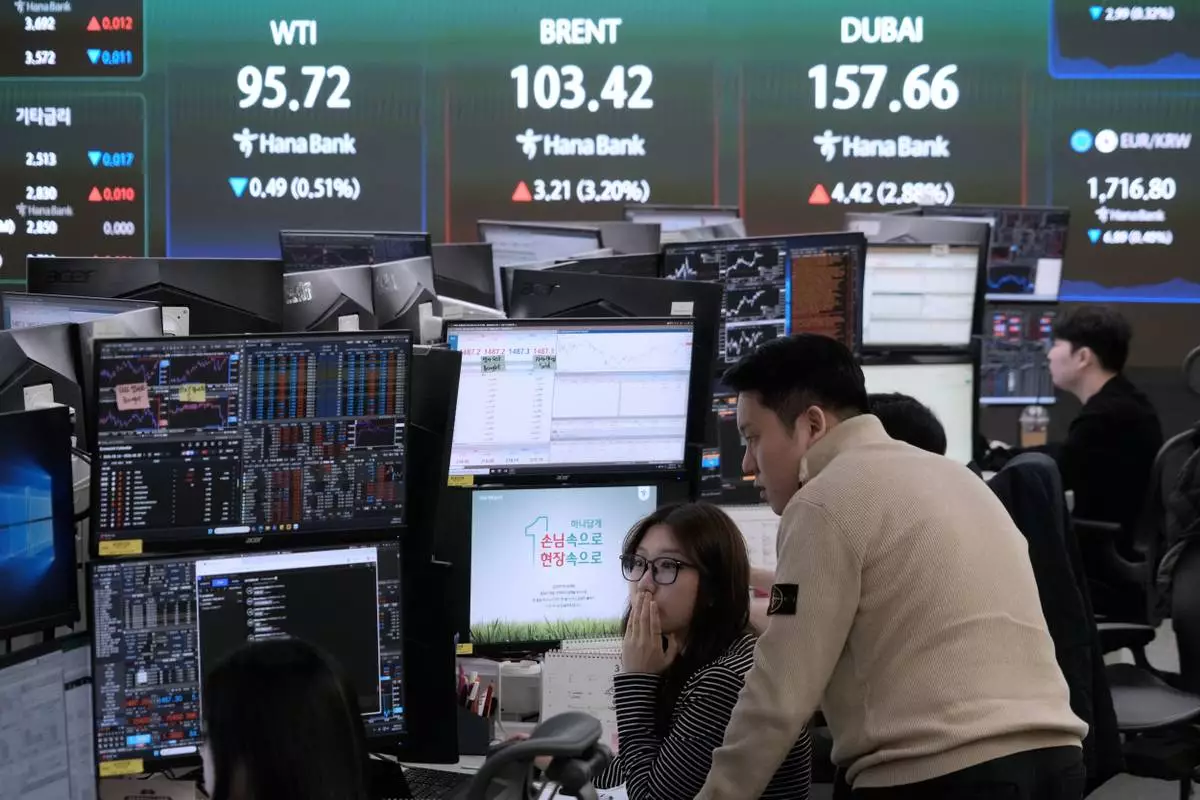
Currency traders watch monitors near a screen showing international oil prices at the foreign exchange dealing room of the Hana Bank headquarters in Seoul, South Korea, Wednesday, March 18, 2026. (AP Photo/Ahn Young-joon)
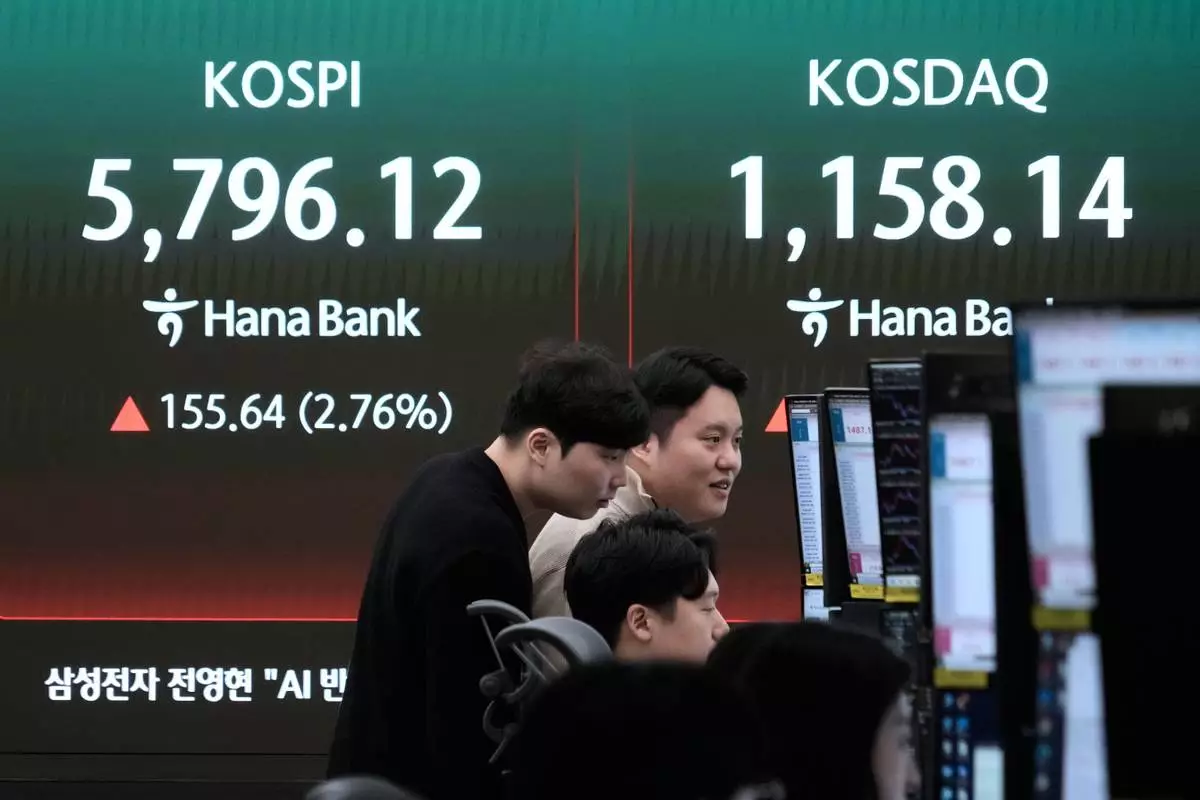
Currency traders watch monitors near a screen showing the Korea Composite Stock Price Index (KOSPI), left, at the foreign exchange dealing room of the Hana Bank headquarters in Seoul, South Korea, Wednesday, March 18, 2026. (AP Photo/Ahn Young-joon)
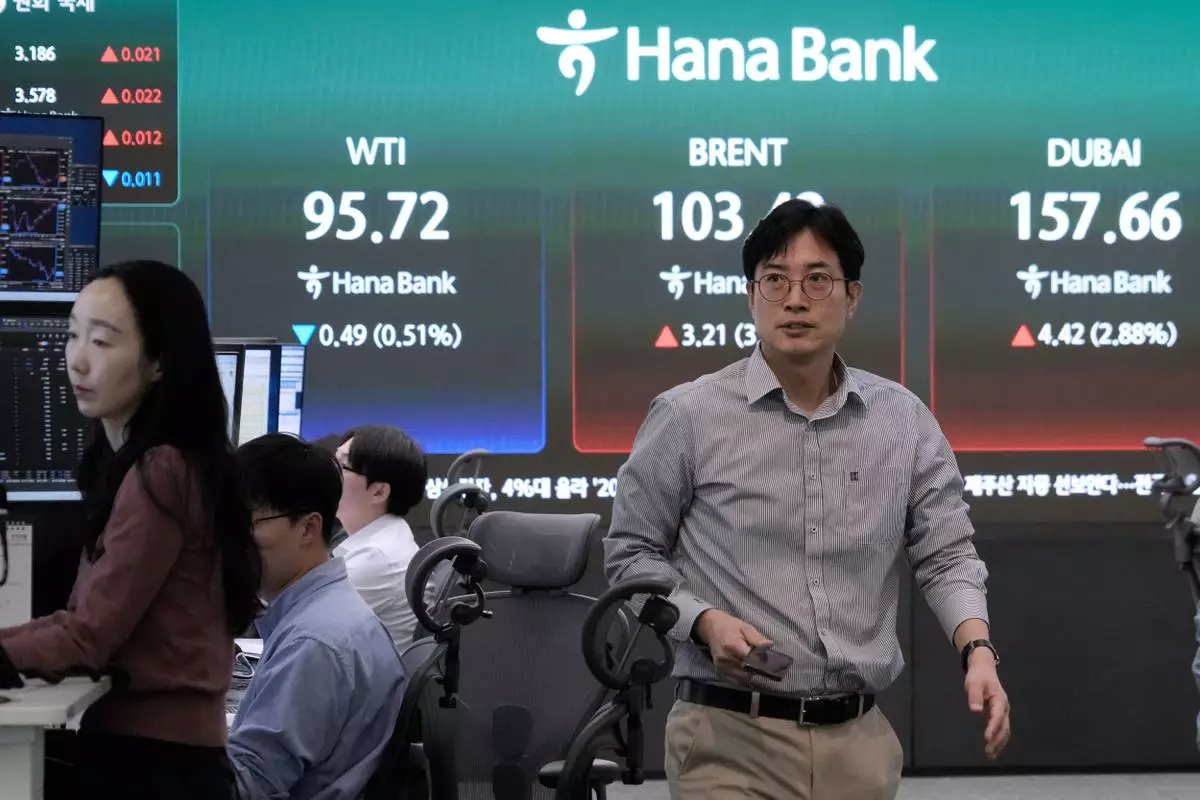
A currency trader passes by a screen showing international oil prices at the foreign exchange dealing room of the Hana Bank headquarters in Seoul, South Korea, Wednesday, March 18, 2026. (AP Photo/Ahn Young-joon)
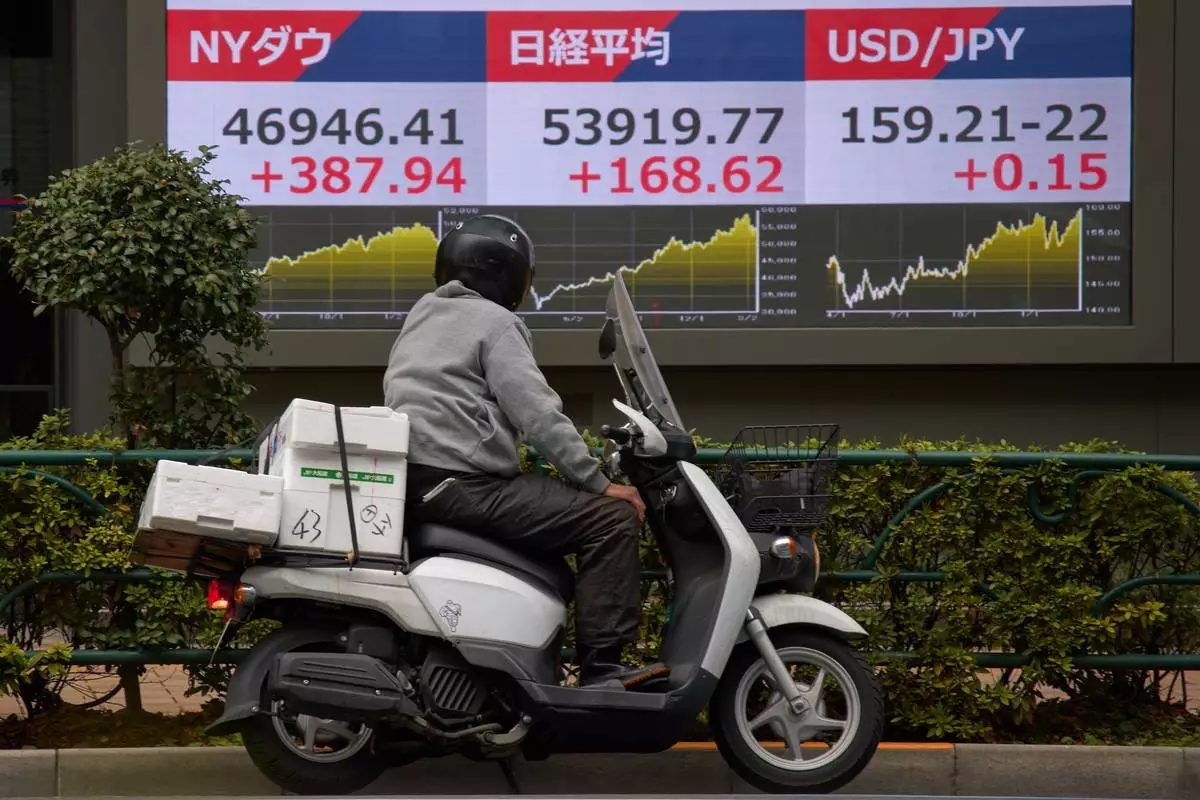
A person looks at a stock price monitor showing New York Dow and Nikkei indexes also US dollar Japanese yen exchange rate at a security company Tuesday, March 17, 2026, in Tokyo. (AP Photo/Eugene Hoshiko)
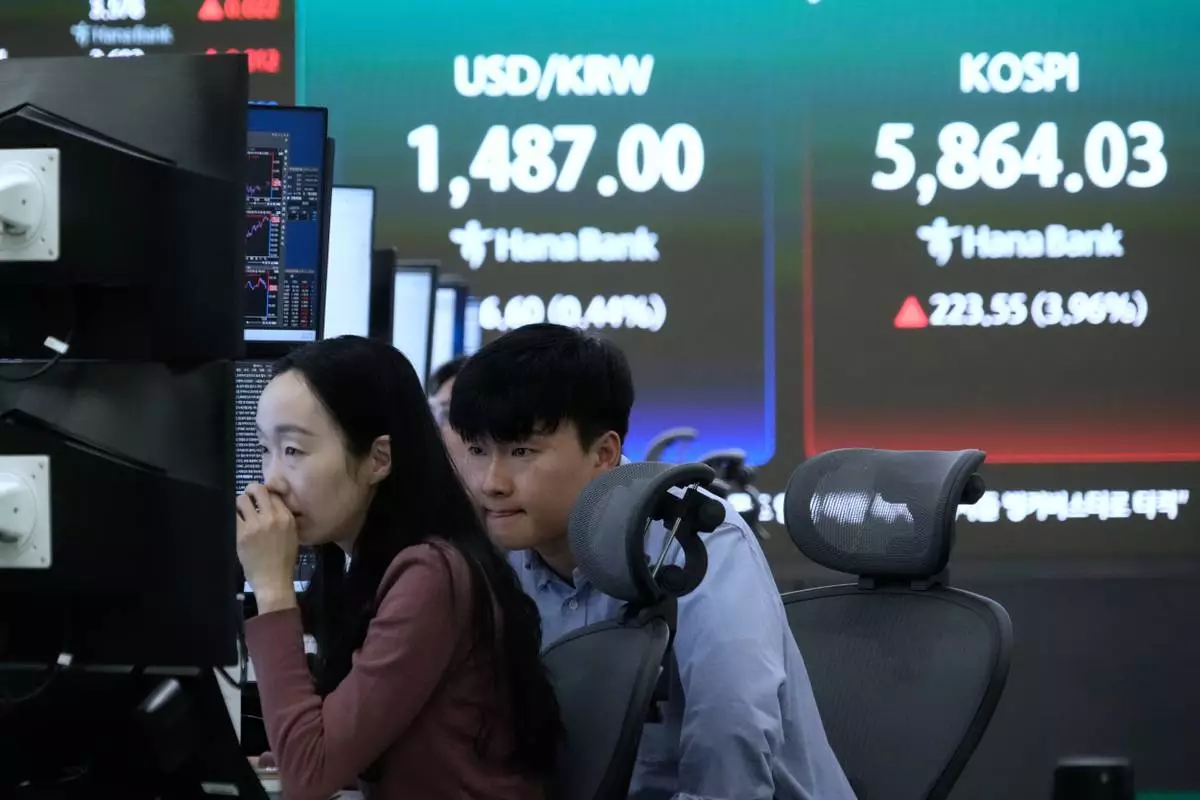
Currency traders watch monitors near a screen showing the Korea Composite Stock Price Index (KOSPI), top right, at the foreign exchange dealing room of the Hana Bank headquarters in Seoul, South Korea, Wednesday, March 18, 2026. (AP Photo/Ahn Young-joon)