HOUSTON--(BUSINESS WIRE)--Mar 24, 2026--
Houston-based Americana Partners, an independent wealth management firm with over $12.1* billion in client assets, today announced the acquisition of NRT Consulting, a bespoke and full-service financial consulting and accounting firm.
This press release features multimedia. View the full release here: https://www.businesswire.com/news/home/20260324695336/en/
This marks Americana’s third acquisition, preceded by its March 2025 deal with Beverly Hills firm Boulevard Family Wealth and its October 2025 deal with Nashville firm Goodpasture Gray. These milestones underscore the firm’s expanding national presence and growing service platform. With this transaction, Americana can now offer sophisticated financial accounting services for clients’ existing operating businesses and personal holdings, designed to provide insight into revenues, income, net profits, bill pay and cash flow forecasting. This new service line will assist clients with creating a full and organized financial picture.
“We are thrilled to have the team at NRT join us,” said Ron Thacker, President of Americana Partners. “This acquisition reinforces Americana Partners’ commitment to building a leading family office services platform. It enhances our ability to deliver integrated financial solutions while remaining deeply aligned with the long-term goals of families and their businesses.”
Founded in 2018 by Chris Ginsbach, Leah Primera and Katie Rossman, NRT Consulting enables its clients to focus on their core competencies. From family offices and large oil and gas producers to real estate funds and new startups across various industries, NRT Consulting has built a team dedicated to putting their clients’ needs first.
“Merging NRT with Americana is a very natural fit and gives us another service offering for our existing clients,” said Chris Ginsbach, President of NRT Consulting. “It allows us to grow with intention: finding the right client that understands the need for accurate and timely financials. We thrive on helping people meet their goals by helping them do what they do best with the company or their family wealth.”
Following the acquisition, NRT Consulting’s capabilities will be integrated into the Americana Partners Family Office Services suite and offered as a distinct service line. Accounting and consulting services may be engaged independently of the firm’s investment advisory services, allowing clients to elect the services that align with their individual needs and objectives.
“Bringing NRT’s capabilities in-house allows us to provide an even more seamless experience for our clients,” added Jason Fertitta, CEO of Americana Partners. “Our goal has always been to simplify complexity for families and business owners. By integrating accounting and consulting services directly into our platform, we’re deepening that commitment and strengthening the long-term value we deliver.”
About Americana Partners
Founded in 2019 and headquartered in Houston, Americana Partners is an independent wealth advisory firm working with a select network of families and individuals to help them simplify the management of their wealth. The firm offers wealth advisory and family office services, including alternative and traditional investment solutions. Americana serves high-net-worth and ultra-high-net-worth clients across the United States, with a division serving ultra-high-net-worth Latin American clients.
The company will celebrate its seven-year anniversary in April, having grown rapidly since its launch in 2019 to now manage over $12.1* billion in assets as of January 31, 2026. Free from most of the constraints of corporate ownership, Americana is empowered to leverage support from Dynasty Financial Partners and other industry experts.
To learn more, visit www.americanapartners.com. Follow along on LinkedIn, Instagram, or Facebook.
RIA is an SEC-registered investment adviser. Registration does not imply a certain level of skill or training. This release is provided for informational purposes only and does not constitute investment advice or a recommendation. Past performance is not indicative of future results. Certain services referenced herein, including accounting and consulting services, are not investment advisory services and may be offered pursuant to separate agreements.
*Total Client Assets include both Regulatory Assets Under Management (RAUM), as reported in our Form ADV, and Assets Under Advisement (AUA), which are not included in RAUM.

Left to right: Katie Rossman, Americana Partners / Director, PCFO Services; Chris Ginsbach, Americana Partners / Executive Director, PCFO Services; Leah Primera, Americana Partners / Director, PCFO Services
GENEVA (AP) — Scientists in Geneva have begun a first-ever test drive to transport antiprotons through a very delicate journey.
If this so-called antimatter comes into contact with actual matter, even for a fraction of an instant, it will be annihilated in a quick flash of energy, according to experts at the European Organization for Nuclear Research, known as CERN, where the trip is taking place.
The approximately 100 antiprotons are suspended in a vacuum inside a specially designed box and held in place by supercooled magnets.
The entire process is expected to take about four hours, including the half-hour drive.
The drive is designed to test how — if at all — the infinitesimal particles can be transported by road without seeping out. If all goes well, the antiprotons will return to the lab.
THIS IS A BREAKING NEWS UPDATE. AP’s earlier story follows below.
GENEVA (AP) — Scientists in Geneva are taking some antiprotons out for a spin — a very delicate one — in a truck, in a never-tried-before test drive.
If this so-called antimatter comes into contact with actual matter — even for a fraction of an instant — it will be annihilated in a quick flash of energy. So experts at the European Organization for Nuclear Research, known as CERN, will, over the course of four hours Tuesday, gingerly wheel out from its lab about 100 antiprotons. They are suspended in a vacuum inside a specially designed box and held in place by supercooled magnets.
Then, they'll ease it into a truck, and take about a half-hour drive to test how — if at all — the infinitesimal particles can be transported by road without seeping out. If all goes well, the antiprotons will be returned back to the lab.
The hard part: Manipulating antimatter, like antiprotons, can be tricky business. As scientists understand the universe today, for every type particle that exists, there is a corresponding antiparticle, exactly matching the particle but with an opposite charge.
If those opposites come into contact, they “annihilate” each other, setting off lots of energy, depending on the masses involved. Any bumps in the road on the test journey that aren't compensated for by the specially-designed box could spoil the whole exercise.
Tuesday’s practice is a first step toward making good on hopes, one day, to deliver CERN antiprotons to researchers at Heinrich Heine University in Düsseldorf, Germany, which is about eight hours away in normal driving conditions.
The antiprotons have been encased in a 1,000-kilogram (2,200 pounds) box called a “transportable antiproton trap.” It's compact enough to fit through ordinary laboratory doors and fit on a truck. It uses superconducting magnets cooled to -269 degrees Celsius (-452 Fahrenheit) that allows the antiprotons to be remain suspended in a vacuum — not touching the inner walls, which are made of ... matter.
The mass in Tuesday's test — slightly less than that of about 100 hydrogen atoms — is so little, experts say, that the worst possible outcome is the loss of the antiprotons. Even if they do touch matter, any release of energy would be unnoticeable, only an oscilloscope, which picks up electrical signals, would be able to detect it.
The trap, says CERN spokeswoman Sophie Tesauri, “is supposed to contain these antiprotons no matter what: if the truck stops, if it starts again, if it has to slam on the brakes — all that.” Work remains: The trap can contain the antiprotons on its own for only about four hours, and the drive to Düsseldorf is twice that.
The Geneva-based center is best known for its Large Hadron Collider, a network of magnets that accelerates particles through a 27-kilometer (17-mile) underground tunnel and slams them together at velocities approaching the speed of light. Scientists then study the results of those collisions.
But the sprawling, buzzing complex of scientific experiment is more than just about smashing atoms together: the World Wide Web, for example, was invented here by Britain’s Tim Berners-Lee in 1989.
Heinrich Heine University is seen as a better place to study antiprotons in-depth, because CERN — with all its other activities — generates a lot of magnetic interference that can skew the study of antimatter.
But to get them there, those antiprotons will have to avoid touching anything on the way.
The center's Antiproton Decelerator, where a proton beam gets fired into a block of metal, causes collisions that generate secondary particles, including lots of antiprotons. It’s billed as a unique machine that produces low-energy antiprotons for the study of antimatter.
CERN’s “Antimatter Factory,” lab officials say, is the only place in the world where scientists can store and study antiprotons.
The center has been experimenting with antimatter for years, and has made breakthroughs on measurement, storage and interaction of antimatter. Two years ago, the team transported a “cloud” of about 70 protons — not antiprotons — across CERN's campus.
It's a similar drill this time, except that with antiprotons, a much better vacuum chamber is needed, according to Christian Smorra, head of a team behind the apparatus designed to store and transport antimatter.
Jittery test teams weren't available for interviews before the exercise, but were expected to explain the results afterward on Tuesday.
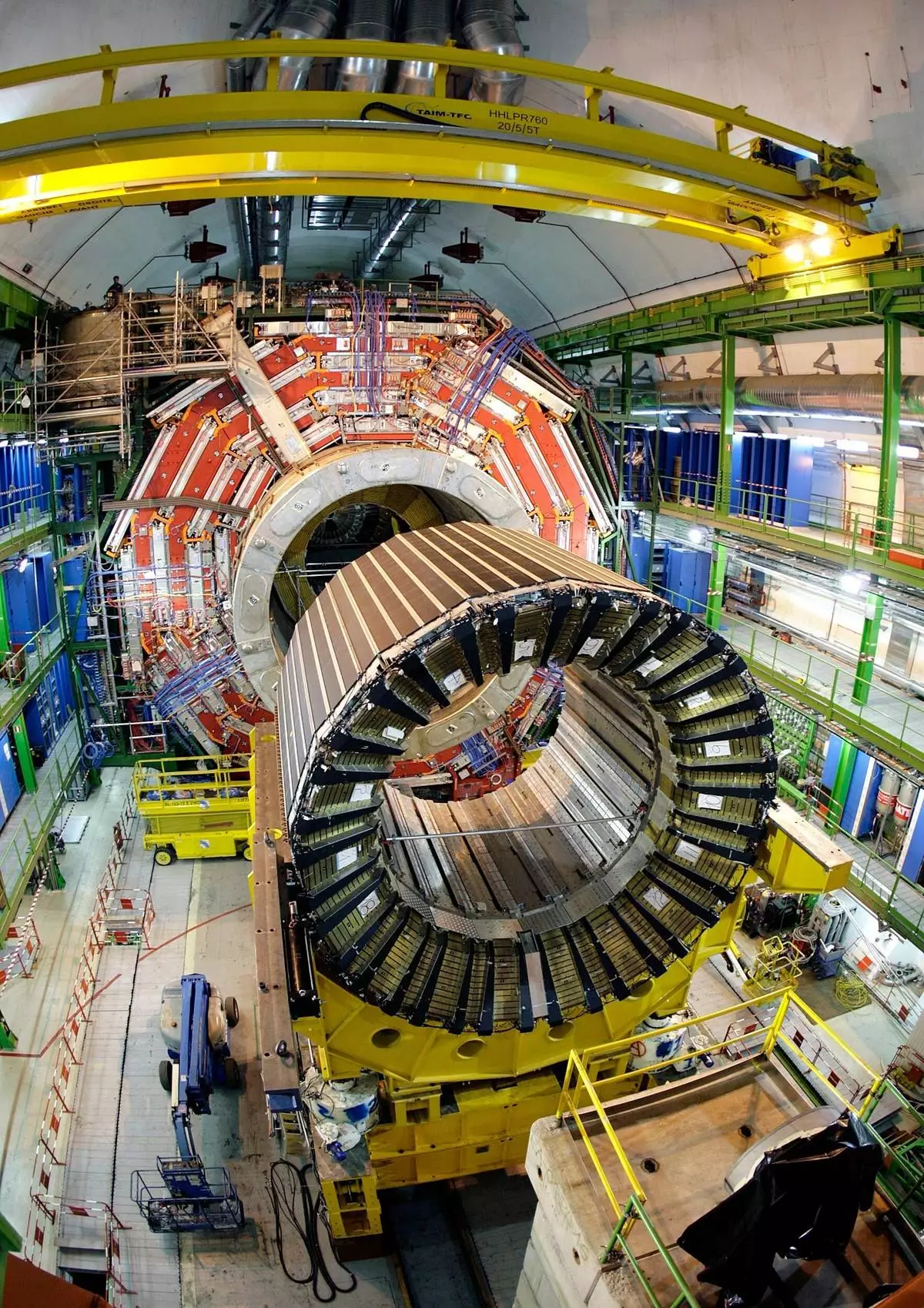
FILE - The magnet core of the world's largest superconducting solenoid magnet (CMS, Compact Muon Solenoid) at the European Organization for Nuclear Research (CERN)'s Large Hadron Collider (LHC) particle accelerator, in Geneva, Switzerland, March 22, 2007. (AP Photo/Keystone, Martial Trezzini, File)
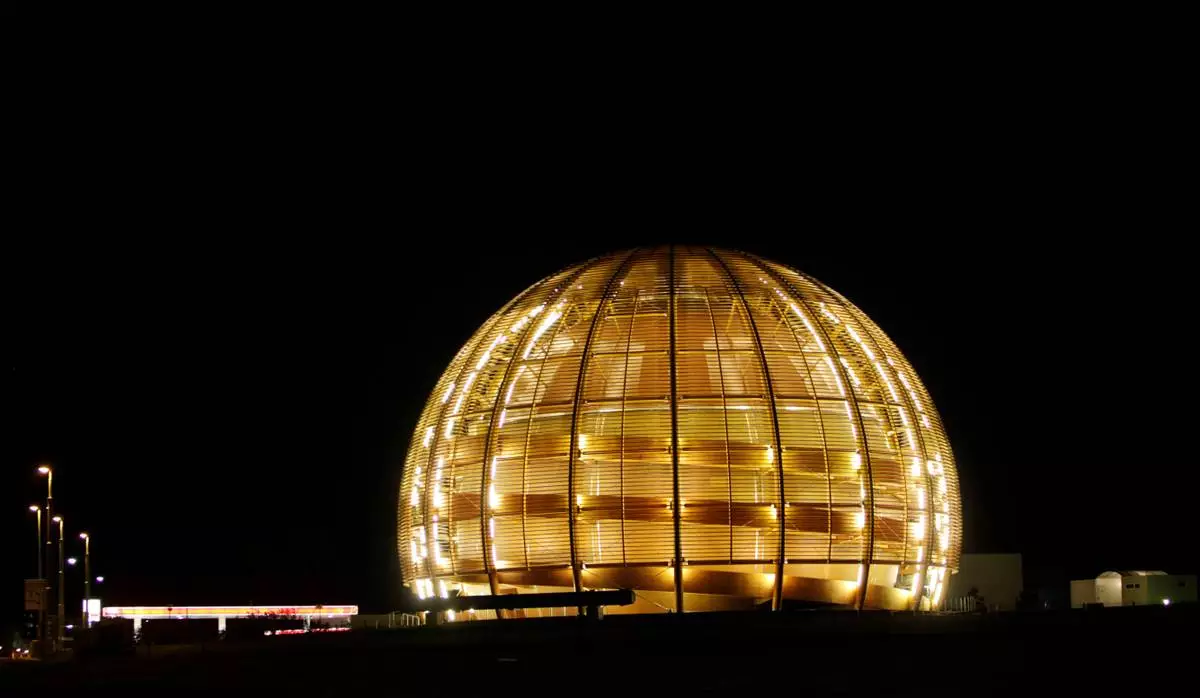
FILE - The globe of the European Organization for Nuclear Research, CERN, is illuminated outside Geneva, Switzerland, March 30, 2010. (AP Photo/Anja Niedringhaus, File)
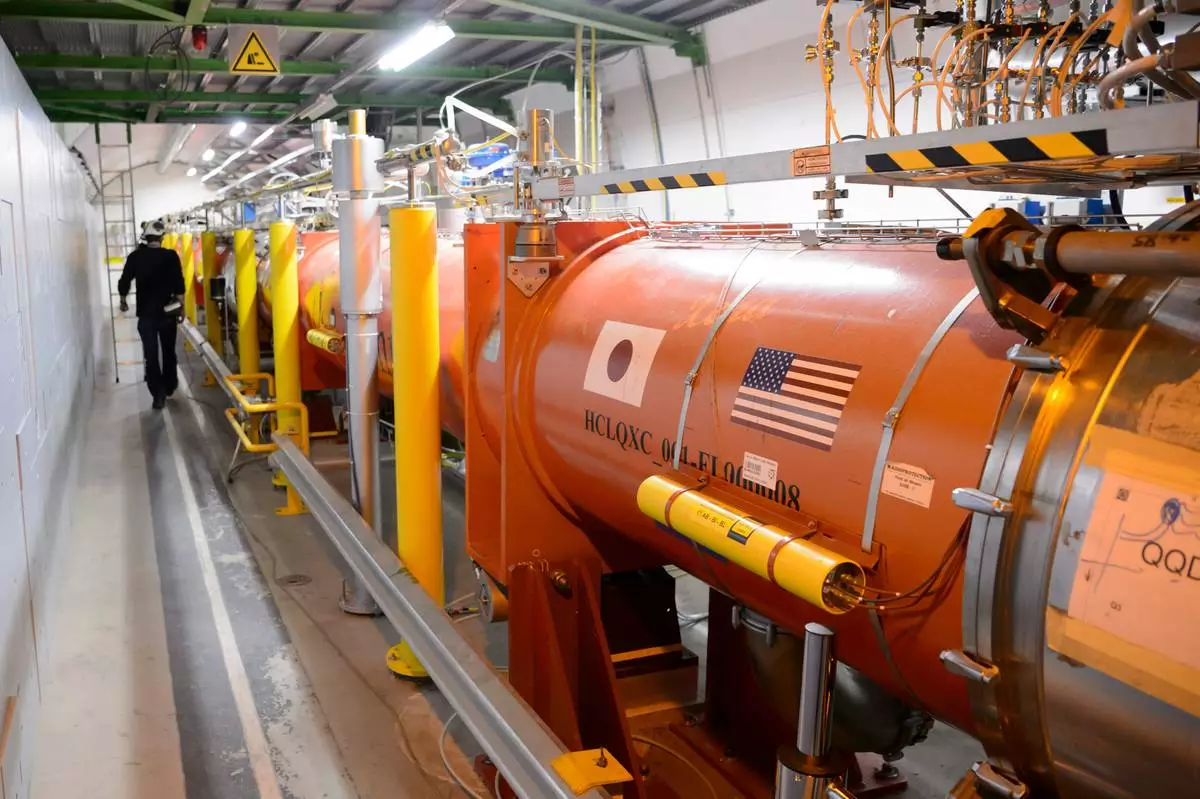
FILE - A technician works in the LHC (Large Hadron Collider) tunnel of the European Organization for Nuclear Research, CERN, during a press visit in Meyrin, near Geneva, Switzerland, Feb. 16, 2016. (Laurent Gillieron/Keystone via AP, File)
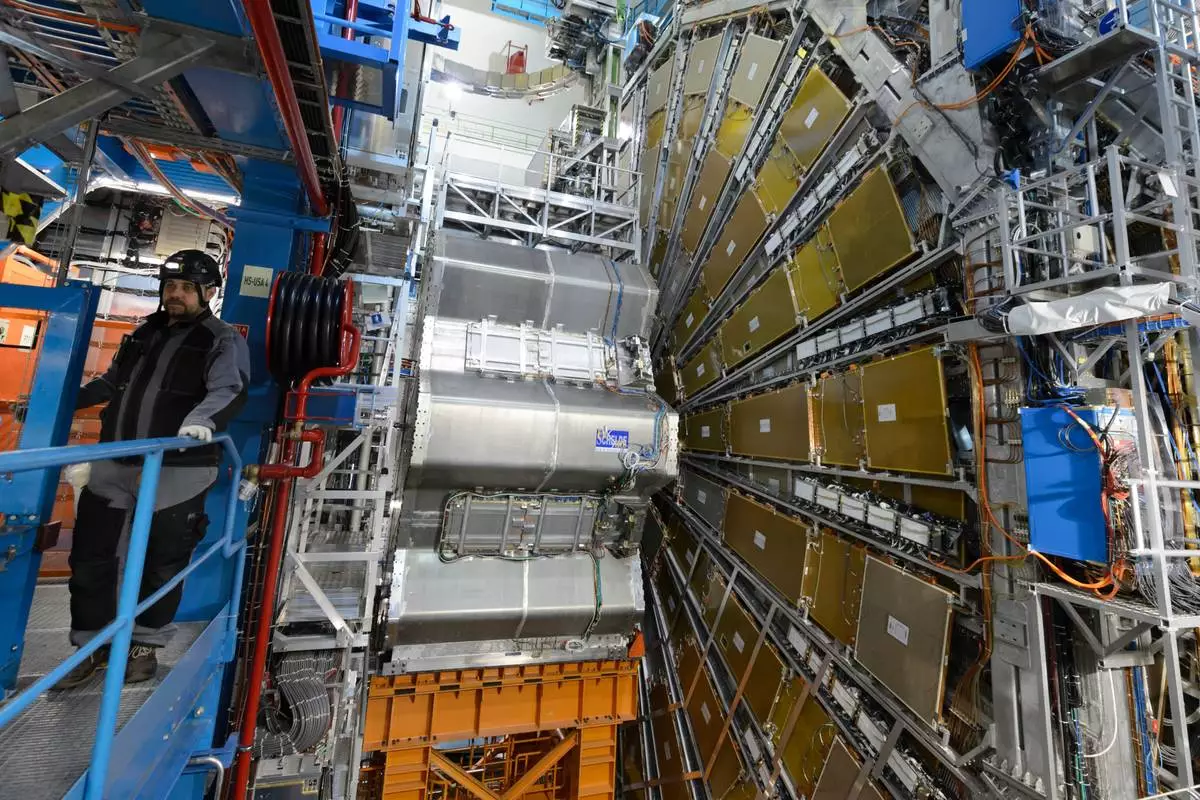
FILE - A technician works in the LHC (Large Hadron Collider) tunnel of the European Organization for Nuclear Research, CERN, during a press visit in Meyrin, near Geneva, Switzerland, Feb. 16, 2016. (Laurent Gillieron/Keystone via AP, File)