BRUSSELS (AP) — European lawmakers voted Thursday to ease the setting up of new migrant detention centers outside the European Union, known as “return hubs.”
Members of the European Parliament voted 389-206 in favor, with 32 abstentions. Right-wing parties made an alliance with far-right groups that they had previously shunned to pass the measure, while parties of the left and center voted against.
Any EU nation can now negotiate on its own or in small coalitions to deport migrants not to their home countries but to facilities yet to be built outside the 27-nation bloc.
Already, Greece, Germany, the Netherlands, Austria, and Denmark have entered into negotiations with governments mainly in Africa to host sites to hold migrants denied asylum.
Far-right parties in Europe have praised the deportation policies of U.S. President Donald Trump and have called for the EU to adopt a similar approach.
Belgium’s far-right Vlaams Belang party and Germany’s far-right AfD party both said in January that they want to form a police group focused on finding and deporting migrants akin to U.S. efforts.
Charlie Weimers, a lawmaker from the right-wing Sweden Democrats and strong proponent of harsher migration policies, said Thursday's vote heralds a new era in the EU.
“There is a new consensus in Europe. The era of deportations has begun,” he said in a social media post.
However, human rights groups say migrants are being brutalized and pushed back illegally at EU borders, while legal protections are increasingly being hollowed out.
Marta Welander, EU advocacy director for the International Rescue Committee, said the vote was “a historic setback for refugee rights.”
She warned it would “pave the way towards a new punitive EU asylum and migration regime, designed to deter, detain and deport people seeking safety. The EU should stand for a system that protects lives, not one that criminalizes survival.”
French lawmaker Mélissa Camara, who voted against the measure, said it passed only by centrist groups allying with the far-right.
“History will remember that the so-called moderate right-wing group sounded the death knell of what remained of the cordon sanitaire,” said Camara, who said ‘return hubs’ are places far from Europe “where fundamental rights cannot be effectively monitored.”

Migrants trying to reach Britain, walk on a beach shore in Gravelines, northern France, Wednesday, March 18, 2026. (AP Photo/Jean-Francois Badias)
NEW YORK (AP) — Uncertainty is weighing on Wall Street about a possible end to the war with Iran, and stock indexes are slipping as oil prices rise on Thursday.
The S&P 500 fell 0.4% and gave back most of its gain from the day before. The Dow Jones Industrial Average was edging up by 42 points, or 0.1%, as of 10 a.m. Eastern time, and the Nasdaq composite was 0.6% lower.
Stock markets fell more sharply in much of Asia and Europe. They’re the latest flip - flops in a week that began with President Donald Trump’s announcement of productive talks about ending the war, which only led to Iran’s public dismissal. Iran issued its own plan for a ceasefire, which includes reparations for the war.
On Thursday, the fighting continued. Thousands more U.S. troops neared the region, while Tehran tightened its grip on the crucial Strait of Hormuz. The narrow waterway typically sees a fifth of the world’s oil sail through it to exit the Persian Gulf and reach customers worldwide.
A barrel of Brent crude oil climbed 3.8% to $100.93 as hopes dimmed for a potential return to normal for the strait. That’s up from roughly $70 before the war began. Benchmark U.S. crude climbed 3% to $93.05 per barrel.
“They better get serious soon, before it is too late,” Trump said on his social media network about Iran’s negotiators, “because once that happens, there is NO TURNING BACK, and it won’t be pretty!”
The jump in oil prices worsened worries about high inflation and sent Treasury yields higher in the bond market.
The yield on the 10-year Treasury rose to 4.35% from 4.33% late Wednesday and from just 3.97% before the war started. That leap has already sent rates higher for mortgages and other kinds of loans for U.S. households and businesses, which slows the economy.
A report on Thursday morning said slightly more U.S. workers filed for unemployment benefits last week, though the number is still low compared with historical figures.
Usually, a slowing job market can encourage the Federal Reserve to cut interest rates to juice the economy. But hopes have cratered for a possible cut to interest rates this year, even though traders came into 2026 forecasting several. That’s because lower interest rates can worsen inflation, and the worry is centered on the spike in oil prices.
On Wall Street, Meta Platforms and Alphabet were two of the heaviest weights on the market. They had held relatively steady the day before, when a jury found Instagram and YouTube liable in a landmark social media addiction trial.
The financial penalties were small compared with the companies’ vast profits, but it could be a watershed moment that invites more lawsuits.
Meta Platforms fell 3.1%, while Alphabet sank 1.4%.
Commercial Metals slipped 0.6% after the maker of steel rebar and other products reported a weaker profit for the latest quarter than analysts expected. CEO Peter Matt said bad weather hurt its North American operations during the quarter, but underlying market conditions looked favorable.
On the winning side of Wall Street were oil and natural as companies, which benefited from a resumption of rising energy prices. ConocoPhillips gained 1.4%.
In stock markets abroad, Germany’s DAX lost 1.6%, Hong Kong’s Hang Seng sank 1.9% and South Korea’s Kospi dropped 3.2%. Japan’s Nikkei 225 had one of the world’s milder losses, at 0.3%.
AP Business Writers Chan Ho-him and Matt Ott contributed.

Bobby Charmak works on the floor at the New York Stock Exchange in New York, Wednesday, March 25, 2026. (AP Photo/Seth Wenig)

James Denaro, center, and Dilip Patel, left, work on the floor at the New York Stock Exchange in New York, Wednesday, March 25, 2026. (AP Photo/Seth Wenig)
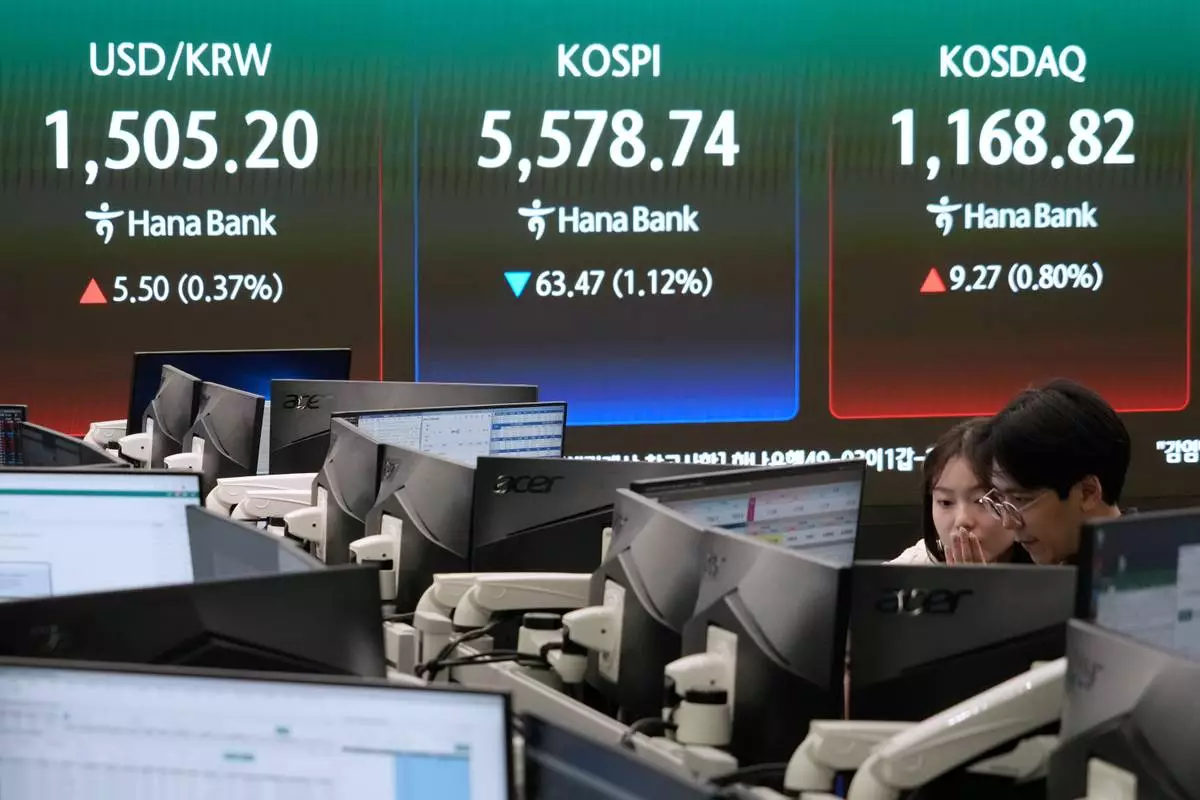
Currency traders watch monitors near a screen showing the Korea Composite Stock Price Index (KOSPI), top center, and the foreign exchange rate between U.S. dollar and South Korean won, top left, at the foreign exchange dealing room of the Hana Bank headquarters in Seoul, South Korea, Thursday, March 26, 2026. (AP Photo/Ahn Young-joon)
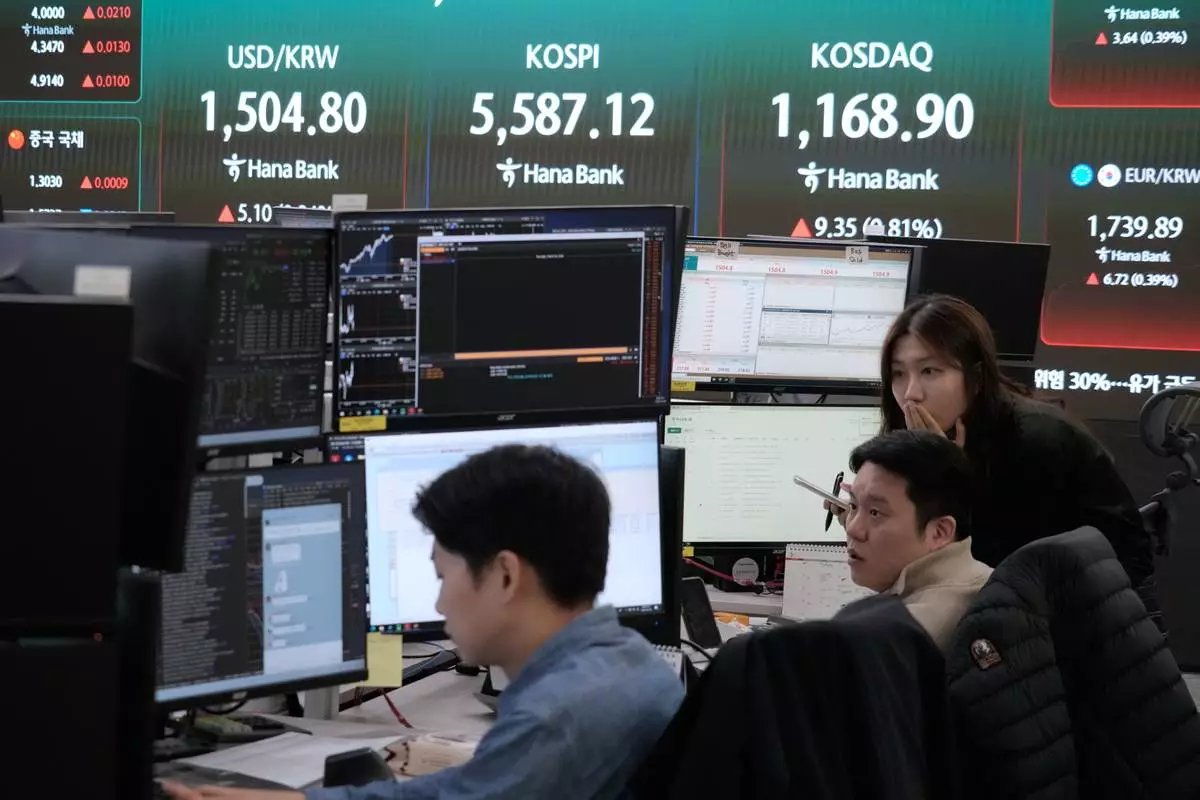
Currency traders watch monitors near a screen showing the Korea Composite Stock Price Index (KOSPI), top center, and the foreign exchange rate between U.S. dollar and South Korean won, top left, at the foreign exchange dealing room of the Hana Bank headquarters in Seoul, South Korea, Thursday, March 26, 2026. (AP Photo/Ahn Young-joon)
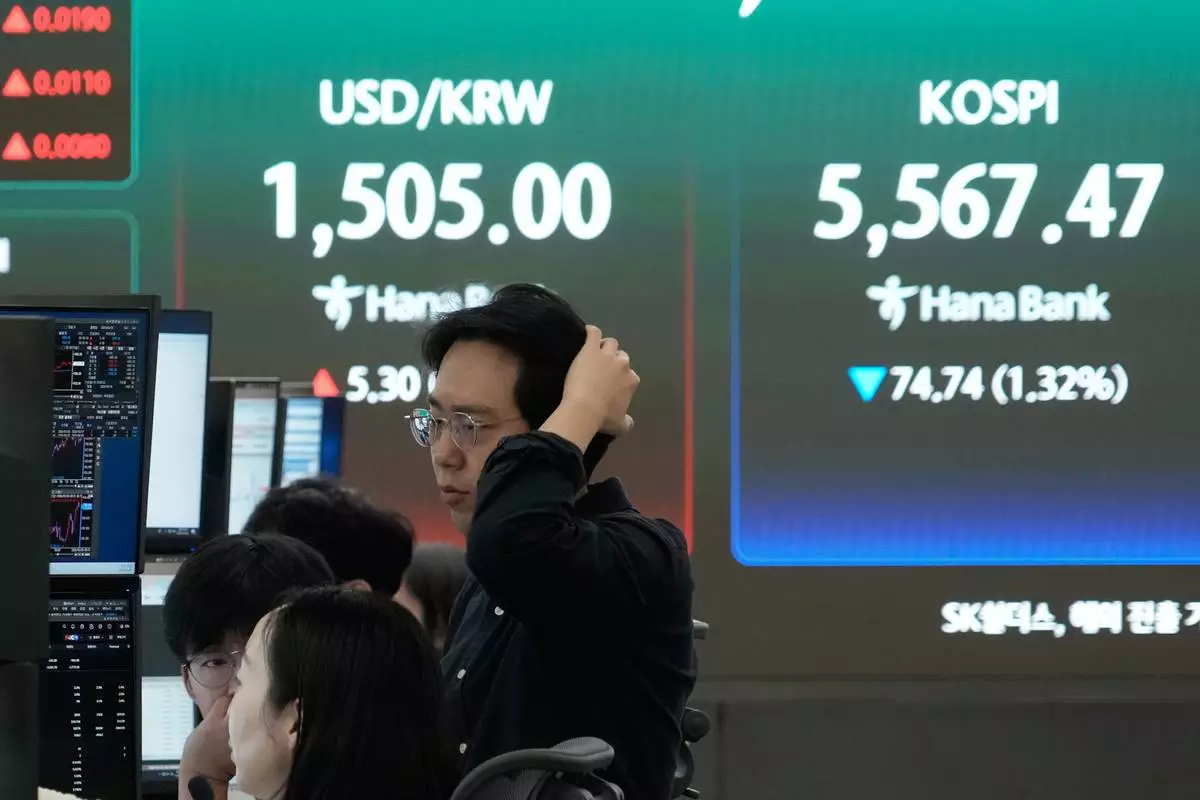
Currency traders watch monitors near a screen showing the Korea Composite Stock Price Index (KOSPI), right, and the foreign exchange rate between U.S. dollar and South Korean won at the foreign exchange dealing room of the Hana Bank headquarters in Seoul, South Korea, Thursday, March 26, 2026. (AP Photo/Ahn Young-joon)