ABUJA, Nigeria (AP) — The U.N. General Assembly’s resolution on Wednesday declaring the trafficking of enslaved Africans “the gravest crime against humanity” and calling for reparations is being welcomed across Africa and among slave descendants and advocates of restorative justice.
At the same time, questions swirl over what the resolution means and what reparations could look like.
About 12 million Africans were forcefully taken by European nations from the 16th to the 19th century and enslaved on plantations that built wealth at the price of misery.
Here's what to know about the U.N. resolution:
Ghana sought the resolution that also urged “the prompt and unhindered restitution” of cultural items — including artwork, monuments, museum pieces, documents and national archives — to their countries of origin without charge.
Ghana foreign affairs minister Samuel Okudzeto Ablakwa said the resolution "recognizes that even within (its) complexity, there are moments in history that stand apart ... To acknowledge this is not to diminish any other history; it is to deepen our collective moral awareness.”
Although General Assembly resolutions are not legally binding, they are an important reflection of world opinion and are often referenced as the legal framework for causes.
In this case, the decision “marks an important step toward truth, justice and healing,” the African Union said in a statement.
A total of 123 member states voted in favor of the resolution, with three votes against it from Argentina, Israel and the United States. The United Kingdom and all 27 members of the European Union were among the 52 abstentions.
Speaking before the vote, deputy U.S. ambassador Dan Negrea said while the U.S. opposes the past wrongdoing of the trans-Atlantic slave trade and all other forms of slavery, it “does not recognize a legal right to reparations for historical wrongs that were not illegal under international law at the time they occurred.”
France through Sylvain Fournel, legal adviser for its U.N. mission, argued that the resolution “seems to establish a hierarchy among crimes against humanity,” an outcome that gives rise to “serious legal difficulties and runs the risk of creating a competition against historic tragedies.”
The U.N. resolution is “an answer to the prayers of our kidnapped, oppressed and murdered ancestors,” said Erieka Bennett, founder of the Diaspora African Forum, a Ghana-based organization that connects people of African descent with their roots.
“This vote will energize our collective resolve to continue the fight for the dignity of African people and the liberation of our Motherland from the stranglehold of Western domination,” she added.
Nadege Anelka, a travel agent from the French overseas territory of Martinique in the Caribbean, moved to Benin and became a citizen under a 2024 law granting citizenship to those who can trace their lineage to the slave trade.
She described Wednesday’s resolution as “fantastic news” even if it does not mean much for her at this stage. “Having returned to Benin, I already feel like I have undergone my 'journey of reparations',” said Anelka, 58.
Gilles Olakounle Yabi, founder of WATHI, the West Africa Citizen Think Tank, said the resolution is “symbolic,” coming at a time when not many are eager to acknowledge the cost of slavery.
Yabi said the votes against the resolution and abstentions indicate that "it’s still not so clear that people recognize the immensity of the crimes that were committed.”
At a reparations summit in Ghana in 2023, participants from across the world tried to answer that by establishing a Global Reparation Fund to push for financial compensation as reparations.
However, as recently as a few years ago, Americans viewed the prospect of reparations mostly negatively. A Pew Research Center survey conducted in 2021 found that only about three in 10 U.S. adults said descendants of people enslaved in the U.S. should be repaid in some way, such as being given land or money.
Some activists have said reparations should go beyond direct financial payments to also include developmental aid for countries, the return of colonized resources and the systemic correction of oppressive policies and laws.
Efforts made in the form of reparations must address “justice for those communities who have suffered from this abject, inhuman and serious practice,” said Elkory Sneiba with SOS Esclaves, an anti-slavery group in Mauritania.
Beverly Ochieng, a Senegal-based analyst at Control Risks Group, said it's unlikely Western governments will set aside funds to pay for slavery.
“Some will argue that they have tried to develop former colonies and countries they exploited,” Ochieng said.
Olivette Otele, distinguished research professor of the Legacies and Memory of Slavery at SOAS, University of London, once wrote that advocates for reparations “hardly ever" seek only money. According to her, "their work is grounded in an understanding that the social, the political and the economic are bound together and must be addressed together, creating the possibility of a better world."
Associated Press writers Mark Banchereau and Monika Pronczuk in Dakar, Senegal contributed to this report.

FILE - A dungeon at Cape Coast Castle, a "slave castle" used in the trans-Atlantic slave trade, is seen in Cape Coast, Ghana, Oct. 3, 2018. (AP Photo/Carolyn Kaster, File)
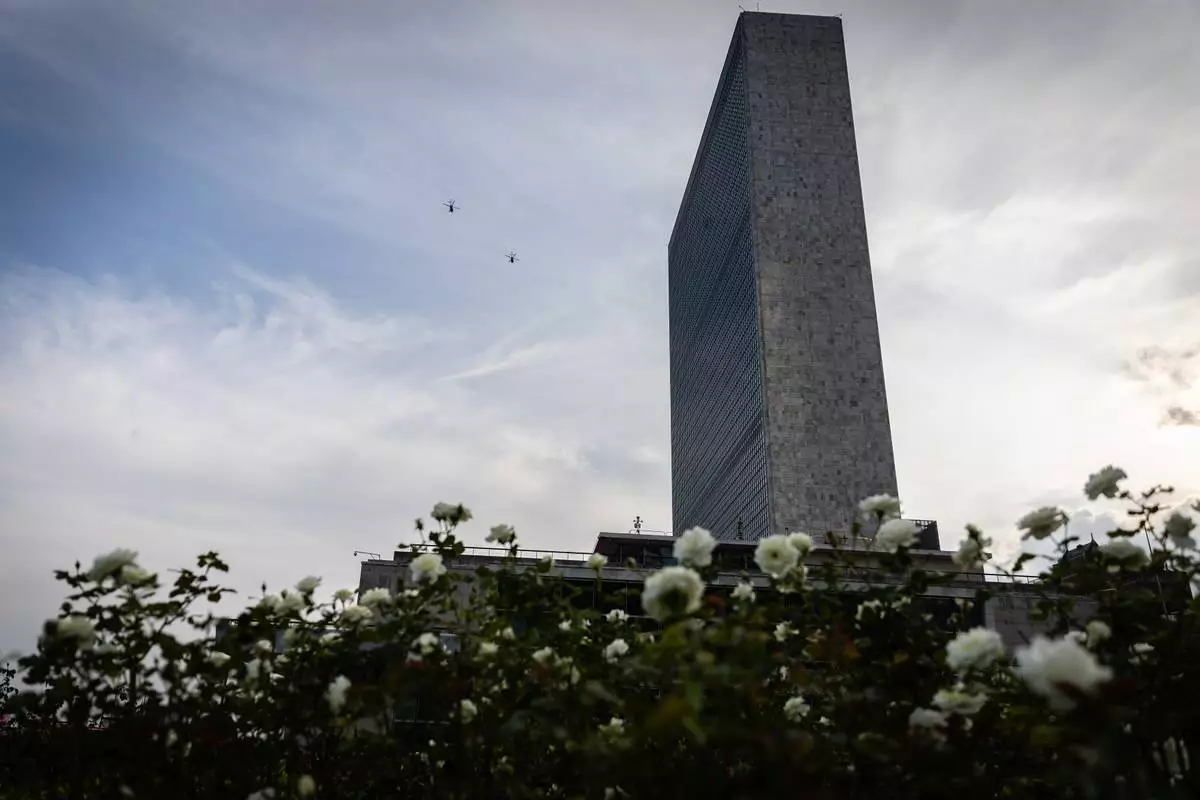
FILE - Military helicopters fly past the United Nations Headquarters building as seen from the rose garden, Sept. 23, 2025. (AP Photo/Stefan Jeremiah, file)
NEW YORK (AP) — U.S. stocks had their worst day since the war with Iran started, as doubt took over again from hope on Wall Street about a possible end to the conflict. The S&P 500 fell 1.7% Thursday. The index is headed for a fifth straight losing week, which would be the longest such losing streak in almost four years. The Dow Jones Industrial Average dropped 1%, and the Nasdaq composite sank 2.4%. They’re the latest flip-flops for financial markets this week after Iran rejected a U.S. offer for a ceasefire. Oil prices rose more than 4%, and Treasury yields climbed in the bond market.
THIS IS A BREAKING NEWS UPDATE. AP’s earlier story follows below.
NEW YORK (AP) — Doubt is taking over again from hope on Wall Street about a possible end to the war with Iran, and stocks are back to falling as oil prices rise Thursday.
The S&P 500 sank 1.4%, more than erasing its gain from the day before, and is back on track for a fifth straight losing week. That stretches back to before the war with Iran began, and it would be the longest such streak in nearly four years.
The Dow Jones Industrial Average was down 384 points, or 0.8%, with an hour remaining in trading, and the Nasdaq composite was 2% lower.
Stock markets likewise fell sharply across much of Asia and Europe. They’re the latest flip - flops for financial markets in a week that began with President Donald Trump’s announcement of productive talks about ending the war. That led to Iran’s public dismissal of a U.S. ceasefire proposal, while Iran issued its own plan, which includes reparations for the war.
On Thursday, the fighting continued, and thousands more U.S. troops neared the region. Iran, meanwhile, tightened its grip on the crucial Strait of Hormuz. The narrow waterway typically sees a fifth of the world’s oil exit the Persian Gulf through it to reach customers worldwide, and blockages there have sent oil prices near $120 per barrel at times.
A barrel of Brent crude oil climbed 4.8% to settle at $101.89 as hopes dimmed for a potential return to normal for the strait. That’s up from roughly $70 before the war began. Benchmark U.S. crude rose 4.6% to $94.48 per barrel.
“They better get serious soon, before it is too late,” Trump said on his social media network about Iran’s negotiators, “because once that happens, there is NO TURNING BACK, and it won’t be pretty!”
The rise in oil prices worsened worries about high inflation and sent Treasury yields higher in the bond market.
The yield on the 10-year Treasury climbed to 4.41% from 4.33% late Wednesday and from just 3.97% before the war started. That leap has already sent rates higher for mortgages and other kinds of loans for U.S. households and businesses, which slows the economy.
A report on Thursday morning said slightly more U.S. workers filed for unemployment benefits last week, though the number is still low compared with historical figures.
A slowing job market would typically encourage the Federal Reserve to cut interest rates to juice the economy. But hopes have cratered on Wall Street for a possible cut to interest rates this year, even though traders came into 2026 forecasting several. That’s because lower interest rates carry the risk of worsening inflation, and the spike in oil prices has heightened those worries.
On Wall Street, tech stocks were the heaviest weights on the market.
Meta Platforms fell 8.1%, and Alphabet sank 3.3% after each had held relatively steady the day before, when a jury found Instagram and YouTube liable in a landmark social-media addiction trial.
The financial penalties were small compared with the companies’ vast profits, but it could herald a watershed moment that invites more lawsuits.
Other Big Tech stocks also fell, including drops of 3.6% for Nvidia and 1.8% for Amazon. Apple was an outlier and rose 0.6%.
Commercial Metals fell 2.2% after the maker of steel rebar and other products reported a weaker profit for the latest quarter than analysts expected. CEO Peter Matt said bad weather hurt its North American operations during the quarter, but underlying market conditions looked favorable.
In stock markets abroad, Germany’s DAX lost 1.5%, Hong Kong’s Hang Seng sank 1.9% and South Korea’s Kospi dropped 3.2%. Japan’s Nikkei 225 had one of the world’s milder losses, at 0.3%.
AP Business Writers Chan Ho-him and Matt Ott contributed.

Bobby Charmak works on the floor at the New York Stock Exchange in New York, Wednesday, March 25, 2026. (AP Photo/Seth Wenig)

James Denaro, center, and Dilip Patel, left, work on the floor at the New York Stock Exchange in New York, Wednesday, March 25, 2026. (AP Photo/Seth Wenig)
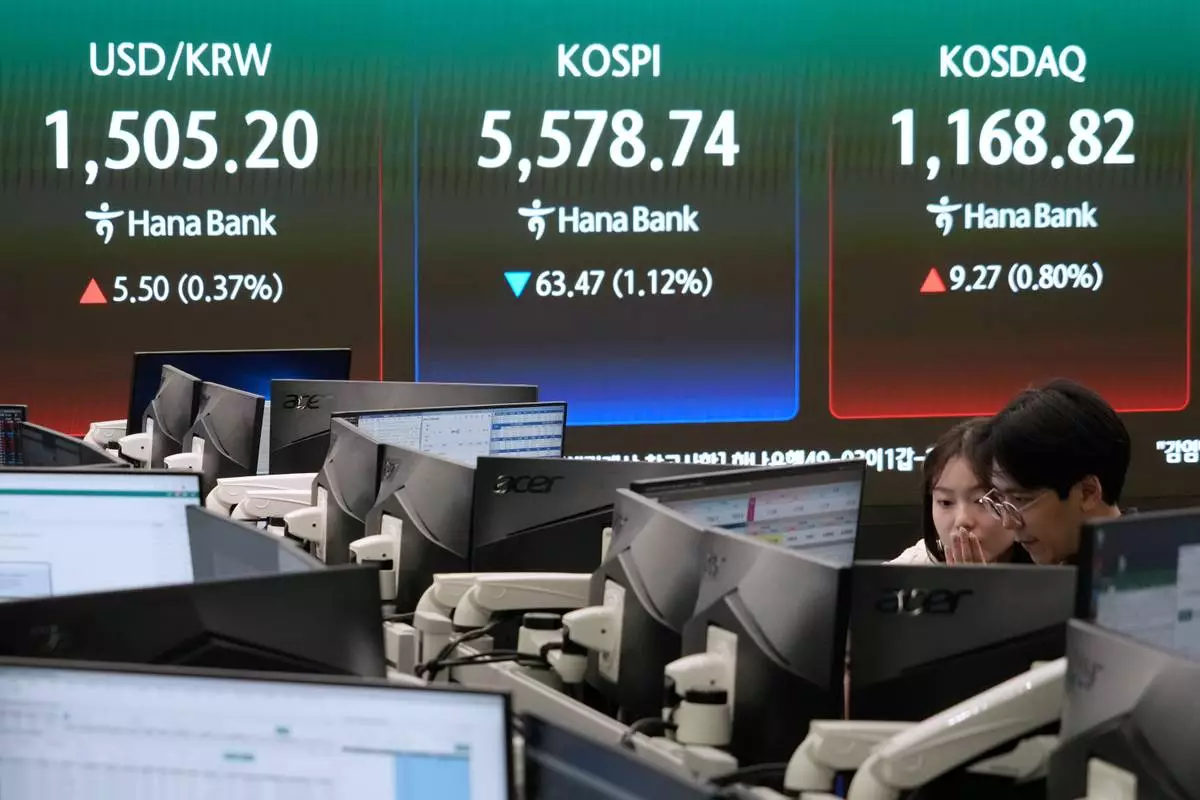
Currency traders watch monitors near a screen showing the Korea Composite Stock Price Index (KOSPI), top center, and the foreign exchange rate between U.S. dollar and South Korean won, top left, at the foreign exchange dealing room of the Hana Bank headquarters in Seoul, South Korea, Thursday, March 26, 2026. (AP Photo/Ahn Young-joon)

Currency traders watch monitors near a screen showing the Korea Composite Stock Price Index (KOSPI), top center, and the foreign exchange rate between U.S. dollar and South Korean won, top left, at the foreign exchange dealing room of the Hana Bank headquarters in Seoul, South Korea, Thursday, March 26, 2026. (AP Photo/Ahn Young-joon)
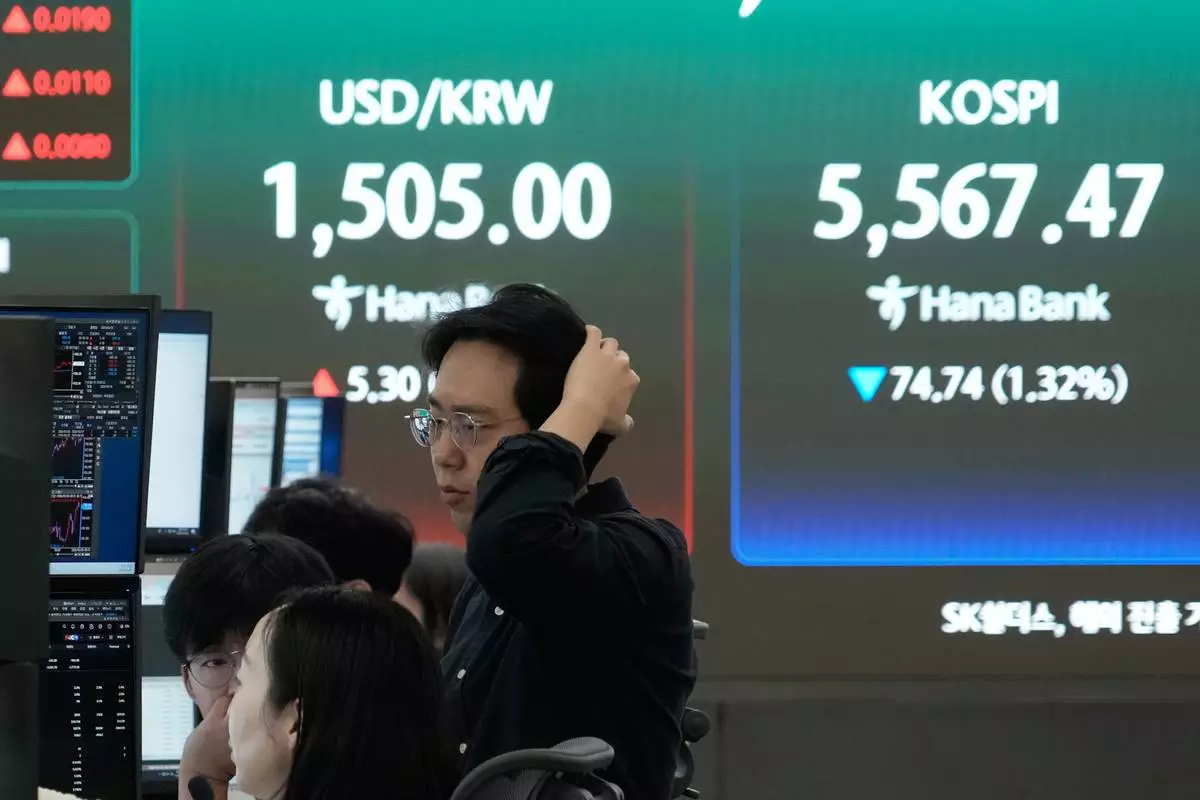
Currency traders watch monitors near a screen showing the Korea Composite Stock Price Index (KOSPI), right, and the foreign exchange rate between U.S. dollar and South Korean won at the foreign exchange dealing room of the Hana Bank headquarters in Seoul, South Korea, Thursday, March 26, 2026. (AP Photo/Ahn Young-joon)