Wang Xiaogang, co-founder and executive director of SenseTime and chairman of ACE Robotics, said that his company has open-sourced a robot model trained on real human data that allows a single AI "brain" to control multiple robots, pointing to a possible future robotics paradigm.
Wang made the remarks on the sidelines of the Boao Forum for Asia (BFA) Annual Conference 2026 in Boao, south China's Hainan Province, where he attended a panel discussion called "Advancement and Breakthrough of Humanoid Robotics" on Wednesday.
In an interview with China Global Television Network (CGTN), Wang identified the major bottleneck in the development of the robotics industry as embodied intelligence moves into real-world applications. He also highlighted his company's efforts to break this bottleneck by developing a new model.
"In the field of embodied intelligence, there has been a major bottleneck in the research paradigm, and at its core is data. In the past, most data collection relied on humans manually operating robots in controlled environments to gather training data. This approach is not only inefficient, but also limited in its ability to capture data from real-world production and daily scenarios. Another challenge is that models are often tied to specific robot hardware. Different physical structures require different models, making it difficult to scale across platforms. Recently, we open-sourced a world model that learns from real human data, understanding the physical world, causal relationships, and patterns of human behavior. This allows us to apply a single model across different types of robots, essentially enabling 'one brain, multiple bodies.' This represents a significant shift in the research paradigm," said Wang.
Wang also predicted rapid data growth and regional expansion to scale robot research and applications across Southeast Asia.
"Looking ahead, we expect that within the next two years, the industry could accumulate up to 10 million hours of data. At the same time, we are seeing greater integration across regions in terms of supply chains, data, computing power, and application scenarios. Asia, particularly Southeast Asia, has strong advantages in this regard, with well-established industrial chains and rich, real-world scenarios that generate valuable data. Our founding team comes from across the region, including Chinese mainland, Hong Kong, and Singapore. We have already established an office in Hong Kong, and plan to expand into Singapore soon, with the goal of scaling both our research and business across Southeast Asia and globally," said Wang.
Founded in 2001, the BFA is a non-governmental and non-profit international organization committed to promoting regional economic integration and bringing Asian countries closer to their development goals.
Running from March 24 to 27, this year's conference is themed "Shaping a Shared Future: New Dynamics, New Opportunities, New Cooperation".
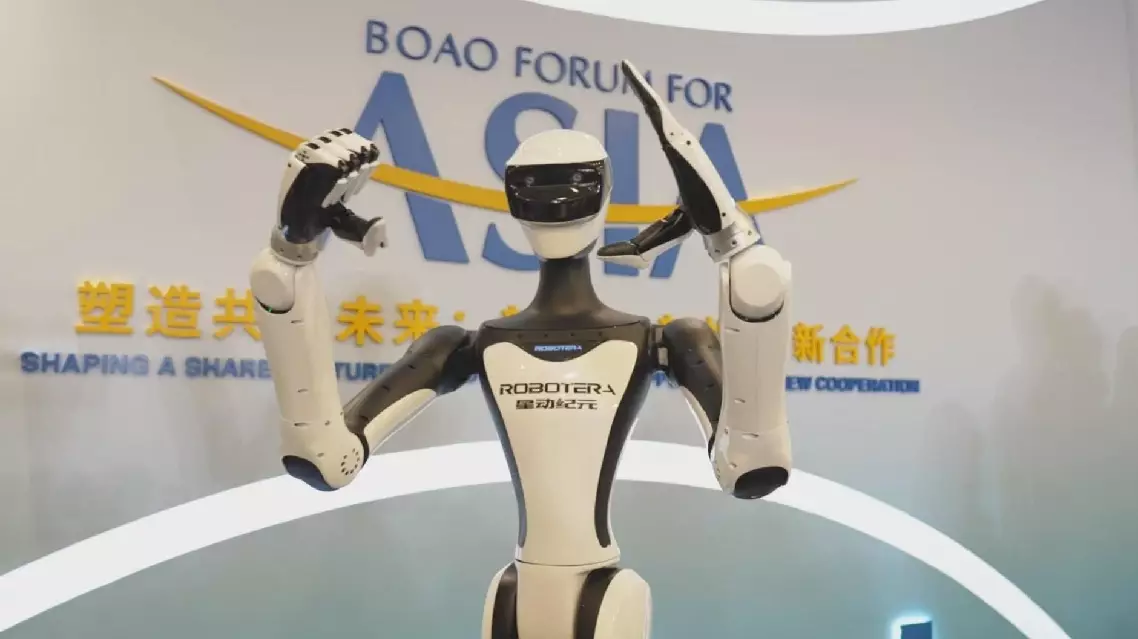
"One brain, multiple bodies" potential paradigm for future robotics: insider