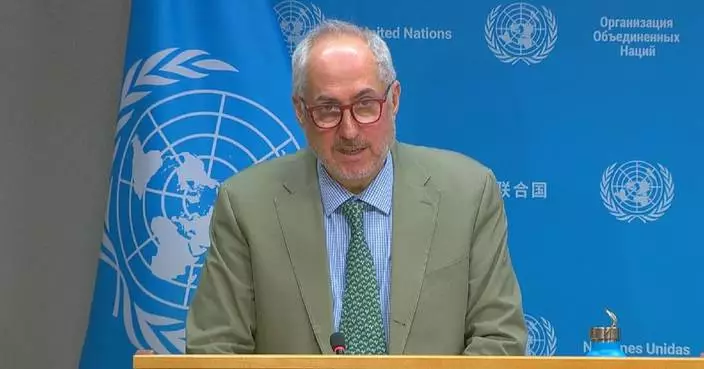
International Atomic Energy Agency (IAEA) Director General Rafael Mariano Grossi has called on the United States, Israel and Iran to return to the negotiating table after Iran's nuclear sites were hit, warning that diplomacy is the only path to a lasting solution.
Speaking in an exclusive interview with China Global Television Network (CGTN) in Beijing, Grossi said Iran's Bushehr Nuclear Power Plant, located near the conflict zone, faces potential risks. He stressed that attacking nuclear facilities is unacceptable and reaffirmed the agency's longstanding principle that their physical integrity must never be compromised.
"Our world is full of promise, but also with serious challenges, in particular, these days, we cannot hide from this reality. We see it these days with the Iran-U.S.-Israel war, where the nuclear power plant of Bushehr, while not affected, and we hope it will remain the case, has been under alert because of military activities not too far from it," Grossi said.
Grossi noted that the IAEA had previously reinforced nuclear safety pillars during the Russia-Ukraine war, underscoring that such facilities should never be targeted.
"Here is where the role of the IAEA is also crucial, because the IAEA -- we have developed a number of safety pillars, which should always be observed. We put them forward at the time of the beginning of the Russian-Ukrainian war, basically reinforcing the longstanding principle that the nuclear power plant should never be attacked, or its physical integrity should never be compromised," he said.
Grossi added that the agency has been engaged in U.S.-Iran negotiations for years, but the last round of talks in Geneva ended without agreement. He said only renewed dialogue can resolve a dispute that has shadowed Iran's nuclear program for more than two decades.
"Now, there is a possibility of a restart of a diplomatic conversation. And for me, this is indispensable because a problem like this, which has been there for more than 20 years with Iran that has been growing in every area of its nuclear program, can only be solved through a diplomatic process. So, this is why I say and I repeat and I urge my counterparts in all these countries that we need to be able to come again around the table in order to try to find a long-lasting solution to this problem," Grossi said.
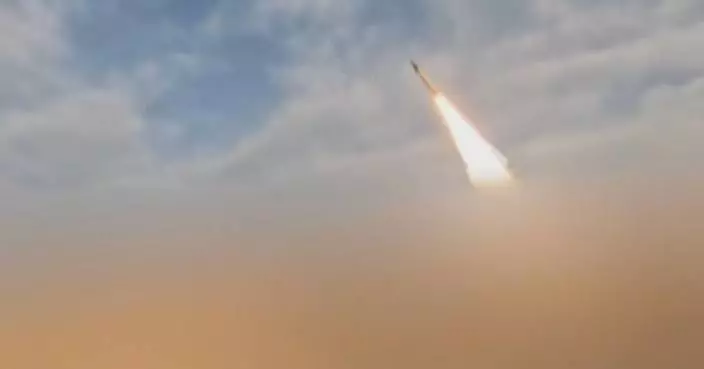
The United States and Israel launched a large-scale military campaign against Iran on February 28. They carried out two airstrikes on the Natanz nuclear facility on March 1, struck a building at the Bushehr nuclear power plant site on March 17, and again targeted the Natanz uranium-enrichment facility on March 21.
The IAEA has repeatedly warned that attacks on nuclear facilities could have grave consequences for public safety, the environment and regional stability.

IAEA chief urges talks after U.S.-Israeli strikes on Iran’s nuclear sites