WASHINGTON (AP) — For several hours Friday, in the stillness before dawn, the Senate appeared to have finally figured out how to fund most of the Department of Homeland Security before it faced the longest partial shutdown in U.S. history.
Senators handed House Speaker Mike Johnson, R-La., their deal and headed for the airports, seemingly confident of success.
Then it collapsed. Spectacularly.
An incensed Johnson marched out of his office Friday afternoon. He angrily rebuked the plan that the Senate had unanimously agreed to as a “joke.”
“I have to protect the House, and I have to protect the American people,” Johnson told reporters.
It was a dramatic denunciation of a deal that his counterpart, Senate Majority Leader John Thune, R-S.D., had negotiated after weeks of effort, and was the latest abrupt turn in a funding saga that has bedeviled top Republicans for much of the year.
The collapse of the deal leaves Congress, now on a two-week spring break, with no easy way out of the impasse that has put DHS into a shutdown since mid-February. It also has exposed a rare rupture between the two Republican leaders in Congress, testing their alliances as they labor to move another set of President Donald Trump's priorities into law before the November elections.
Nothing ahead is likely to be easy.
Thune had a deal with Democratic senators after negotiating for weeks on their demands for new restrictions on the department's immigration enforcement work. Offers were traded several times. The talks moved along at a stop-start pace. Votes failed again and again.
Out of time and patience, senators essentially settled on a draw for the bill: They would not include funding for U.S. Immigration and Customs Enforcement ICE and for U.S. Border Patrol, while setting aside all the Democratic demands for new limits on the agencies.
Thune pointed out that Congress had allotted money for immigration enforcement and he told reporters that “we can get at least a lot of the government opened up again and then we’ll go from there.”
Asked if he had cleared the compromise with Johnson, Thune said the two had texted.
“I don’t know what the House will do,” the senator said early Friday as the deal came together.
But as House Republicans woke up to the news, their outrage was swift.
Rep. Nick LaLota, R-N.Y., said that on a GOP conference call that morning to discuss their path forward, a few dozen members ranging from moderates to hard-line conservatives spoke in opposition to what the Senate had done.
“The Senate chickened out,” he said. "The cowards there, only a few of them in the middle of the night with I think only three to five senators present on the floor, chickened out because they wanted to go home for two weeks. We need to raise the bar.”
The bitter split threatens to make the job for Republican leaders more difficult as they try to advance their priorities while they still have guaranteed control of both chambers. Trump has said that legislation to impose strict new proof of citizenship requirements on voting is his top priority, but there is no real path for that plan in the Senate with its 60-vote threshold for advancing legislation.
Some Republicans have pushed instead for a budget package that could potentially put some parts of the voter ID law in place. Republicans are also contemplating how to pass an expected request from the White House to fund the war with Iran that could total more than $200 billion, among other priorities.
Meanwhile, the flop of the funding deal has given Democrats another chance to pin the partial shutdown on House Republicans.
“They know this is a continuation of the shutdown because the Senate is gone,” said Massachusetts Rep. Katherine Clark, the No. 2 Democratic leader. "So they know fully well what they’re doing.”
It is not clear what the Senate will do next. A quick resumption of talks is unlikely. Negotiations ended acrimoniously on both sides, with each blaming the other for moving the goalposts along the way.
Senate Democratic leader Chuck Schumer of New York said he was proud of his caucus for “holding the line.” But Republican Sen. Susan Collins of Maine, who leads the Senate Appropriations Committee, said Democrats were “intransigent and unreasonable.”
Thune said he believed that Democrats never wanted a deal and would not vote for ICE funding under any circumstances.
“I felt like from the beginning, they just didn’t want to get to ‘yes,’” Thune said after the vote.
The dynamic left senators convinced that the deal was the only way to move past their disagreements and reopen DHS.
But House Republicans on Friday night seemed to revel in the fact they had defied the wishes of the Senate. GOP members said that they work from a perspective that is closer to the will of their constituents.
To Rep. Virginia Foxx, R-N.C., the Senate's proposal was “nothing more than unconditional surrender masquerading as a solution.” She said the House ”will not bend itself into submission by acquiescing.”
Those searching for a way out of the shutdown seemed discouraged.
"This takes two chambers to get the job done,” said Pennsylvania Rep. Brian Fitzpatrick, a moderate Republican. “Apparently, there’s not enough communication between those chambers.”
Associated Press writer Kevin Freking contributed to this report.

Senate Appropriations Committee Chair Susan Collins, R-Maine, walks to the chamber after meeting behind closed doors with fellow Republicans on the Homeland Security budget stalemate, at the Capitol in Washington, Thursday, March 26, 2026. (AP Photo/J. Scott Applewhite)
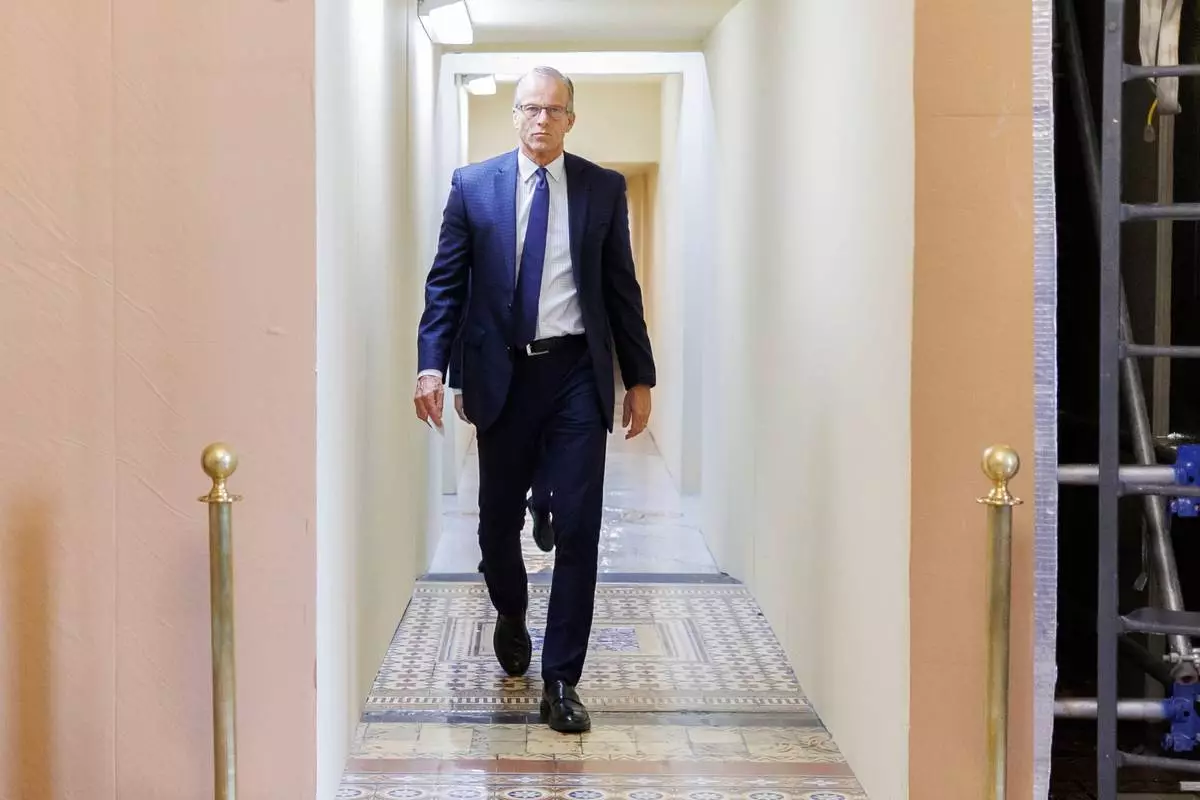
Senate Majority Leader John Thune, R-S.D., walks to the Senate Chamber ahead of a vote on Capitol Hill on Sunday, March 22, 2026, in Washington. (AP Photo/Tom Brenner)

Speaker of the House Mike Johnson, R-La., center, speaks while House Majority Whip Tom Emmer R-Minn., right, and House Republican Conference Chair Lisa McClain, R-Mich., left, listen during a news conference on Capitol Hill, Friday, March 27, 2026, in Washington. (AP Photo/Mariam Zuhaib)
CAPE CANAVERAL, Fla. (AP) — The four astronauts making NASA’s next lunar leap bear little resemblance to the Apollo era.
The Americans who blazed the trail to the moon more than half a century ago were white men chosen for their military test pilot experience. This first Artemis crew includes a woman, a person of color and a Canadian, products of a more diversified astronaut corps.
None of them were alive during NASA’s storied Apollo program that sent 24 astronauts to the moon including 12 moonwalkers. They won’t land on the moon this time or even orbit it, but the out-and-back journey will take them thousands of miles deeper into space than even the Apollo astronauts ventured, promising unprecedented views of the lunar far side.
Here’s a look at the Artemis astronauts whose mission aims to pave the path for future moon landings:
Leading the nearly 10-day mission is a widower who considers solo parenting — not rocketing to the moon — his biggest and most rewarding challenge.
Wiseman, 50, a retired Navy captain from Baltimore, was serving as NASA’s chief astronaut when asked three years ago to lead humanity’s first lunar trip since 1972. His wife Carroll’s death from cancer in 2020 gave him pause.
He’d spent more than five months at the International Space Station in 2014, and his two teenage daughters, especially the older one, had “zero interest” in him launching again.
“We talked about it and I said, ‘Look, of all the people on planet Earth right now, there are four people that are in a position to go fly around the moon,” he said. “I cannot say no to that opportunity.”
The next day, homemade moon cupcakes awaited him, along with his daughters' support. The toughest part isn’t leaving them — “it's the stress that I’m putting on them,” he said.
Open with his daughters about everything, he recently told them where he keeps his will.
As one of NASA’s few Black astronauts, Glover sees his presence on the mission as “a force for good.”
The 49-year-old Navy captain and former combat pilot from Pomona, California, makes it a habit to listen to Gil Scott-Heron’s “Whitey on the Moon” and Marvin Gaye’s “Make Me Wanna Holler” from the white-dominated Apollo era.
“I listen to those for perspective,” he said. “It captures what we did well, what we did poorly.”
The ability for him now to offer hope to others is “an amazing blessing and a privilege.” Despite having one spaceflight behind him — an early SpaceX crew run to the International Space Station — he finds himself in new personal territory. His four daughters are in their late teens and early 20s, “and I spend as an much time and thought preparing them as NASA does preparing me.”
He’s hyper-focused on running “our best race so that we can hand the baton off to the next leg” — a 2027 practice docking mission in orbit around Earth between an Orion crew capsule and one or two lunar landers. The all-important moon landing would follow in 2028 with yet another set of astronauts.
The last time Koch blasted into space, she was gone almost a year, so she’s not sweating a quick trip to the moon and back.
The 47-year-old electrical engineer from Jacksonville, North Carolina, holds the record for the longest single spaceflight by a woman — 328 days. She took part in the first all-female spacewalk during her lengthy stay at the space station in 2019.
More than any one individual, “it’s about celebrating the fact that we’ve arrived to this place in history” where women can fly to the moon, she said.
Before she got called up by NASA, Koch spent a year at a South Pole research station. Between that and her space stint, she feels she's “inoculated” most of her family and friends.
“So far, I haven't gotten too many nerves from folks. Maybe my dog, but I've reassured her that it's only 10 days. It's not going to be as long as last time.”
Her and her husband's rescue pooch is named Sadie Lou.
The Canadian fighter pilot and physicist is making his space debut, stressful enough, but also serving as his country's first emissary to the moon.
“Maybe I'm naive, but I don't feel a lot of personal pressure.”
Hansen, 50, grew up on a farm near London, Ontario, before moving to Ingersoll and pursuing a flying career. The Canadian Space Agency selected him as an astronaut in 2009, and he was named to the Artemis crew in 2023.
He realizes only now how much effort it took to send men to the moon during Apollo.
“When I walk out and I look at the moon now, it looks and feels a little bit farther than it used to be,” he said. “I just understand in the details how much harder it is than I thought it was watching videos of it.”
Dangers still loom — something he’s shared with his college-aged son and twin daughters. “The most likely outcome is that we will come back safe. There’s a chance we won’t, and you will be able to move through life even if that happens,” he assured them.
The Associated Press Health and Science Department receives support from the Howard Hughes Medical Institute’s Department of Science Education and the Robert Wood Johnson Foundation. The AP is solely responsible for all content.
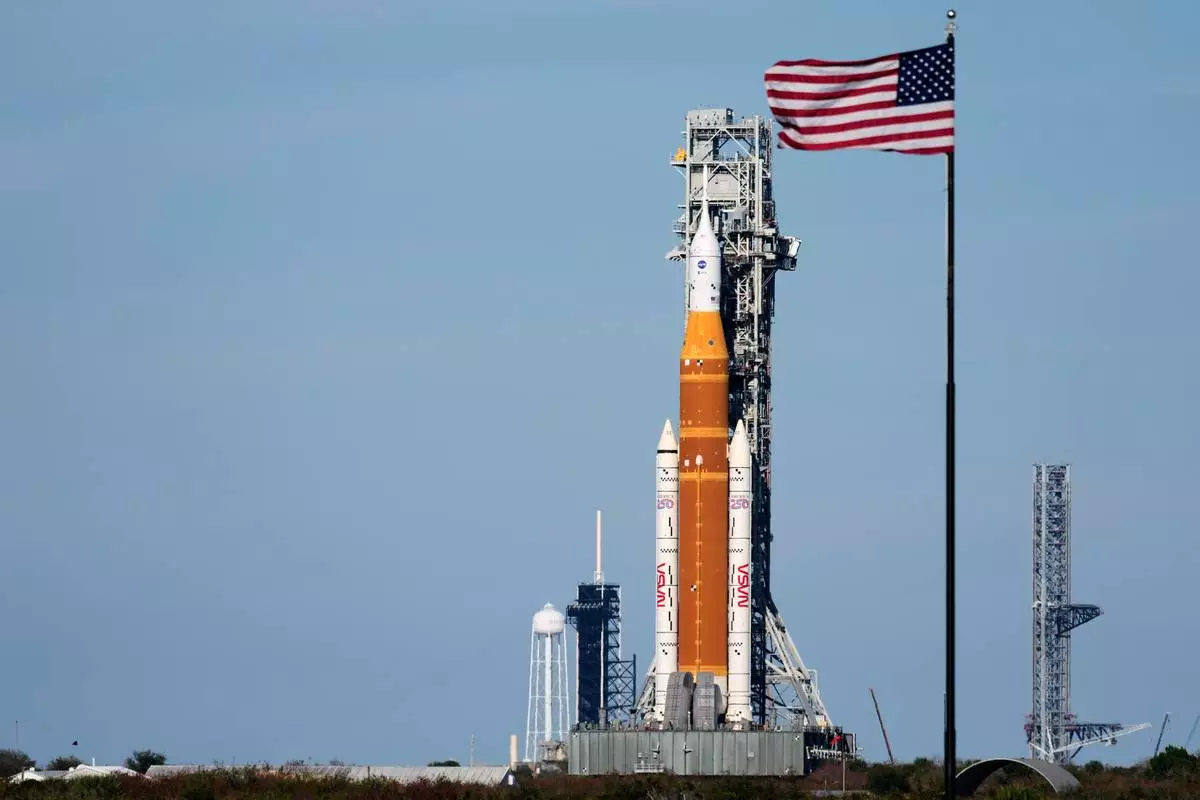
FILE - NASA's Artemis II SLS (Space Launch System) moon rocket with the Orion spacecraft slowly rolls back towards the Vehicle Assembly Building at the Kennedy Space Center, Feb. 25, 2026, in Cape Canaveral, Fla. (AP Photo/John Raoux, File

NASA's Space Launch System rocket with the Orion spacecraft set for the Artemis 2 mission is seen on Launch Complex 39B at sunrise at the Kennedy Space Center, Tuesday, March 24, 2026, in Cape Canaveral, Fla. (AP Photo/John Raoux)

FILE - NASA administrator Jared Isaacman, left, answers questions during a news conference, next to the crew of the new moon rocket, Artemis II, from left, Canadian Space Agency astronaut Jeremy Hansen, mission specialist Christina Koch, pilot Victor Glover and commander Reid Wiseman at the Kennedy Space Center, Jan. 17, 2026, in Cape Canaveral, Fla. (AP Photo/John Raoux, FIle)

Artemis 2 crew members, from left, Mission Spc. Jeremy Hansen, of Canada, Mission Spc. Christina Koch, Commander Reid Wiseman, and Pilot Victor Glover pose for a photo after the crew's arrival at the Kennedy Space Center Friday, March 27, 2026, in Cape Canaveral, Fla. (AP Photo/Chris O'Meara)