As China faces the growing demands of an aging society, debilitating knee pain has emerged as a major challenge. A Shanghai-based surgical team, led by Dr. Wang You, is pioneering a solution - a revolutionary metal-free implant that could help set a new global standard.
The PEEK modular knee prosthesis is a metal-free joint made from an advanced polymer. It pioneers a "soft-to-soft" concept and is the result of a decade of intensive research by the team of Dr. Wang and his collaborators.
"Our key innovation is using PEEK to replace metal. It's fundamentally more bone-compatible. Its stiffness is similar to human bone, which reduces the 'stress shielding' that causes bone loss around rigid metal implants. But the biggest advantage is in diagnostics. Metal creates major distortions on CT and MRI scans. PEEK is virtually transparent. This allows us to see the joint and surrounding tissue clearly, enabling earlier detection and treatment of potential issues like infection or inflammation," said Dr. Wang, chief orthopedic expert of Shanghai Renji Hospital and chief scientist of the National Key Research and Development Program of China.
But to replace metal, the implant had to survive extreme testing. In certified labs, it was subjected to trials simulating decades of use, proving its strength and durability under the highest international standards.
"Our fatigue tests simulate millions of cycles, applying forces up to five times a person's body weight to prove its long-term integrity. Wear-rate testing also confirms its durability is extremely high. Beyond strength, we validated its performance in radiotherapy. Metal implants block radiation, compromising cancer treatment for patients. Our tests show PEEK causes virtually no interference, allowing for precise and effective therapy without harming healthy tissue. This is a critical safety advantage," said Dr. Wang.
This breakthrough is a product of deep collaboration, connecting medical vision with engineering science and industrial manufacturing, supported by enterprise partners.
"This success required a strong alliance. It starts with doctors identifying the clinical need. Then, engineering experts provide the scientific solutions to overcome technical hurdles. Finally, our enterprise partner must perfect the complex manufacturing process. For me as a doctor, participating in the entire chain of innovation—solving a clinical problem and creating a superior product that helps patients—that sense of accomplishment is the ultimate reward," said Dr. Wang.
The PEEK artificial joint has been designated a National Innovative Medical Device. And with regulatory approval imminent, the team is now focused on making the implant even more advanced.
"The future lies in 'modified PEEK.' We are developing bioactive surfaces so bone can grow directly onto the implant, creating a stronger biological bond. But the ultimate goal, perhaps in ten years, is the intelligent implant. We want to embed sensors that can transmit data on performance and wear. This would transform orthopedics into an era of big data analytics—a future that PEEK makes possible," said Dr. Wang.
After ten years of research, Dr. Wang You's vision is a reality: the world's first "soft-to-soft" PEEK modular knee prosthesis. Its metal-free, bone-compatible, and imaging-friendly design provides a glimpse into the future of intelligent and bio-integrated orthopedic medicine.
This vision sets a new benchmark of medical breakthroughs in China for the benefit of the world.
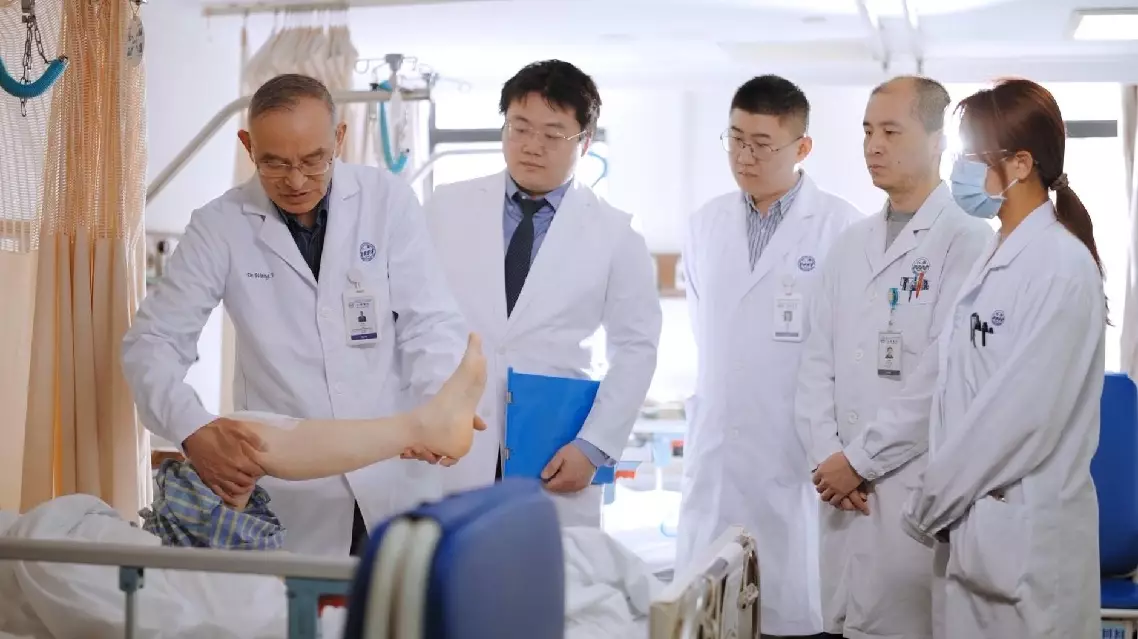
World's first metal-free PEEK knee implant launched in Shanghai