A film elaborating China's development was screened in Guediawaye of Dakar, capital of Senegal, on Sunday, reflecting the strengthening ties between China and Africa.
The film screening was organized by China Media Group in collaboration with Cinema Numerique Ambulant (CNA), or Mobile Digital Cinema, a pan-African network aims to bring African films on digital media in rural areas, as a side event of the Global Dialogue series "China in Springtime: China's Development Shared Opportunities for the World."
In a video address to the event, President of China Media Group Shen Haixiong noted the development of China's cinema and the audiovisual sector, a model that Coumba Sarr, director of the CNA, believes Africa should learn from.
"We are discussing development and strategic paths, reinforced by the cooperation between our two nations, Senegal and China. We are embracing the spirit of sharing -- understanding each other through imagery, sharing perspectives, and identifying possible areas of collaboration across many sectors. I was very happy to hear him [Shen] mention cinema and the audiovisual sector, because China is truly far ahead in these fields. It would be a privilege for Senegal and for all of Africa to benefit from that know-how. I believe that together, we are stronger," said Sarr.
Beyond the cultural aspect, the film highlights China's growing role as a key player in global development, particularly through its investments and cooperation projects in Africa.
"It's very interesting. I watched the film from start to finish. It's about agriculture, livestock, and many other things. Especially for the people who cut wood in the forests, they've replaced woods with bamboos. Here in Senegal, we have bamboos. We tend to lose our forests because of logging. So we thank China and welcome them to come here to share their expertise. We are very grateful for that and we welcome them with open arms," said Serigne Mbaye Sarr, neighborhood representative of Wakhinane Nimzatt, a densely populated municipality in the suburbs of Dakar.
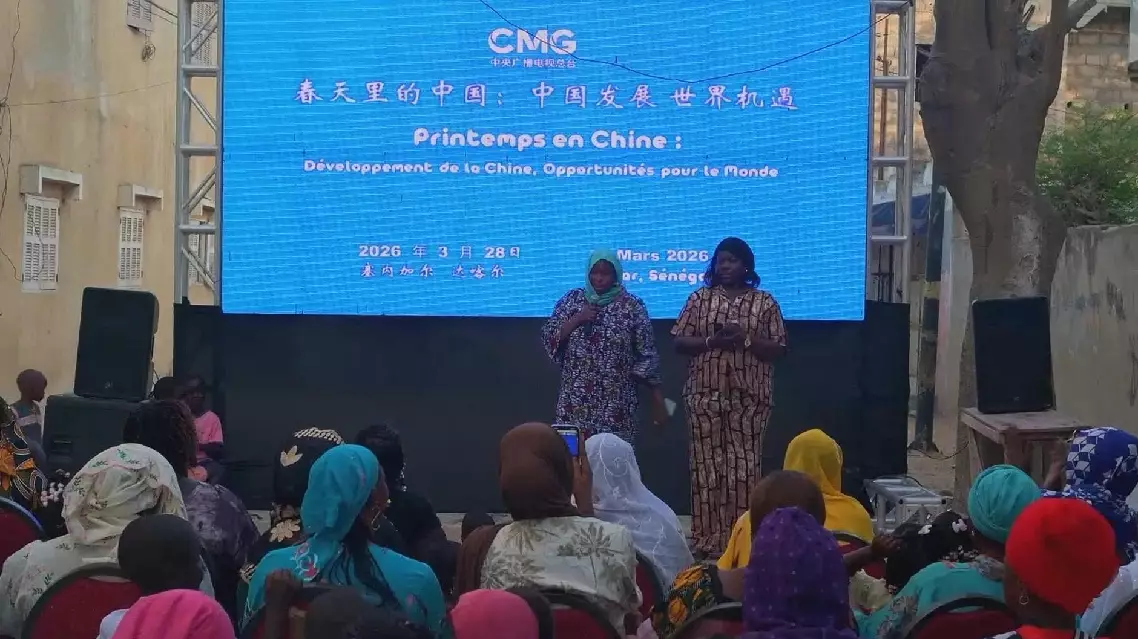
Film on China's development screened in Dakar amid growing China-Africa ties