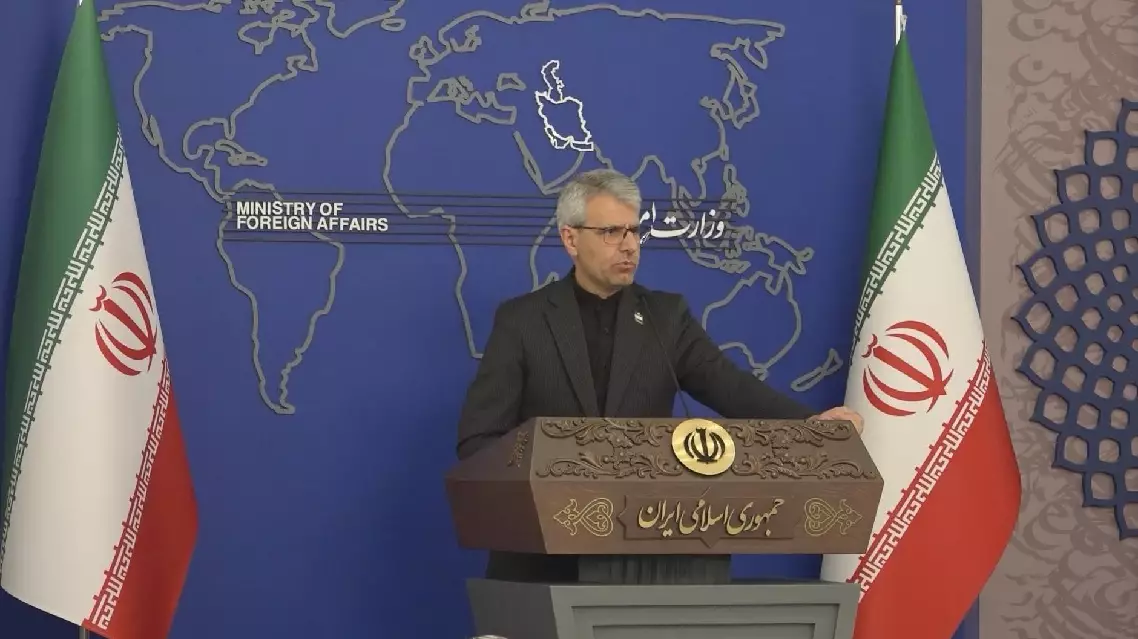
Iran's Foreign Ministry on Monday confirmed the death of Islamic Revolutionary Guard Corps (IRGC) Navy commander Alireza Tangsiri, as spokesman Esmaeil Baghaei denounced the wider military campaign as an "act of aggression".
Speaking at a regular press conference in Tehran, Baghaei made the remarks when asked to characterize the killing in legal terms.
"From a legal perspective, I draw your attention to the very point I mentioned. Fundamentally, the entire framework is illegal and unjust. Whatever occurs within this framework constitutes a war crime. The war itself is illegal and unjust. In legal terminology, this war is an act of aggression -- an aggressive act -- and an unlawful use of force," said Esmaeil Baghaei.
The IRGC said Tangsiri, 64, died from severe injuries sustained while organizing and strengthening naval defenses along islands and coastlines targeted by hostile forces. In a statement published by its official outlet Sepah News, the corps extended condolences for his "martyrdom" and praised the "heavy blows" its naval forces dealt to U.S. and Israeli facilities under his command.
Israeli Defense Minister Israel Katz said Thursday that Israel's military killed Tangsiri in an overnight airstrike, adding that other senior navy officials also died in the attack.
Iran confirms death of IRGC navy commander, denounces US, Israeli "act of aggression"
A Chinese mainland spokesperson on Wednesday slammed Taiwan leader Lai Ching-te over his latest remarks on cross-Strait relations, accusing him of promoting secessionism and escalating tensions across the Taiwan Strait.
Chen Binhua, spokesperson for the Taiwan Affairs Office of the State Council, said in a press release that Lai's speech marking his second anniversary in office was "filled with lies and deception, hostility and confrontation."
Chen accused Lai of stubbornly adhering to a secessionist stance in pursuit of "Taiwan independence," while exaggerating the so-called threats from the mainland and intensifying confrontation across the Strait.
Lai played an old trick of advocating the secessionist agenda on one hand and, on the other, calling insincerely for dialogue and exchanges with the mainland, attempting to mislead people in Taiwan and deceive the international community, he said.
Chen said that these common tricks have been seen through by more and more Taiwanese people. Their deceptive and provocative actions will be met with firm opposition from compatriots on both sides and the international community, and are doomed to fail.
Reaffirming the mainland's position on the Taiwan question, Chen said Taiwan has never been a country, is not one now, and will never become one in the future.
He described the Taiwan question as a historical issue left over from a Chinese civil war in the 1940s.
No election result in Taiwan could alter the fact that Taiwan is part of China or sever the historical and legal bonds linking the two sides of the Strait, according to Chen.
The mainland would never allow any person or force to pursue secessionist activities under any pretext, he added.
Calling secessionists "the chief culprit" who undermines cross-Strait peace, Chen said the mainland would continue to uphold the one-China principle and the 1992 Consensus, unite broadly with Taiwan compatriots, combat secessionist activities, and safeguard peace and stability across the Strait.
Central government spokesperson refutes Lai Ching-te's latest remarks, warns against secessionist moves