SAN LEANDRO, Calif.--(BUSINESS WIRE)--Mar 31, 2026--
Torani announced it is on pace to surpass $1 billion by 2030, driven by a manufacturing model that embeds opportunity directly into operating systems. The category-leading flavor company has sustained more than 20% average annual growth for three and a half decades while maintaining a track record of zero layoffs after more than 100 years in business. As many U.S. manufacturers reduce headcounts amid economic pressure, Torani is expanding production capacity and its workforce in the San Francisco Bay Area.
This press release features multimedia. View the full release here: https://www.businesswire.com/news/home/20260331454763/en/
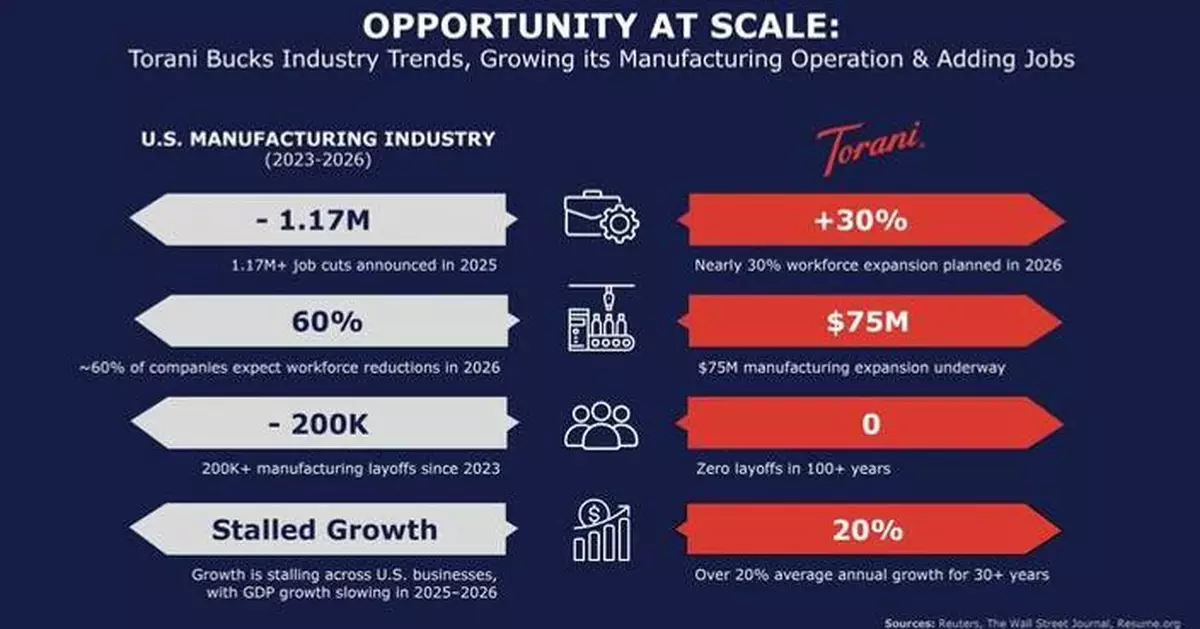
More than 1.17 million job cuts were announced nationally in 2025, with over 200,000 layoffs in manufacturing alone since 2023, and nearly six in ten companies are expecting additional workforce reductions in 2026. In contrast, Torani plans to expand its team by nearly 30% over the next year. The company is also investing $60 million of its own capital into a new manufacturing expansion to increase its domestic production capacity. As many manufacturers delay or scale back capital projects amid economic pressures, Torani is advancing infrastructure and workforce growth in parallel.
The company’s performance trajectory is driven by a commitment to putting people at the center of every business decision. Rather than managing volatility by reducing labor, the company embeds opportunity into capital decisions, automation investments, and workforce development. The result is a growth model where resilience, engagement, and performance reinforce one another, demonstrating that workforce growth and business success can scale together.
“At Torani, we’re proving that expanding opportunity isn’t a tradeoff with business performance. In fact, it fuels it,” said Torani CEO Melanie Dulbecco. “When people have financial stability and room to grow, the business grows alongside them. That’s how we’re building a company designed to scale for the long term.”
Scaling With Structural Stability
Scaling toward $1 billion requires disciplined resource allocation, especially amid economic volatility. Torani builds workforce stability directly into its operations, with employees receiving predictable schedules and consistent hours. When production lines pause, frontline hourly team members are redeployed to maintenance, quality improvement, or cross-training initiatives, ensuring pay protection while expanding capability. While this may not be the norm in the manufacturing industry, creating this operational continuity produces measurable results for the company.
Torani’s employee retention stands 19% above the industry average at 90% with an average tenure of 5.5 years, approximately 40% higher than industry norms. The company also prioritizes growing talent from within, resulting in 30% of qualified roles being filled internally in 2025.
By protecting its workforce when tradeoffs are hardest, Torani preserves institutional knowledge, strengthens trust, and positions itself to accelerate as conditions stabilize. The company’s sustained growth reflects decades of consistent, principle-driven decisions, with this commitment proven by the numbers. Since 1925, Torani has grown without a single layoff, navigating the Great Depression, multiple recessions, and a global pandemic, all while continuing to build for the long term.
Automation That Expands Capability
Modern manufacturing demands continuous improvements in throughput, quality, and efficiency. Without these advancements, competitiveness erodes. Torani’s approach is to pair automation with workforce elevation, rather than workforce reduction: a philosophy the company calls “Automate and Elevate,” setting it apart from companies that tie automation to job elimination.
For example, in 2025 the company introduced a new collaboration and automation platform at its “Flavor Factory” headquarters, enabling frontline team members to capture video of production issues and instantly coordinate across maintenance, quality, and operations. Teams now hold between two and six data-driven huddles daily to review performance and adjust in real time. The system has driven a five-percentage-point increase in Overall Equipment Effectiveness (OEE), with additional gains expected over time.
At Torani, technology elevates the capability of frontline roles rather than removing them. Team members can now interpret data, make real-time decisions, and collaborate across the business. As a result, reducing physically demanding tasks makes roles more technical, inclusive, and competitive in today's labor market.
Over the past six years, every Torani manufacturing team member has built valuable new skills and capabilities as the company dramatically expanded and automated its production lines. At Torani, automation is not a workforce reduction strategy but rather a capability-building strategy. Operational performance and opportunity advance together, reinforcing both long-term competitiveness and employment stability.
How Financial Resilience Drives Performance
As Torani scales, its team members’ financial opportunity also expands. Through its Employee Stock Ownership Plan (ESOP), profit sharing, and annual bonuses, every employee across the organization, including those in frontline manufacturing roles, are building long-term wealth alongside the business. In 2025, 100% of eligible employees automatically received ESOP shares, profit sharing, and year-end bonuses directly tied directly to the company’s accelerated growth performance.
This approach reflects a significant shift from traditional corporate models, where compensation and incentives are often tiered by hierarchy and income volatility can be common. At Torani, entry-level wages are set above market rates, and all full-time employees receive comprehensive benefits and financial incentives. Predictable schedules and a zero-layoff track record further reinforce income stability.
“Being part of Torani’s ESOP means I’m not just a team member—I’m an owner helping build the company’s future,” said Michael Hardnett, Associate Supervisor for Raw Materials and Ingredients at Torani. “By maxing out my 401(k), I’m also investing in my family’s future. It gives me confidence that the work I’m doing today is helping create long-term stability and opportunity for them down the road.”
By tying employee financial rewards to business performance, Torani creates shared accountability across every level of the organization. Wealth-building opportunities are not concentrated at the top. They reach the manufacturing floor and beyond, strengthening engagement, ownership thinking, and long-term financial resilience.
Torani shows that opportunity and performance can work together instead of against each other. When embedded strategically into the foundation of a business, opportunity becomes a structural advantage. As the company approaches $1 billion, its model proves that disciplined investment in people and production can strengthen growth rather than constraining it, even in periods of economic contraction.
About Torani:
Torani is committed to being an amazing flavor company that is deeply connected to our purpose of “flavor for all, opportunity for all.” Established in San Francisco’s North Beach neighborhood in 1925, we put Italian sodas on the U.S. map in the 1920s and created the world's first flavored latte in the 1980s. From the beginning, we’ve used only the best ingredients, like natural flavors and pure cane sugar, to craft flavors that are vibrant and delicious. Enjoyed in cafés, restaurants, and home kitchens for over 100 years, Torani proudly helps shape flavor innovation globally while remaining a fiercely independent, people-first Bay Area business. In practice and life beyond the bottle, Torani is a certified B Corp that believes businesses can and should create more opportunity, and we’re dedicated to helping all the people, partners, and communities we touch thrive. Learn more at torani.com.
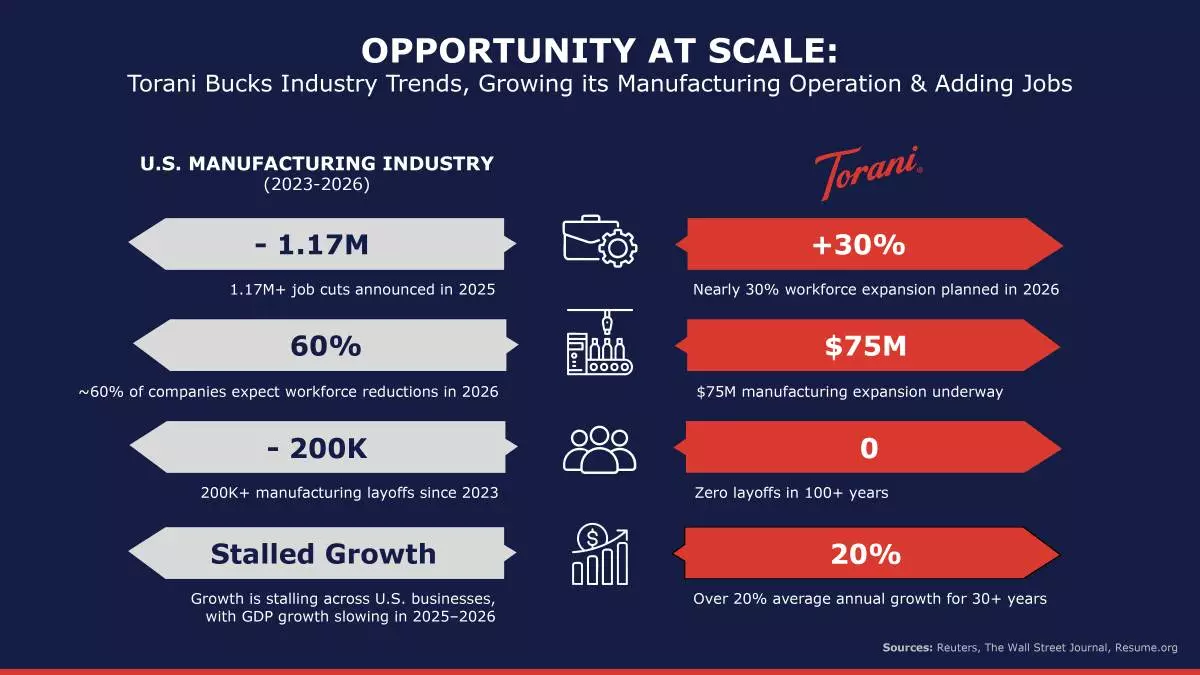
With zero layoffs over the last century and a 30% workforce expansion planned this year, Torani is proving workforce stability and growth can scale together.