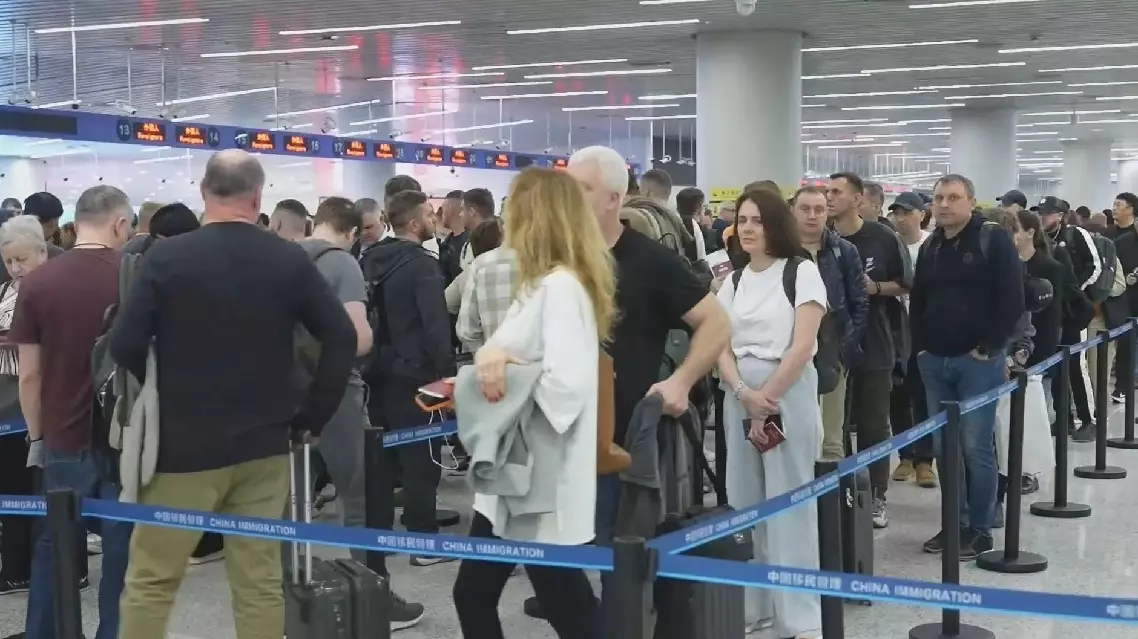
South China's Guangdong Province has witnessed a sharp rise in inbound travel and international tourist spending as well as surging traffic at its seaports since the start of this year, as China's expanded visa waiver policies continue to entice a greater number of visitors.
Largely fueled by China's expanded visa-free transit program and optimized tax refund scheme, the number of land crossings made by foreign nationals at Shenzhen City, which borders Hong Kong, has exceeded 2 million entries and exits as of Sunday, data from the Shenzhen General Station of Exit and Entry Frontier Inspection showed.
Notably, this milestone figure was reached a whole 20 days earlier than in 2025, while representing a year-on-year increase of over 30 percent compared to this date last year.
The number of foreigners entering under China's visa-free program has continued to rise, reaching 597,000 visits, a staggering 52 percent rise over last year and accounting for nearly 60 percent of the total inbound foreign nationals the country has reported so far in 2026.
At Shenzhen's Futian Port, a border crossing connecting the Chinese mainland and Hong Kong, a special e-channel has been set up to facilitate the customs clearance process of foreign arrivals.
"I think it's a great convenience not to apply for a visa, and just come in on just a passport," a traveler from Poland told China Central Television (CCTV) at the port.
Like the Futian port, all other border crossings across Shenzhen have also introduced more efficient customs clearance facilitation methods.
At the city's West Kowloon checkpoint, a Scottish traveler said he was impressed by how simple and fast foreign nationals were cleared for entry through just accessing an online declaration system.
"I live in Hong Kong. And I've filled out the online declaration, and it is very easy," he told CCTV.
Staff at the port highlighted the user-friendly nature of the online system.
"This system can automatically input information from the passport's data page, intelligently identify the official language of the issuing country, and translate the text on the arrival card, thus helping travelers understand the required information and instructions. Since its introduction, it has facilitated over 170,000 foreign travelers, slashing the time needed to fill out the forms by an average of 60 percent to 80 percent," said Huang Chun, a staff member at the West Kowloon checkpoint.
In addition to the easier entry requirements for many passport holders, simplified tax refund rules are also drawing an influx of international travelers to Shenzhen.
As a city known as a hub of sci-tech innovation, many visitors are taking the opportunity to come and purchase high-tech products ranging from state-of-the-art drones and robots to wearable smart watches and AI glasses, and experience firsthand how such advanced technologies are reshaping people's everyday lives in China.
"You can order your coffee via drone. You can rider a car without the driver. You can see the cutting-edge technology, obviously, and AI as well. So, I'm very impressed with Shenzhen. I think this is one of the leading cities not just in China, but globally," said the Polish traveler.
"The main products we sell are AI-powered smart devices, which have become very popular among the foreign visitors. On weekends and holidays in particular, large groups of travelers from Hong Kong, Macao, and foreign countries come to buy our gadgets," said Mr. Zheng, who works at a store in Shenzhen's bustling Huaqiangbei Electronics Market, China's largest electronics distribution center.
Meanwhile, in Guangdong's provincial capital Guangzhou, the Guangzhou Baiyun International Airport, a major aviation hub in the Guangdong-Hong Kong-Macao Greater Bay Area, has also seen increased traffic this year, recording nearly 5 million border crossings as of Monday, passing this figure 21 days earlier than last year.
Of this total, the airport handled over 1.9 million entries by foreign nationals, up 34 percent from last year, with the number of visa-free entries exceeding 460,000, surging 75 percent year over year.
Elsewhere, the Port of Nansha, which falls under the Guangzhou Port Group, has introduced an upgraded smart inspection system which is capable of reducing the clearance time for large ships, cutting costs, and greatly improving the daily operations.
Guangzhou is also bracing for a surge in both incoming international visitors and cargo ahead of the upcoming 139th edition of the China Import and Export Fair, or Canton Fair, which is scheduled to open on April 15. Held biannually, the fair has been the longest-running of several comprehensive international trade events in China and is regarded as the barometer of the country's foreign trade.
Visa-free policies see surging inbound travel, tourist spending in Guangdong